Computing Machinery and Intelligence
Alan M. Turing replaces the question of machine thought with an imitation game, explains digital computation and universality, examines nine objections, and proposes learning machines. His ESP discussion considers telepathy, clairvoyance, precognition, psychokinesis, and possible test controls as a philosophical challenge rather than a new experiment. The linked 21-page educational reproduction of the 1950 article omits one illustrative state-transition table; page citations refer to this PDF.
Search extracted document text
Probed searches extracted/indexed text and can show matching pages when page indexing is available.
Document Intel
Source status, provenance, and extraction context.
- Source / agency
- Mind
- Type
- Document
- Classification
- Unclassified
- Reference #
- —
- Published
- 1950-10-01
- Content Type
- application/pdf
- Pages
- 21
Structured Analysis
Claims and source material extracted from the document text. Timeline context is surfaced in document intel.
Turing replaces an ambiguous question about whether machines think with an imitation game involving written questioning.
Instead of attempting such a definition I shall replace the question by another, which is closely related to it and is expressed in relatively unambiguous words. The new form
Turing designs the game to separate intellectual performance from physical appearance and bodily capacities.
The new problem has the advantage of drawing a fairly sharp line between the physical and the intellectual capacities of a man. No engineer or chemist claims to be able
Turing restricts the proposed comparison to digital computers and asks about possible future machines rather than the performance of every existing machine.
we are not asking whether all digital computers would do well in the game nor whether the computers at present available would do well, but whether there are imaginable computers which would do well. But this is
Turing explains a digital computer through its store, executive unit, and control.
A digital computer can usually be regarded as consisting of three parts: (i) Store. (ii) Executive unit. (iii) Control. The store is a store
Turing argues that a suitably programmed digital computer can mimic any discrete-state machine given adequate speed and storage.
This special property of digital computers, that they can mimic any discrete-state machine, is described by saying that they are universal machines. The existence of machines with this property has
Turing predicts that within about fifty years a machine could make an average interrogator no more than seventy percent accurate after five minutes.
I believe that in about fifty years' time it will be possible, to programme computers, with a storage capacity of about 109, to make them play the imitation game so well that an average interrogator will not have more than 70 per cent
Turing replies to mathematical-limit objections by noting that comparable limits on human intellect have not been ruled out.
The short answer to this argument is that although it is established that there are limitations to the Powers If any particular machine, it has only been stated, without any sort of proof, that no such limitations apply to the human intellect. But
Turing argues that the mysteries of subjective consciousness need not be fully solved before evaluating performance in his proposed test.
I do not wish to give the impression that I think there is no mystery about consciousness. There is, for instance, something of a paradox connected with any attempt to localise it. But I do not think these mysteries necessarily need to be
Turing distinguishes mechanical malfunction from errors of conclusion and argues that machines can produce the latter.
Errors of conclusion can only arise when some meaning is attached to the output signals from the machine. The machine might, for instance, type out mathematical equations, or sentences in English. When a false
Responding to Lovelace’s originality objection, Turing says machines often surprise him and rejects equating programmed consequences with consequences already known to the programmer.
Machines take me by surprise with great frequency. This is largely because I do not do sufficient calculation to decide what to expect them to do, or rather because, although I do a calculation, I do it
Turing treats ESP as a substantial philosophical objection and explicitly includes telepathy, clairvoyance, precognition, and psychokinesis.
I assume that the reader is familiar with the idea of extrasensory perception, and the meaning of the four items of it, viz., telepathy, clairvoyance, precognition and psychokinesis. These disturbing phenomena seem to
Turing’s hypothetical ESP test allows for psychokinetic influence on a machine’s random-number generator and suggests isolating contestants if telepathy is admitted.
But then the random number generator will be subject to the psychokinetic powers of the interrogator. Perhaps this psychokinesis might cause the machine to guess right more often than would be expected
Turing proposes educating a child-like program rather than directly programming every feature of an adult mind.
Instead of trying to produce a programme to simulate the adult mind, why not rather try to produce one which simulates the child's? If this were then subjected to an appropriate course of education one would obtain the adult brain. Presumably
Turing argues that rewards and punishments alone provide too little information for education and proposes additional communication channels.
The use of punishments and rewards can at best be a part of the teaching process. Roughly speaking, if the teacher has no other means of communicating to the pupil, the amount
Turing notes that a teacher may not fully understand a learning machine’s internal processes and that learned behavior can be fallible.
An important feature of a learning machine is that its teacher will often be very largely ignorant of quite what is going on inside, although he may still be able to some extent to predict his pupil's
Turing recommends exploring both abstract intellectual tasks and language learning supported by sensory interaction.
Many people think that a very abstract activity, like the playing of chess, would be best. It can also be maintained that it is best to provide the machine with the best sense organs that money can buy, and then
Chronology extracted from the document text.
Computing Machinery and Intelligence published
Turing’s paper appears in Mind, volume 59, pages 433–460.
Jefferson’s Lister Oration
Turing discusses Geoffrey Jefferson’s consciousness objection from the 1949 Lister Oration.
Babbage’s Cambridge professorship
Turing identifies Charles Babbage as Lucasian Professor while discussing the Analytical Engine.
Referenced In Coverage
Investigative posts, source items, and other coverage that currently cite this document.
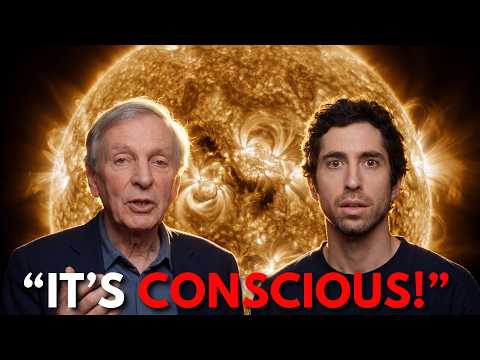

Probed ingest of: The Most Controversial Biologist Alive Breaks Down Telepathy
American Alchemy host Jesse Michels interviews Rupert Sheldrake about telepathy, morphic resonance, perception, bioelectricity, precognition, artificial intelligence, and the possibility of a conscious Sun. The conversation moves from dog-return experiments and negative screen-watching results to proposed alarm and earthquake studies, plasma speculation, angels, and gratitude. The analysis distinguishes Michels’ connections from Sheldrake’s claims and compares key points with Turing’s paper, solar-consciousness research, Tufts, and USGS.