Events
LIVE

Condon Committee

Event

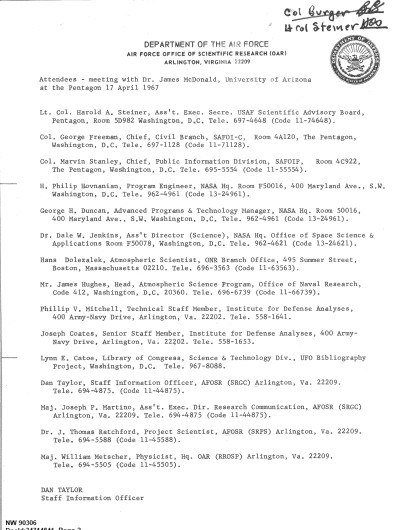
From 1966–1968, the University of Colorado’s Air Force–funded “Condon Committee,” led by physicist Edward Condon, reviewed UFO reports and advised that further official study was unwarranted. The report helped justify ending Project Blue Book,

University of Colorado, Boulder, Colorado, USA
investigation
0
Mentions (30d)
0
Active Signals
0
Sources
0
Co-mentions
30-Day Activity
30d agoToday
Attached Sightings
0
No sightings attached.
Related SignalsLIVE
0
Event LocationUniversity of Colorado, Boulder, Colorado, USA
Probed Analysis

The Condon Committee was a University of Colorado–based, U.S. Air Force–funded review of UFO reports conducted from 1966 to 1968 under the direction of physicist Edward U. Condon. It matters less for any single case it examined than for how it functioned as a pivot point in U.S. official posture: an ostensibly academic assessment used to argue that further government-sponsored UFO study was not warranted.

The committee’s work culminated in a report whose bottom-line recommendation became a policy instrument, helping justify the termination of Project Blue Book and shaping decades of institutional skepticism. In UAP/disclosure ecosystems, the committee sits at the intersection of three enduring fault lines—outsourcing sensitive questions to academia, converting scientific tone into administrative closure, and the long afterlife of a “no further study” conclusion that continues to be disputed by critics and defended by others as a rational endpoint.

On-record, the basic frame is straightforward: the Air Force funded a review at a major public university, Condon led it, the committee examined UFO reports, and the resulting report advised that additional official study was unwarranted. The significance is amplified by timing. By the late 1960s, the government’s long-running public-facing UFO apparatus had become both politically inconvenient and operationally unproductive, and the committee’s recommendation provided a clean rationale for shutting the door.

The committee’s identity is often flattened into a single object—the “Condon Report”—but the entity of interest is the mechanism: a formal evaluation positioned as scientific and independent while being funded by the Air Force. That combination is not inherently disqualifying, but it is structurally fragile from a credibility standpoint. Any perception that the sponsor is also the stakeholder in the outcome makes the review vulnerable to charges of motivated reasoning, even if the day-to-day work is conducted in good faith.

The decisive output was not merely a catalog of observations but a recommendation about what the government should do next. In bureaucratic practice, that recommendation is the payload. Once a commissioned expert body says further study is unwarranted, an agency can disengage while pointing to external expertise rather than owning the decision as policy preference.

This is why the committee is treated as a “closure event” in UAP history. It supplied language that could be repeated without re-litigating the underlying cases. It also created an implicit threshold: UFO reports would have to be not just interesting, but sufficiently compelling to overturn a credentialed, university-stamped determination that the topic was not worth official effort.

The report’s downstream effect—helping justify ending Project Blue Book—is part of the committee’s enduring footprint. Blue Book’s termination is sometimes discussed as if it were simply the end of a program; operationally, it was a shift in how the state managed public attention and internal workload around anomalous reports. Once Blue Book ended, the absence of a comparable, visible channel for public reporting and official response altered the information environment: fewer structured releases, fewer standardized summaries, and more space for speculation to fill the void.

Where analysis becomes contested is not the committee’s existence or its formal recommendation, but what that recommendation implied about the evidence and how the evidence was handled. Critics have argued, in various forms, that the committee’s conclusion was too sweeping relative to the complexity of the subject. Defenders counter that the committee’s remit was practical—whether the topic merited further official study—and that a negative recommendation can be justified even if some cases remain unresolved.

Without additional signals tied to this entity, the most defensible assessment is about incentives and institutional dynamics rather than hidden motives. An Air Force–funded university committee has built-in pressures that are mundane but powerful:

  • Produce a deliverable that can be operationalized by the sponsor.
  • Translate a messy set of reports into a crisp administrative recommendation.
  • Preserve scientific credibility while navigating a politically charged topic.
  • Avoid endorsing a line of inquiry that would require indefinite resources and invite public controversy.

Those pressures do not prove outcome engineering. They do, however, explain why a conclusion that “further official study is unwarranted” is attractive even under uncertainty, and why such language tends to outlive the specific cases it was meant to address.

The Condon Committee also illustrates a recurring pattern in UAP governance: delegating adjudication to a body that appears insulated from operational and intelligence equities. That separation can protect scientific integrity, but it can also ensure that the final product is framed as epistemic rather than strategic—an “answer” rather than a choice. In the UAP arena, that distinction matters because it influences how gaps in data are interpreted: as absence of phenomenon, absence of priority, or absence of collection.

For disclosure-focused analysis, the committee’s most important residue is reputational. Its name is often invoked as a shorthand for “the government already looked and found nothing worth pursuing,” regardless of whether the speaker has engaged the underlying material. That rhetorical use makes the committee a reference point in debates about whether official study was prematurely curtailed, whether the scientific posture was adequately cautious, and whether the public was offered a genuine accounting or a convenient stopping rule.

In practical terms, the entity’s legacy is a template: commission a review, anchor it in academic authority, distill complexity into a recommendation, and close the official file. Once that template succeeds, reopening the file later becomes harder, because any renewed attention can be framed as regression—revisiting a question that “was already settled”—even when the original settlement was administrative rather than evidentiary.

Filters
Time
Source type
Loading coverage...
Mention Velocity
30d agoToday