U.S. Secret Service
OrgU.S. Secret Service
OrgThe U.S. Secret Service protects national leaders and major events while investigating counterfeiting, cyber-enabled financial crime, and threats to payment systems.
The U.S. Secret Service protects national leaders and major events while investigating counterfeiting, cyber-enabled financial crime, and threats to payment systems.




The United States Secret Service is a federal law-enforcement agency with two integrated missions: protection and investigation. Created in 1865 to combat counterfeit currency, it later assumed responsibility for protecting presidents and other designated people. Since 2003 it has operated within the Department of Homeland Security while retaining its financial-crime and protective authorities.
The agency protects the president, vice president, their families, visiting heads of state, former presidents, the White House, and designated national special security events. It also investigates counterfeiting, fraud, cyber-enabled financial crime, and attacks on payment infrastructure. Protective work draws on intelligence, advance teams, airspace restrictions, communications, and coordination with military and civilian agencies. Protective operations begin well before a public event. Agents assess threats, survey venues, coordinate motorcades and airspace, establish command posts, and work with local police and federal partners. Uniformed Division officers protect fixed sites, while special agents carry both investigative and protective assignments. Those separate roles can generate different records concerning the same place or person.
The Secret Service can appear in UAP records when a sighting or alleged incident involves a protectee, presidential travel, restricted airspace, or a White House claim. Its presence establishes a protection or investigative function, not an agency judgment about an object’s origin. Records may also be withheld for security reasons unrelated to the nature of a reported phenomenon.
The agency matters in the public record mainly as a chain-of-custody and jurisdictional actor. A credible account should specify whether agents witnessed an event, received a report, secured an area, or merely supported a protectee. Conflating those roles can inflate routine protective activity into evidence of a hidden UAP program. The relevant facts are the assignment, date, official record, and relationship to other responding agencies.

Vance got mad his UFO trip to Italy was leaked? (JOOOOKES) 😁 https://t.co/UXLvLtwGEv [Quoted] A Secret Service agent on Vice President JD Vance's security detail is under internal review and has been put on administrative leave after being suspected of leaking information for a news story that included details about Vance's travel, a source familiar with the matter said. https://t.co/0WwrKpyGrC


RT @Polymarket: JUST IN: U.S. Secret Service is hiring drone operators for surveillance and protective operations.

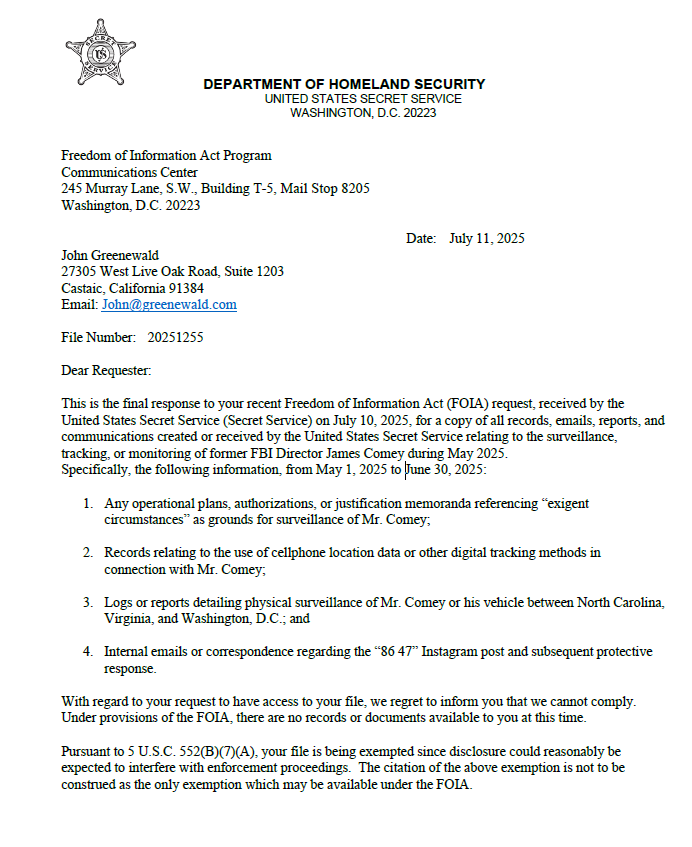
The writing was on the wall… or shall we say in the sand. Posted this last July. https://t.co/7rP4yI0njF [Quoted] 🚨 The U.S. Secret Service refuses to release any information about the surveillance, tracking, or investigation of former FBI Director James Comey and his "8647" post because it may "interfere with enforcement proceedings." All three #FOIA cases were denied today. https://t.co/fwtG0JekVA

RT @WashTimes: “Shots fired,” screamed the Secret Service agents. President Trump and Cabinet members were escorted out of the main ballro…