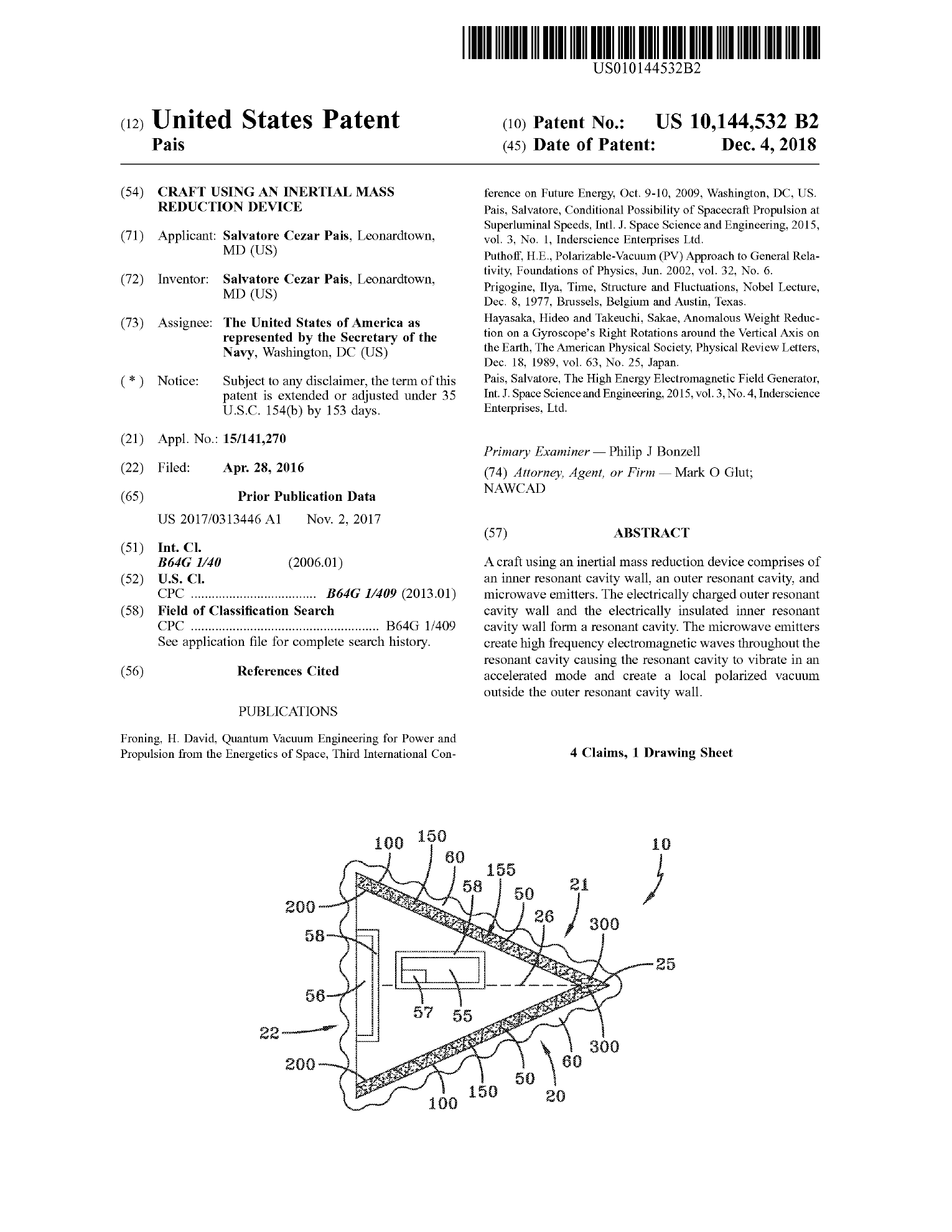
Craft Using an Inertial Mass Reduction Device
Navy-assigned U.S. Patent 10,144,532 B2 describes Salvatore Cezar Pais’s proposed craft using charged resonant-cavity walls, microwave emitters, accelerated vibration, and vacuum polarization to reduce inertia. It records the claimed apparatus and patent scope, including aerospace and undersea embodiments, but does not itself provide experimental validation of the extraordinary performance claims.
Search extracted document text
Probed searches extracted/indexed text and can show matching pages when page indexing is available.
Document Intel
Source status, provenance, and extraction context.
- Source / agency
- United States Department of the Navy
- Type
- Patent
- Classification
- Unclassified
- Reference #
- US10144532B2
- Published
- 2018-12-04
- Content Type
- application/pdf
- Pages
- 6
Structured Analysis
Claims and source material extracted from the document text. Timeline context is surfaced in document intel.
U.S. Patent 10,144,532 B2 names Salvatore Cezar Pais as inventor, the United States as represented by the Secretary of the Navy as assignee, and December 4, 2018 as the patent date.
Inventor: Salvatore Cezar Pais, Leonardtown, MD (US) Assignee: The United States of America as represented by the Secretary of the Navy
The patent states that the invention may be manufactured and used by or for the U.S. government for governmental purposes without royalty payments.
The invention described herein may be manufactured and used by or for the Government of the United States of America for governmental purposes without payment of any royalties
The abstract defines the proposed device as inner and outer resonant-cavity walls plus microwave emitters intended to vibrate the cavity in an accelerated mode and create a local polarized vacuum.
The microwave emitters create high frequency electromagnetic waves throughout the resonant cavity causing the resonant cavity to vibrate in an accelerated mode and create a local polarized vacuum
The patent proposes that a moving object’s inertial and gravitational mass can be reduced through accelerated vibration and rotation that polarize the local vacuum and manipulate nearby quantum-field fluctuations.
inertial mass reduction can be achieved via manipulation of quantum field fluctuations in the local vacuum energy state, in the immediate proximity of the object/system.
The patent claims that polarizing the local vacuum could reduce a craft’s resistance to acceleration and enable extreme speeds.
it is possible to reduce a craft’s inertia, that is, its resistance to motion/acceleration by polarizing the vacuum in the close proximity of the moving craft.
The patent proposes that high-frequency axial spin or vibration of minimally charged objects could produce strong interaction with quantum-vacuum fluctuations in a laboratory environment.
strong local interaction with the high energetics of the quantum vacuum fields’ fluctuations superposition (macroscopic vacuum energy state) is possible in a laboratory environment
The patent cites Pais’s 2015 paper on conditional superluminal propulsion and discusses energy-mass removal through exotic matter, gravity waves, or vacuum polarization.
A recent paper, by the inventor, published in the International Journal of Space Science and Engineering (Pais, S. C., Vol. 3, No. 1, 2015)
The patent proposes using the Gertsenshtein effect to generate high-frequency gravitational waves with electromagnetic radiation and thereby modify gravitational fields near the craft for propulsion.
the production of high frequency gravitational waves by high frequency electromagnetic radiation, in this manner modifying the gravitational fields in close proximity to the craft, resulting in its propulsion.
The patent acknowledges that later experiments reported null or questionable results for Hayasaka and Takeuchi’s claimed gyroscope weight reduction, while arguing those replications did not reproduce the original setup.
Several null result experiments followed (a recent one as well) which declared the Hayasaka et al. results null and void, or at least questionable
The preferred embodiment places xenon or another noble gas in an annular resonant cavity that may surround crew, power, and cargo compartments protected by a Faraday-type cage.
In the preferred embodiment, the resonant cavity 150 is filled with a noble gas 155. The gas xenon may be used
The patent specifies microwave emitters operating from 300 megahertz to 300 gigahertz and discusses ordinary metals or cryogenically cooled superconductors for the outer cavity wall.
in the electromagnetic (EM) spectrum range of 300 Megahertz to 300 Gigahertz.
One proposed craft embodiment may use a cone or lenticular triangle/delta-wing configuration; the passage describes a design option in the patent rather than an observation of an operating craft.
the craft 10 (which can be, but without limitation, a cone or lenticular triangle/delta wing configuration).
The patent envisions a hybrid aerospace/undersea craft that it claims could attain extreme underwater speeds and enhanced stealth inside a vacuum-plasma sheath.
a hybrid aerospace/undersea craft (HAUC), which due to the physical mechanisms enabled with the inertial mass reduction device, can function as a submersible craft capable of extreme underwater speeds
The granted claim set covers a craft with inner and outer resonant-cavity walls and microwave emitters, with dependent claims for noble-gas filling, an electrically charged outer wall, and accelerated axial rotation.
What is claimed is: 1. A craft using an inertial mass reduction device comprising: an inner resonant cavity wall; an outer resonant cavity wall
Chronology extracted from the document text.
U.S. Patent 10,144,532 B2 issued
The patent issued with four claims and one drawing sheet.
Patent application published
The prior publication is listed as US 2017/0313446 A1.
Inertial-mass-reduction patent application filed
Application 15/141,270 was filed for the proposed craft.
Related electromagnetic-field-generator patent application filed
The patent incorporates a related application by the same inventor describing an electromagnetic field generator.

Referenced In Coverage
Investigative posts, source items, and other coverage that currently cite this document.


Probed ingest of: “I Saw a Triangle Shaped UFO At a NASA Hangar!” -Dylan Borland Tells All
American Alchemy host Jesse Michels interviews former Air Force geospatial-intelligence specialist Dylan Borland about his claimed 2012 encounter with a silent triangular craft over Langley, his 2025 congressional testimony, and alleged failures in the UAP whistleblower process. The episode follows Borland from drone-war imagery analysis through AARO and ICIG disclosures, disputed retaliation claims, recovered-craft allegations, classification law, Vanguard Enterprise, and a speculative final discussion of consciousness, religion, and nonhuman intelligence.