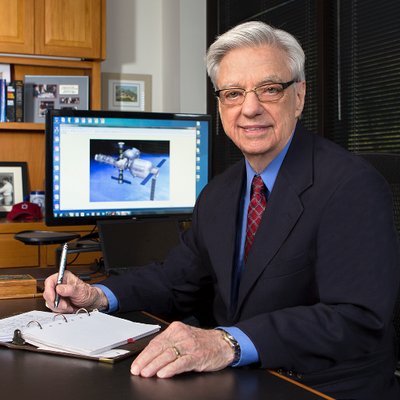
Hal Puthoff
PersonScientistHal Puthoff
PersonScientistHarold “Hal” Puthoff is a physicist whose career spans laser research, CIA-funded remote viewing, advanced-propulsion studies, and modern UAP organizations.
Harold “Hal” Puthoff is a physicist whose career spans laser research, CIA-funded remote viewing, advanced-propulsion studies, and modern UAP organizations.
Harold E. Puthoff is an American physicist and engineer who worked in laser research and later became a central figure in government-funded parapsychology and advanced-physics programs. At Stanford Research Institute in the 1970s, he and Russell Targ investigated remote viewing for U.S. intelligence agencies. He later founded EarthTech International and the Institute for Advanced Studies at Austin.
Puthoff’s early work included laser research and engineering before he joined Stanford Research Institute, where he and Russell Targ ran experiments with people described as remote viewers. He later founded private research organizations and advised government or industry sponsors on unconventional energy and propulsion concepts. The continuity across those phases is institutional entrepreneurship: Puthoff repeatedly created small programs where intelligence officials, physicists, and anomalous claimants could work together outside ordinary university structures.
Puthoff has published and sponsored work on zero-point energy, spacetime engineering, and other speculative propulsion concepts. He advised Robert Bigelow-linked programs, contributed to technical studies associated with AAWSAP, and joined To The Stars Academy. He has also spoken publicly about alleged recovered materials and government knowledge, but much of the evidence underlying those statements has not been released for independent examination.
Puthoff is a connective figure across remote viewing, exotic propulsion, and modern UAP disclosure. His documented participation in unusual government contracts is significant; it does not automatically validate every theoretical or testimonial claim attached to those programs. His biography is essential to understanding how Cold War consciousness research evolved into today’s network of scientists, contractors, and disclosure advocates. That institutional continuity is one of the defining features of his long public career.