1948 Aztec, NM UFO Crash
The Aztec crash story claims a saucer fell near Aztec, New Mexico in 1948; the tale came from Frank Scully and is widely treated as a hoax.
The 1948 Aztec, New Mexico UFO crash is the alleged recovery of a large saucer and small bodies near Hart Canyon, northeast of Aztec, New Mexico.
The story entered UFO history through journalist Frank Scully, who wrote about crashed saucers in Variety columns in 1949 and then in his 1950 book Behind the Flying Saucers. Scully's sources were Silas Newton and Leo Gebauer, two men who claimed inside knowledge of government crash recoveries and alien technology. Their version placed a controlled landing or crash near Aztec on March 25, 1948 and described a craft roughly 99 feet across with sixteen dead occupants. Those details became the template for the case, but they did not come from a public military record, a named recovery team, or physical material with chain of custody.
They came through promoters who were also selling oil-finding devices said to use principles learned from crashed saucers. That overlap is central to the case.
By 1952, journalist J. P. Cahn had investigated the story for True magazine and presented Newton and Gebauer as confidence men. A metal sample tied to the claims reportedly tested as ordinary aluminum, and later accounts of Newton's career describe repeated fraud allegations.
In that respect, Aztec differs from Roswell: both became crash-retrieval touchstones, but Roswell began with an acknowledged 1947 military debris recovery, while Aztec began as a book-and-magazine story sourced to men later exposed as unreliable. The Aztec narrative still resurfaced in UFO literature after the 1970s, especially as crash-retrieval claims became a larger subgenre. It also benefited from proximity to New Mexico's better documented Cold War aerospace and nuclear history. A 1950 FBI memo from Guy Hottel is sometimes cited as support for Aztec because it relayed a secondhand claim about recovered discs and small bodies.
The FBI later cautioned that the memo was unverified, second- or third-hand information and that the bureau did not investigate it as confirmation of a crash. That distinction matters because an FBI Vault record can show that a rumor reached government files without proving the rumor.
What is documented is the publication history, the fraud history around key sources, and the later reuse of the tale in crash-retrieval lore.
What is claimed is the recovery itself: craft, bodies, military removal, and secret study.
What is disputed is nearly everything that would turn the claim into an event rather than folklore. No official crash report, recovery inventory, autopsy record, photograph, or named military witness has surfaced in a form that can outweigh the hoax record.
The case still matters because it helped establish the rhetorical shape of later crash stories: remote desert site, intact saucer, small occupants, military secrecy, and insiders who say the proof is hidden. It also shows how early post-Kenneth Arnold saucer enthusiasm created a market for extraordinary claims before the evidence standards had caught up.
Probed read: Aztec is best read as an influential crash-retrieval legend with a strong documented paper trail for publication and debunking, not for recovery. Its value is historical and diagnostic: it shows how a weakly sourced claim can harden into UFO canon when it fits public expectations.
What would move the assessment: A contemporaneous military record, authenticated photographs, recovery logistics, or independent named witnesses with verifiable access would be required. Short of that, the fraud trail around Newton and Gebauer keeps confidence in the crash claim low.


So glad that @AlchemyAmerican is covering the 1948 Aztec UFO crash. When it comes to UFO crash retrievals, Aztec became my personal “book encounter”. Hope the wider public learns more about it now. Here are the basic facts. Also, read Sedge Masters 👀. - Craft recovered was intact, except for a broken porthole. It measured 100' in diameter, needed to be taken apart in order to move it due to its size. - Craft remained intact probably due to auto-pilot kicking in after exposure killed the occu...
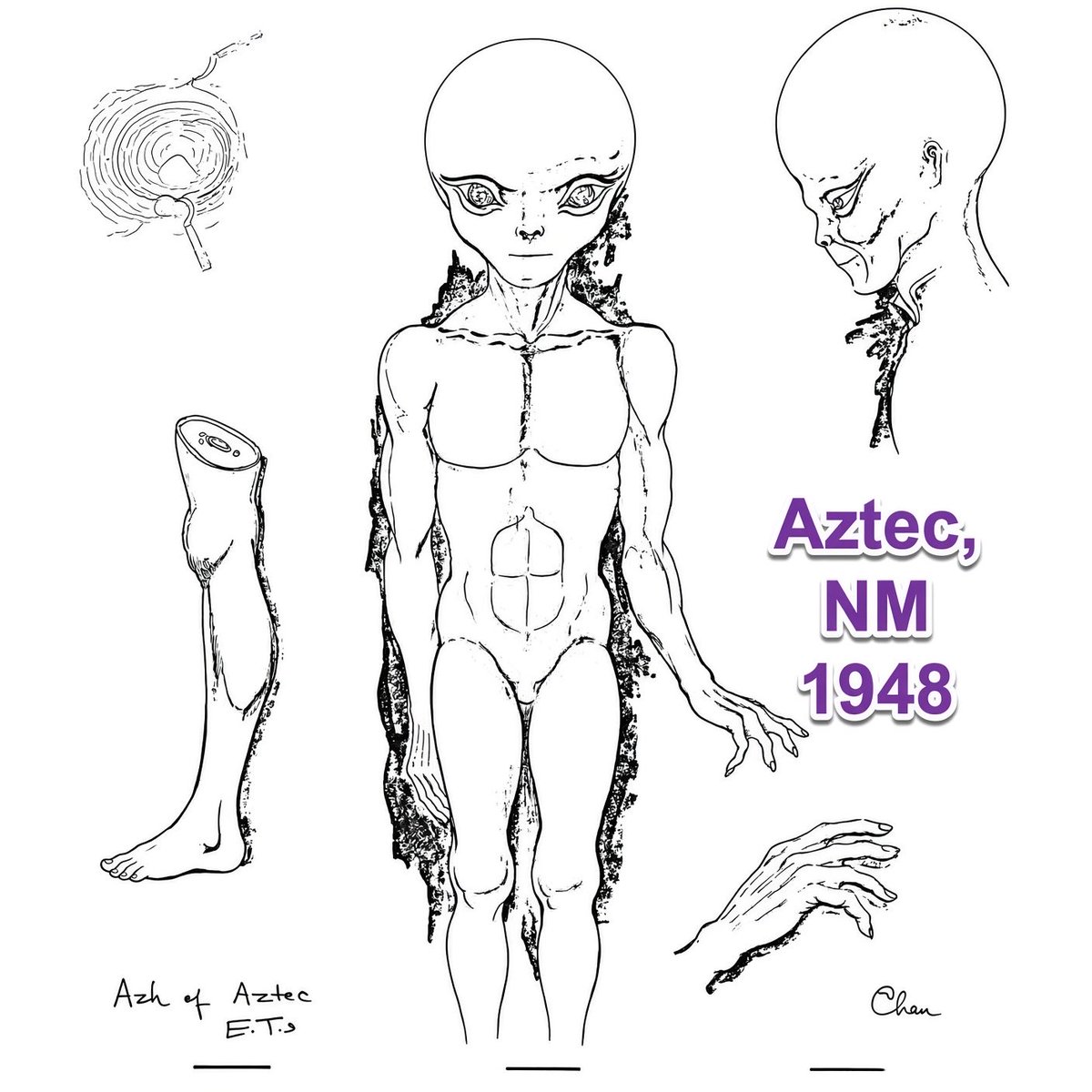

Right after George H W Bush was elected, SecDef Carlucci showed off the Fluxliner ARV to Brad Sorenson, the MJ-12 files were deemed BOGUS, the CIA remote-viewed the Ark of the Covenant, and the MJ-12 program and the DIA's knowledge of the 1948 Aztec, NM UFO crash-retrieval was assessed weeks later


Right after George H W Bush was elected, SecDef Carlucci showed off the Fluxliner ARV to Brad Sorenson, the MJ-12 files were deemed BOGUS, the CIA remote-viewed the Ark of the Covenant, and the MJ-12 program and the DIA's knowledge of the 1948 Aztec, NM UFO crash-retrieval was assessed weeks later


Right after George H W Bush was elected, SecDef Carlucci showed off the Fluxliner ARV to Brad Sorenson, the MJ-12 files were deemed BOGUS, the CIA remote-viewed the Ark of the Covenant, and the MJ-12 program and the DIA's knowledge of the 1948 Aztec, NM UFO crash-retrieval was assessed weeks later
