Defense Intelligence Agency (DIA)
OrgGovernment AgencyDefense Intelligence Agency (DIA)
OrgGovernment AgencyThe Defense Intelligence Agency provides military intelligence to defense leaders, combatant commands, policymakers, and force planners across the United States government.
The Defense Intelligence Agency provides military intelligence to defense leaders, combatant commands, policymakers, and force planners across the United States government.


The Defense Intelligence Agency is a Department of Defense organization created in 1961 to integrate military intelligence for senior defense leaders, combatant commands, and national policymakers. It produces analysis of foreign military capabilities, manages human-intelligence and technical missions, and coordinates with the services and wider Intelligence Community. Its director is a military officer accountable through defense and intelligence leadership.
DIA’s work spans overt and clandestine collection, attaché reporting, scientific and technical intelligence, and support to operations. Many products remain classified because they expose foreign sources, American capabilities, or military judgments. A DIA contract or report demonstrates an authorized defense-intelligence activity, though individual contractor conclusions do not automatically become agency findings.
The agency awarded the 2008 AAWSAP contract to BAASS for advanced aerospace studies and anomalous-phenomena work. That program generated technical papers, databases, and investigations later central to disputes about AATIP and Skinwalker Ranch. DIA has also contributed to modern interagency UAP assessments. Public records confirm the contract and deliverables while leaving disagreement about the program’s intended emphasis and the evidentiary value of its extraordinary cases.
DIA’s importance lies in the meeting point between foreign military threats, technical possibility, and classified collection. That mandate makes unusual aerospace reports relevant without implying an alien conclusion. Accurate institutional history separates agency-approved requirements, contractor work, finished intelligence, and later personal accounts, each of which carries a different level of authority. The agency’s public reading room and contracting record provide anchors for that separation. They show what was authorized, when funds moved, and which products were delivered even where the interpretation of the work remains contested. Those records make DIA a central source for reconstructing the institutional transition from AAWSAP to later UAP efforts.

[Retweeted] Highlight reel for folks that don’t have time to watch Bigelow podcast episode 8. 👇🏼 Kelleher says the DIRDs started because UFOs were doing right-angle turns at 5,000 mph — then the White House can’t find the 8–10k pages he FedEx’d to DIA. https://t.co/OoUdw94JGM


[Retweeted] Highlight reel for folks that don’t have time to watch Bigelow podcast episode 8. 👇🏼 Kelleher says the DIRDs started because UFOs were doing right-angle turns at 5,000 mph — then the White House can’t find the 8–10k pages he FedEx’d to DIA. https://t.co/OoUdw94JGM

⏳ 16 Years 👴🏻 "There was a stack of three-ring binders...between 5 and 6 feet tall in my office that were eventually FedExed to [DIA]. They definitely are at the[DIA]." ~CK 🛸 Is the DIA Incompetent, Lying, or Confused? 🛸 @g_knapp: "Word from the White House, which was asked, 'Well, where's the rest of it?' Because the list of all the [AAWSAP] reports that you guys created has been public for a couple of years now, and everyone's wondering where the heck are they? I mean, a lot of it's bee...

Probed ingest of: The New Space Race, AI Threats, and National Survival | Bigelow Podcast Ep. 8

Update: I Missed the Point https://t.co/9ekX5qNt2k [Quoted] "All of our references were, specifically, scanned in, electronically, at DIA." ~Lacatski (I REALLY missed the point yesterday with my rare "Breaking" post. Yes, senior WH officials CAN see copies of the DIA's AAWSAP files in Vegas at Mr. Bigelow's place. But, they shouldn't https://t.co/ky34StLh88

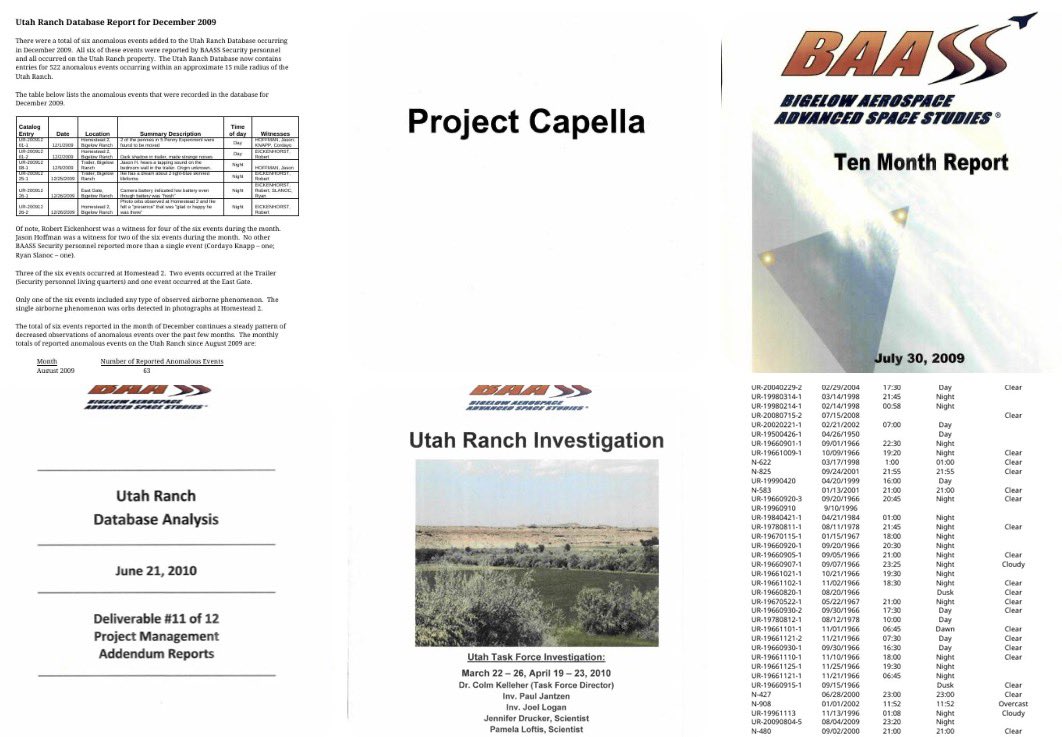
[Retweeted] The DIA claim they cannot locate the AAWSAP/BAASS documents. Not sure if this is what is being referred to but @Teg_OM obtained and released some BAASS reports in 2025 👇 https://t.co/fbtkL8sfXC


They are now only viewable at https://www.war.gov/UFO/ and on https://archive.org

[Retweeted] "All of our references were, specifically, scanned in, electronically, at DIA." ~Lacatski (I REALLY missed the point yesterday with my rare "Breaking" post. Yes, senior WH officials CAN see copies of the DIA's AAWSAP files in Vegas at Mr. Bigelow's place. But, they shouldn't have to do that.) Lacatski: "When I left, all of our references were specifically scanned in, electronically, at DIA. Now, I can't say what happened in the years since I retired in 2016. It could have been tha...


[Retweeted] Figure 7 in this DIRD (Einstein and the T-Rex looking at each other through a wormhole) is lifted straight from Kip Thorne’s popular 1994 book, Black Holes and Time Warps (“Reference 9” in the figure caption). And all of the concepts discussed in this DIRD written by Eric Davis were freely available in the technical and popular physics literature (scattered among different sources) for decades prior. The only novel (and admittedly cool) thing here is that the Defense Intelligence...

[Retweeted] The DIA says the AAWSAP files are missing, so they can’t release them. Lucky for them, I like being helpful. So here are some of the AAWSAP files they’ve misplaced. (I signed no NDA, they leaked from PhenomAInon dot com a few years back) Download at the link below👇 #PURSUE https://t.co/fClTVa6ULW