1980 Cash-Landrum Incident
The 1980 Cash-Landrum incident was a Texas close-encounter claim involving heat injuries, a diamond-shaped object, helicopters, and a failed federal lawsuit.
The Cash-Landrum incident centers on a reported close encounter near Huffman, Texas, on December 29, 1980. Betty Cash, Vickie Landrum, and Colby Landrum said they saw a bright diamond-shaped object over a rural road, felt intense heat, and later watched military-style helicopters near or around the object. The case became one of the most discussed American UFO injury claims because the witnesses tied their reported illness to the encounter and then tried to hold the federal government responsible in court.
The story has several layers. First is the roadside observation: the witnesses described a brilliant object at low altitude, with flame or heat coming from below it. Second is the medical claim: Cash and the Landrums reported symptoms including burns, nausea, weakness, hair loss, and eye problems. Third is the helicopter claim: they said numerous helicopters, often described as Chinook-type aircraft, appeared in connection with the object. That helicopter element is what pushed the case from a private sighting into a claim of possible government involvement.
Documentation exists, but it is uneven. The witnesses gave statements, were interviewed at Bergstrom Air Force Base in 1981, and became part of civilian UFO research conducted through MUFON figures including John Schuessler. A federal suit followed, with Cash and Landrum seeking damages from the United States. The case was dismissed in 1986 after the court was not persuaded that a U.S. agency possessed or operated the alleged object or that the reported helicopters could be attributed to the military.
That legal outcome is central. It does not prove the witnesses saw nothing, and it does not prove their symptoms were fabricated. It does show that the evidence could not establish government responsibility. Skeptical investigators later challenged the location, timeline, radiation interpretation, and medical record claims. Proponents emphasize witness consistency, the seriousness of Cash's illness, and independent helicopter reports in the region. Both sides are dealing with a thin technical record: no recovered material, no confirmed flight logs, no sensor data, and no medical consensus that ties the reported injuries to a specific external source.
The case remains important because it asks what kind of evidence would be required when a UAP report includes alleged harm. It also foreshadows modern fights over Whistleblowers & Testimony, official denial, and the limits of civilian investigation. Unlike the Stephenville Lights, where later radar analysis became the main evidentiary hook, Cash-Landrum depends heavily on witness accounts and contested medical interpretation.
Probed read: The incident is credible as a documented allegation of a frightening encounter and subsequent legal action. It is not established as a military operation or a radiation exposure case. The helicopter claim is the hinge, and it remains unproven.
What would move the assessment: Unit flight logs, FAA or military radar data, hospital records with expert review, radiation or toxicology evidence, and original witness interview tapes would materially change the case. Without those, the event remains serious but unresolved.


RT @anonymoushadoww: (Images): “The Cash Landrum Incident of 1980” A Diamond Shaped Craft Caused Burns To 3 People On December 29, 1980 B…

Probed ingest of: Steven Spielberg and Close Encounters of the Third Kind


There are some good cases - Lonnie Zamora, Cash Landrum, Bentwaters, Rendlesham, ... - and many potentially legitimate accounts by non-famous people. But at the same time, there is an AWFUL lot of dubious science and claims out there. For example, it's really hard for me to believe that something which necessarily has to a) be relatively rare and/or sneaky so as to avoid being trivially obvious by now b) is the product of intelligences and/or alien species far more powerful than us, would c)...
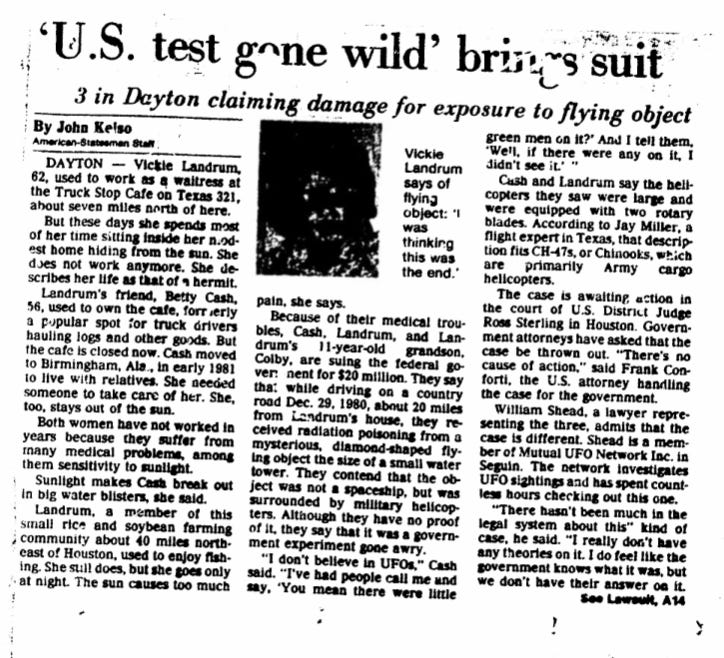
"It Had To Be Something The Government Had Up There" -- What Was The Cash-Landrum Object?
The UFO Case That Went to Federal Court


The Cash Landrum UFO incident in Texas remains unsolved 🛸👽🇺🇸 In 1980, three ordinary Texans saw a glowing craft hovering low over the road. One screamed: “Stop the car!” They got close enough to feel the heat. “That car was so hot, it burned her ring into her finger. I thought it was the end of time.” Then 23 military helicopters swarmed in… but the military denied any involvement. The witnesses suffered stomachaches, diarrhea, vomiting, burns, and hair loss - symptoms doctors said were “...

🚨 Cash-Landrum UFO Nightmare - Real ET Craft Hijacked by Black Ops? 😱🛸👽 Dr. Steven Greer exposes: "The Cash–Landrum UFO incident was in fact a real UFO but was later altered by the US government because they didn’t know how to operate its energy system." "The black ops https://t.co/dnXXmFTIft
