Pentyrch Pyramid UFO Incident
The Pentyrch Pyramid UFO incident is a disputed UAP-related event associated with Pentyrch, a community in South Wales, that circulates primarily through witness-centered retellings rather than through a single, stable, contemporaneous public record. It matters less for any one alleged object description than for what it reveals about how a local anomaly narrative hardens into an enduring “case” without a clear evidentiary spine. In UAP analysis terms, it is an example of an attribution cascade: an initial report (or cluster of reports) becomes inseparable from subsequent interpretations about military activity, airspace management, and official denial. The incident is repeatedly characterized as involving an unusual aerial presence and an associated pattern of lights, noise, or aircraft activity in the area; however, those elements often appear in secondhand summaries, not in accessible primary documentation.
The case is therefore useful as an integrity test for methodologies that claim to separate witness experience from later community mythology.
At the level of on-record fact that can be asserted without overreach, the incident’s core “entity” is the narrative itself: a named event label applied to a set of claimed observations near Pentyrch that have been treated as a coherent episode. Beyond that naming convention, the available signal does not provide date, time, weather conditions, or a roster of original witnesses, and those absences are consequential. When analysts cannot anchor a case to a timeline and a chain of custody for testimony, the case’s probative value drops sharply even if the story remains culturally potent. The persistent use of a distinctive label suggests the case has achieved memetic stability, which is a separate phenomenon from evidentiary stability.
The “pyramid” descriptor is central but also analytically hazardous. If the descriptor comes from a primary witness description, it should be treated as a shape impression under adverse viewing conditions rather than as a precise geometric claim. If the descriptor emerges later, it may function as a narrative hook—an easy tag that survives retelling because it is visually legible and dramatic. Without a contemporaneous statement, it cannot be determined whether “pyramid” refers to a triangular silhouette, a three-point light arrangement, a perspective effect, or a later interpretive overlay.
A disciplined profile has to separate three layers that often collapse into one another in popular retellings:
- Observations: what someone reports seeing or hearing (lights, motion, sound, perceived proximity).
- Attributions: what the observer or later narrators think it was (craft, drone, aircraft, “non-human” technology).
- Implications: what the event is said to indicate (military engagement, airspace containment, official concealment).
The incident persists because it offers a complete narrative arc that many UAP cases lack: a striking object description, an implied operational response, and an implied institutional boundary around what can be publicly acknowledged. That arc is compelling even when the underlying episode is thinly documented. In intelligence terms, this is exactly the kind of case where rumor intelligence and belief reinforcement can outpace any underlying sensor or documentary record. The resulting “case file” becomes more about social transmission than about aerial phenomena.
Because the signal set here is minimal, specific claimed details commonly associated with Pentyrch cannot be treated as verified. If there are claims of military aircraft presence, unusual low flights, or post-event official interactions, those would fall under “reported/attributed claims” until tied to dated flight logs, ATC recordings, public notices, or contemporaneous media. Likewise, any assertion that an object was engaged, damaged, or recovered would be a high-impact claim requiring correspondingly high-quality corroboration. In the absence of such anchors, the incident should be treated as unresolved and primarily testimonial.
The analytical hinge for this incident is not whether a “pyramid” could exist, but whether the case can be reconstructed as an event with auditability. Auditability means: who said what, when they said it, what else was happening in the airspace, and whether independent sources converge without cross-contamination. Many UAP narratives fail this test because later interviews and online dissemination introduce feedback loops: witnesses adopt shared language, and ambiguous elements become “known details.” Once that happens, the case becomes hard to use for inference about anything external to the community’s story.
If an investigative team were to treat Pentyrch as a live case study, the initial focus would be mundane but decisive. Key collection targets would include:
- A timestamped earliest-known mention (local press, social media post, report to authorities).
- Any contemporaneous audio/video files with original metadata preserved.
- Aircraft activity data for the relevant window (not to “debunk,” but to bound the problem).
- A clean separation of primary witnesses from secondary narrators and advocates.
Even without those materials in hand, the incident can still be profiled as a cautionary exemplar of how UAP “events” become entities. The name creates a container that invites additional claims to adhere to it over time: new witnesses attach their memory to the established label; unrelated aircraft noise is reinterpreted; later lights in the area are folded back into the original night. The longer that process continues without documentary constraints, the more the incident functions like a folklore node—highly resilient, low resolution.
From an intelligence-focused disclosure perspective, the risk is two-sided. Treating the incident as proven without hard documentation invites easy dismissal and contaminates higher-quality cases by association. Treating it as worthless ignores that testimonial clusters sometimes point to real, classifiable activity—training routes, exercises, or rare atmospheric and astronomical misidentifications—none of which require exotic explanations to still be operationally sensitive.
The Pentyrch Pyramid UFO incident therefore sits in a gray zone: a strong narrative identity with weak accessible sourcing, a vivid shape descriptor with uncertain provenance, and an implied institutional backdrop that may be more inferred than evidenced. Until it is reconstructed from first-order materials, it remains better understood as a case about information dynamics—how a community-level anomaly narrative achieves persistence—than as a case that can responsibly be used to argue for a particular technology, actor, or disclosure claim.

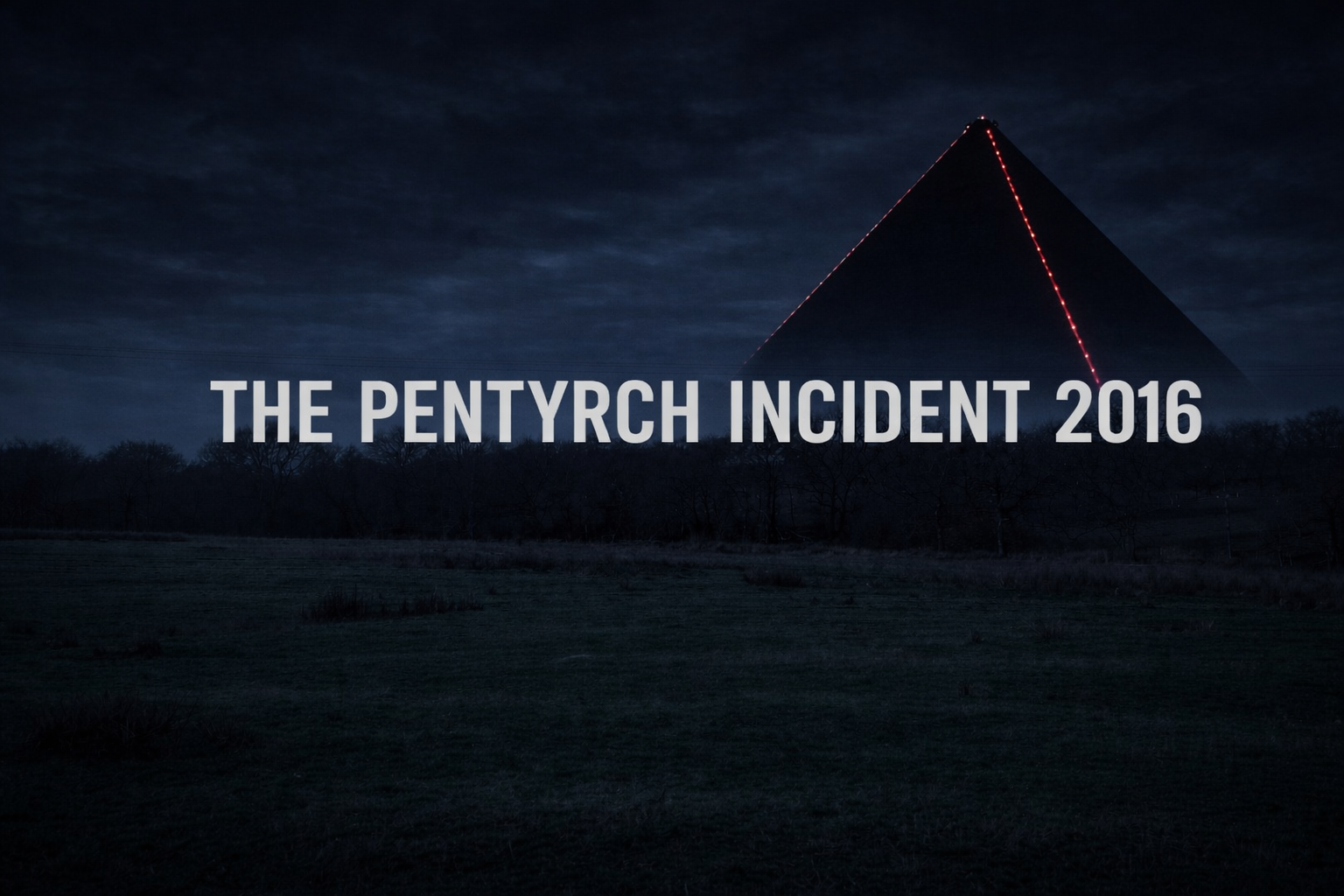
The Pentyrch Pyramid UFO Incident
Key witness speaks out ten years on