Post-Disclosure Scenarios
TopicPost-Disclosure Scenarios
TopicPost-disclosure scenarios examine possible social, political, scientific, and religious responses to confirmed non-human intelligence or hidden UAP programs.
Post-disclosure scenarios examine possible social, political, scientific, and religious responses to confirmed non-human intelligence or hidden UAP programs.



Post-disclosure scenarios explore what might follow an authoritative confirmation about UAP, hidden government activity, or non-human intelligence. The scenarios vary because “disclosure” could mean very different things: release of unresolved sensor records, acknowledgment of a classified program, evidence of extraterrestrial life, or direct contact. Each premise would produce a different institutional and public response, so no single post-disclosure future can be treated as a forecast.
Immediate questions would concern verification and authority. Scientists would seek reproducible access to evidence; legislators and courts would examine classification, spending, and prior representations; allied governments would compare records; and news organizations would authenticate documents and sources. If the announcement involved concealed programs rather than a novel intelligence, the central issue might be accountability. This is why UAP disclosure and government secrecy must remain analytically distinct from confirmation of aliens.
More expansive scenarios consider markets, security, religion, culture, and individual psychology. Research on risk communication and crisis governance suggests reactions would vary across communities rather than forming one global response. The term ontological shock describes possible disruption to basic assumptions, but panic is not inevitable. Trust would depend heavily on the clarity of the evidence, the credibility of messengers, opportunities for independent review, and whether officials acknowledged uncertainty.
The subject is therefore a form of scenario planning, not evidence that disclosure is imminent. Useful scenarios specify assumptions, identify decision points, and test institutional resilience under more than one outcome—including mundane explanations, partial revelation, contested evidence, and confirmed non-human intelligence. They also separate consequences supported by research from dramatic predictions drawn from fiction or advocacy. The practical value lies in preparing verification, communication, oversight, and public-health processes that would be useful even during a major but non-extraordinary information release.
Dr. Jacques Vallée DESCRIBES what will take place on the Day After Disclosure - Psicoactivo #1150


What are our responsibilities in a post disclosure world! Those who practice and understand CE5 will have a critical role in developing the ET-Human relationship. For more discussion of this concept watch Dr. Greer's podcast #23 at https://t.co/WbrKSCn9EG. https://t.co/PEgB30cHtm


I often wonder, how our civilization will transform after disclosure happens. Here’s what I think may begin to change - Experience becomes our real resource Every lived life adds something unique to a collective “consciousness density,” in the same way accumulated history gives a civilization greater maturity and depth. We may eventually measure the value of a civilization less by what it owns and more by what it has experienced and integrated. - Humanity sees itself as part of a larger linea...

I often wonder, how our civilization will transform after disclosure happens. Here’s what I think may begin to change - Experience becomes our real resource Every lived life adds something unique to a collective “consciousness density,” in the same way accumulated history gives a civilization greater maturity and depth. We may eventually measure the value of a civilization less by what it owns and more by what it has experienced and integrated. - Humanity sees itself as part of a larger linea...

I often wonder, how our civilization will transform after disclosure happens. Here’s what I think may begin to change - Experience becomes our real resource Every lived life adds something unique to a collective “consciousness density,” in the same way accumulated history gives a civilization greater maturity and depth. We may eventually measure the value of a civilization less by what it owns and more by what it has experienced and integrated. - Humanity sees itself as part of a larger linea...

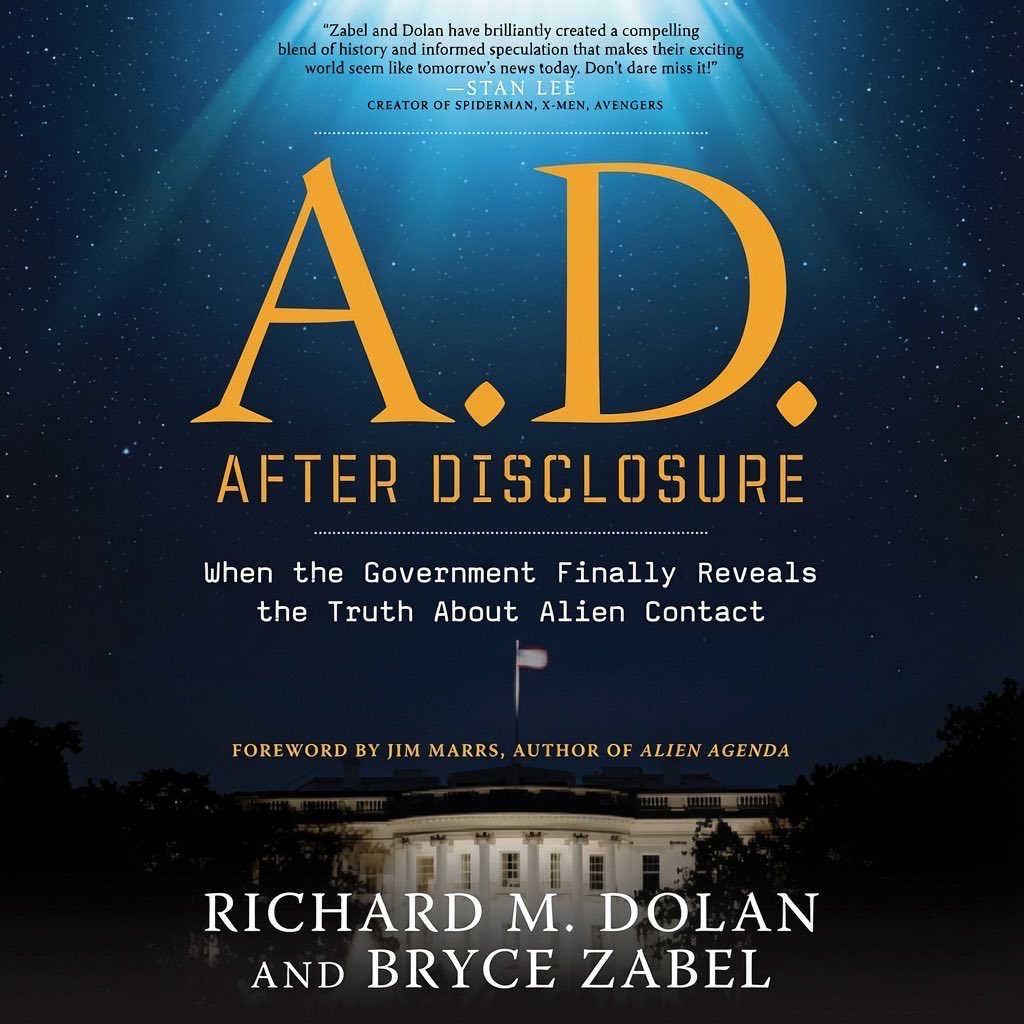
We already have the user manual for what to expect on multiple fronts on the day after POTUS discloses the reality of UFOs, non-human intelligence and the USG’s awareness of such realities. If you’re gonna have a “book encounter” (like many had with Strieber’s Communion or Pasulka’s American Cosmic), then having it with After Disclosure seems the BEST fit right now. Thanks to Dolan and Zabel for this timeless and extremely relevant piece of work.

RT @PostDisclosure: Groupthink scares me. Yes, I do think that, after disclosure, it will be clear that the extremely low probability many…