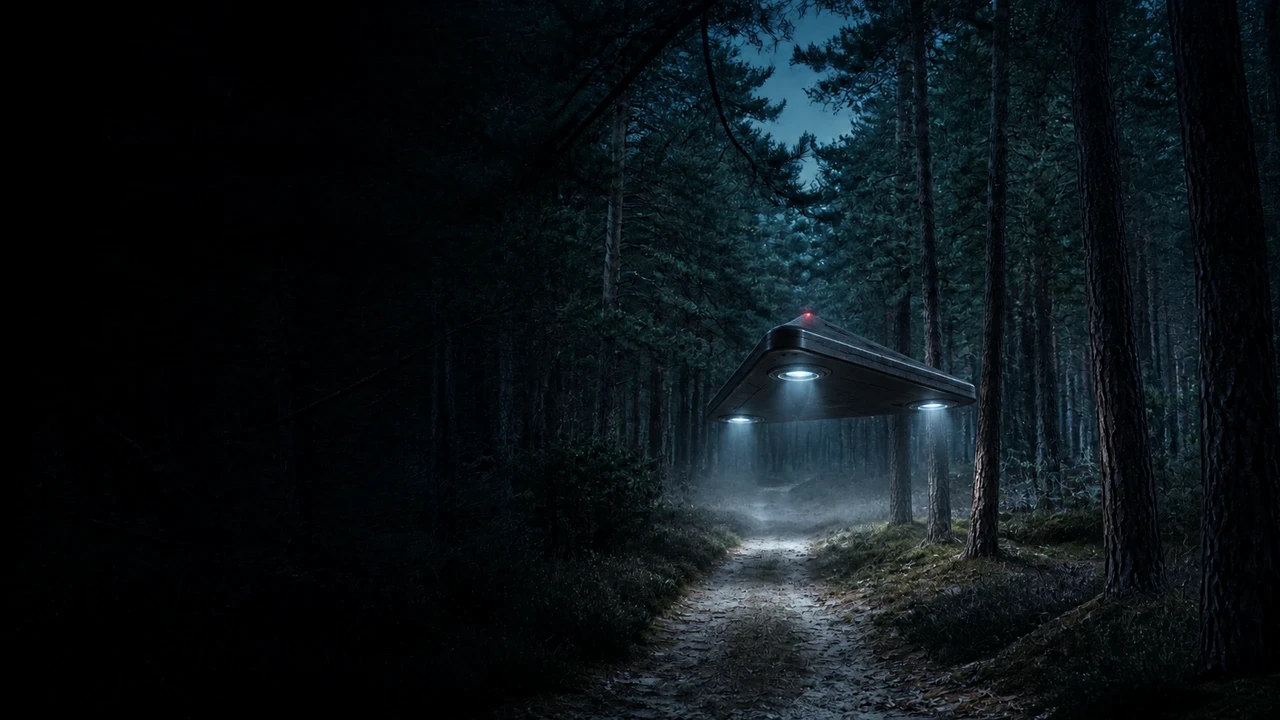
Rendlesham Forest Incident
EventRendlesham Forest Incident
EventincidentOver two nights in Dec. 1980 near RAF Woodbridge/Bentwaters, U.S. personnel reported luminous objects in Rendlesham Forest; Lt. Col. Charles Halt documented the events in an official memo and audio. It remains a leading U.K. military UAP case.
Over two nights in Dec. 1980 near RAF Woodbridge/Bentwaters, U.S. personnel reported luminous objects in Rendlesham Forest; Lt. Col. Charles Halt documented the events in an official memo and audio. It remains a leading U.K. military UAP case.
The Rendlesham Forest Incident is a cluster of UAP reports made over two nights in December 1980 in the vicinity of RAF Woodbridge and RAF Bentwaters in the United Kingdom, involving U.S. military personnel assigned to those installations. It matters less because it produces a clean, self-evident “case solved” narrative—there is no such consensus—and more because it offers an unusually formal paper trail for a UAP claim inside a military context. The incident is tied to an on-record document: Lt. Col.
Charles Halt’s memo, commonly treated as an official contemporaneous account rather than a later recollection. It is also tied to audio associated with Halt, which is often cited as real-time capture of observations and reactions rather than a reconstructed interview. For UAP analysts, Rendlesham persists as a reference point because it sits at the intersection of witness testimony, command-level documentation, and enduring interpretive dispute.
The verified core is narrow: U.S. personnel reported luminous objects in or near Rendlesham Forest across two nights, and Halt produced a memo documenting the events. That memo exists as an official communication artifact, which is materially different from anonymous reporting or secondhand retellings. The associated audio is part of the case’s evidentiary identity, though its probative value depends on provenance and chain-of-custody questions not resolved by the basic narrative alone. The location and timeframe—late 1980 near two named RAF facilities used by U.S. forces—anchor the incident in a specific operational setting.
Beyond that core, much of what circulates around Rendlesham is best treated as attributed claim rather than established fact. Witnesses have described “luminous objects,” but luminosity is a descriptor, not an identification, and can map to multiple mundane or exotic sources. Even the word “object” can be interpretive: observers often infer a discrete craft where the underlying stimulus might be a light source with ambiguous depth cues. The persistence of the case is partly due to how readily ambiguous stimuli become structured narratives in a military environment where people assume adversary capability is plausible.
Halt’s memo as an anchor point shapes how the incident is handled inside disclosure-oriented and skeptical communities alike. In a typical UAP case, analysts confront the problem of late-formed stories; here, the memo is used to argue that reporting occurred within a command chain and therefore cleared at least minimal thresholds of seriousness. That inference can be overstated: official documentation confirms that someone with authority thought it worth recording, not that the underlying phenomenon was extraordinary. Still, the memo functions as a stabilizer that prevents the case from collapsing into pure folklore.
The audio plays a similar role as an authenticity signal, but it is not self-authenticating. If treated as contemporaneous, it can preserve details that later become simplified, embellished, or selectively remembered. If treated as a recording circulated later without rigorous documentation, it can become another contested artifact whose value is mostly rhetorical. Either way, its existence is part of why Rendlesham is filed by many as a “military case” rather than a civilian sighting with military proximity.
The incident is often called a leading U.K. military UAP case, but that label contains a quiet ambiguity: the reporting personnel were U.S. personnel operating from RAF facilities. That duality matters because it complicates jurisdictional assumptions about records, reporting channels, and who had the authority to characterize what happened. It also affects how the case is used in argumentation—supporters may emphasize “RAF” to evoke national-security gravity, while skeptics may focus on the limited set of clearly attributable documents and the interpretive nature of witness accounts. The result is a case that can be invoked by multiple sides without resolving the underlying evidentiary disputes.
From an analytic standpoint, Rendlesham’s value is less about any single claimed feature and more about the kinds of questions it forces. The incident sits on a spectrum between operational report and cultural artifact, with different communities weighting those aspects differently. Key variables that remain implicit in most retellings—timelines, observer positions, environmental conditions, and the precise relationship between the two nights’ events—are often compressed into a single narrative unit. That compression is where uncertainty hides, and where confident reconstructions tend to overreach.
What can be stated without speculation is limited to a few elements:
- The incident occurred over two nights in December 1980 near RAF Woodbridge and RAF Bentwaters.
- U.S. personnel reported luminous objects in Rendlesham Forest.
- Lt. Col. Charles Halt documented the events in an official memo.
- Audio associated with Halt is commonly referenced as part of the record.
Everything beyond those points—what the lights were, whether there was a structured craft, whether there was intelligent control, whether the activity represented foreign technology, an atmospheric misinterpretation, or something else—moves into contested territory. The case’s public longevity has encouraged accretion: later interpretations can read back into early materials, turning tentative language into definitive claims. Analysts who treat Rendlesham responsibly keep the document and audio separate from the wider mythology and avoid importing details that are not actually present in the minimal on-record description.
Rendlesham’s durability also reflects a structural feature of UAP discourse: “military witness plus memo” is a powerful combination even when the observable itself remains undefined. In that sense, the incident functions as an archetype for how authority, documentation, and ambiguity interact. It is repeatedly used to argue that credible institutions encountered an anomalous event, and just as often used to argue that credibility does not equal correctness. Its evidentiary center of gravity—Halt’s memo and associated audio—remains the reason it continues to be treated as a benchmark case even when the underlying phenomenon is left unresolved.
As I’ve documented in other Rendlesham interviews, “everything was documented on film that night.” If the government is going to keep doing UAP info dumps, release the footage from what has been referred to as Britain’s Roswell. @StephenM #UAP #UFO https://t.co/7SeO2NpR5D
I wanted to look back on this very interesting UFO case. Now there’s two versions of this encounter, one where the UFOs are flying all around and this is what the audio recording tells us. The second one is where Jim Penniston allegedly saw a craft of unknown origin landed on the field. Now I don’t believe a craft landed because two witnesses who were there with him, Edward Cabansag and John Burroughs both agree that Jim Pennington lied about he saw a craft. Interestingly enough, Ike Barker,...

We all know 1980 was a tense time in the cold war, blah blah blah... and sometimes lesser known fact, the NATO Dual-Track decision in 1979 meant a lot of nukes everywhere... like 500+ nukes they wanted ready to start deploying by 1983. We know they want nuclear, but WHY??? Here's a serious theory: Nuclear weapons are categorically different from say, conventional bombs, like good ol' dynamite. They don't just rearrange chemical bonds to create reactions, they split the nucleus of atoms, relea...
He said the military uses UAP-related tools and technology to develop weaponry. “Just like the stealth fighter was kept secret for years… eventually they're going to admit we have these capabilities,” Burroughs said. “They're just going to not tell you how they developed them or how it works. But unfortunately it is tied into possibly other intelligence, and that's an even bigger problem to deal with.” When deployed in Bosnia two decades ago, Burroughs said he witnessed the technology that re...

Former U.S. Air Force airman John Burroughs, a firsthand witness to the 1980 Rendlesham Forest UFO incident, says his classified medical records point to deep government secrecy around advanced military technology and non-human intelligence. https://t.co/hckk1KRxpg
There are some good cases - Lonnie Zamora, Cash Landrum, Bentwaters, Rendlesham, ... - and many potentially legitimate accounts by non-famous people. But at the same time, there is an AWFUL lot of dubious science and claims out there. For example, it's really hard for me to believe that something which necessarily has to a) be relatively rare and/or sneaky so as to avoid being trivially obvious by now b) is the product of intelligences and/or alien species far more powerful than us, would c)...
New website called ufoevidence.com just dropped. Landing page says: "Unidentified anomalous phenomena are present in our skies and oceans. Examine the best evidence for yourself, assess the record with rigor, and get involved in advancing public understanding of the phenomenon." They have cases like the US Navy videos, Rendlesham, Phoenix Lights, etc

In December 1980, U.S. Air Force personnel at RAF Woodbridge in Suffolk, England, reported a series of UFO sightings in Rendlesham Forest. Witnesses described unusual lights, a triangular craft, and elevated radiation readings over two nights. Key People - Sgt. Jim Penniston - Approached and touched the alleged craft on the first night. - Later claimed to have received a telepathic binary message. - Lt. Col. Charles Halt - Deputy Base Commander who led the follow-up investigation. - Recorde...
Elizondo did a little Q&A on X yesterday. Here are some answers: Elizondo about the Rendlesham case (for those who dont know the Rendlesham case, watch this short clip) Posted on X: Question: "Do you have any unreported knowledge of what actually happened at Rendlesham" Elizondo: "Yes, and that information will be coming out." I wonder how he knows it will be coming out. Is it part of the current disclosure process? Elizondo: "we are spiritual beings having a human experience" Posted on X: El...