Socorro / Lonnie Zamora UFO Incident

Event

On April 24, 1964, Socorro police officer Lonnie Zamora reported seeing a flaming object land near Socorro, New Mexico, followed by an egg-shaped craft and two small figures. Investigators documented landing marks and other trace evidence, making it

Socorro, New Mexico, USA
incident
0
Mentions (30d)
0
Active Signals
3
Sources
12
Co-mentions
Source material mix
Opinion1Sighting report1Official doc1
Historical context
Attached Sightings
0
No sightings attached.
Event LocationSocorro, New Mexico, USA
Probed Analysis

The Socorro / Lonnie Zamora UFO incident is an April 24, 1964 report by a Socorro, New Mexico police officer who said he witnessed a fiery object descend near the town, then observed an egg-shaped craft and two small figures at close range. It matters in UAP discourse because it is anchored to an on-duty witness describing a short, sequence-specific event rather than a distant light in the sky, and because investigators documented physical traces at the alleged landing site. The combination—trained observer, proximity, and claimed trace evidence—has made it a recurring reference point for arguments that some UAP cases are “data-rich.” At the same time, the case remains constrained by what can be verified: a single principal witness account, subsequent investigative documentation that reportedly noted ground effects, and a set of contested interpretations ranging from mundane explanations to non-human technology. The incident’s durability is less about sensational detail than about the narrow question it poses: what generates a structured, close-range report with alleged physical correlates in a public-safety context?

Zamora’s on-record role is central. He was a local police officer acting in the course of duty when he reported seeing what he described as a flaming object land near Socorro. According to the account as commonly attributed to him, the object’s appearance shifted from “flaming” at distance to a more defined, egg-shaped craft once he was nearer. He also reported seeing two small figures near the craft, a detail that elevates the case from an aerial observation to a claimed encounter with activity on the ground.

The incident timeline, as described, has a built-in internal structure that investigators could interrogate: initial visual stimulus, approach, close observation, and departure. That structure is important because it creates discrete points where perception could be checked against the environment—distance, angles of view, duration, and immediate aftereffects. The provided record here does not specify those variables, so analysis must stay at the level of what is asserted: Zamora described a landing and later a craft with figures. Any reconstruction beyond that becomes interpretive rather than evidentiary.

Trace-evidence claims as the case’s load-bearing element. Investigators reportedly documented landing marks and other trace evidence at the location where Zamora said the object touched down. This is the aspect that typically distinguishes Socorro from high-volume sighting reports: the implication that the environment recorded an interaction. Without details on what marks were found, how they were measured, what controls were used, or how documentation was preserved, the evidentiary value cannot be graded here. What can be stated is narrower: the investigative response included documented observations at a site, rather than relying solely on testimony.

The existence of documented marks does not, by itself, determine cause. Ground traces can be consistent with multiple mechanisms—natural, human-made, or misinterpreted—depending on their morphology and context. In an intelligence-analytic frame, traces are only as strong as their chain of custody, specificity, and exclusion of plausible alternatives. The provided bio indicates investigators took the traces seriously enough to record them, but does not establish that the traces uniquely indicated an “egg-shaped craft” or corroborated “two small figures.”

The “two small figures” report is among the most contested features because it relies entirely on a brief, high-stress observation as described by a single witness. Even if reported faithfully, it can be vulnerable to misperception, distance errors, and schema-driven interpretation—especially if the observer was moving, startled, or viewing an unfamiliar scene. Conversely, the specificity of “two” and the pairing with a structured object is part of what makes the claim persist, because it suggests more than an ambiguous light source. Without additional on-record witness corroboration in the provided material, it remains an attributed claim rather than a verified fact.

Key elements that are on-record or clearly attributed in the provided description can be separated cleanly:

  • On-record core: Zamora reported a flaming object land near Socorro on April 24, 1964.
  • Attributed claims: he reported an egg-shaped craft and two small figures.
  • Investigative action: investigators documented landing marks and other trace evidence.
  • Contested inference: what those observations imply about origin or technology.

This partition matters because the case is often used rhetorically as a single unit—“police officer plus landing plus traces equals unknown craft”—when in practice each link has its own uncertainty. The incident’s utility for serious inquiry is not that it proves an extraordinary hypothesis, but that it defines a bounded set of assertions that can, in principle, be tested against documentation. If the trace documentation is robust, it can constrain explanations; if it is weak or ambiguous, the case reverts to a compelling narrative anchored to a credible witness but still fundamentally testimonial.

Socorro’s place in UAP history also reflects an institutional appetite for cases with tangible artifacts: photographs, measurements, and site reports. In many UAP files, the limiting factor is that the “object” remains at distance and leaves no measurable signature. Here, the alleged landing site serves as a proxy for instrumentation—imperfect, but potentially informative. The case persists because it sits at the intersection of what public agencies can document (a location and markings) and what they often cannot (identity, intent, provenance).

The absence of “signals” associated with this entity in the provided input suggests a profile that should not overreach into later interpretations, alleged identifications, or secondary narratives. What remains, even in this constrained form, is a disciplined question set that defines the incident’s analytic value:

  • What exactly was documented at the site, and with what level of methodological rigor?
  • Which parts of Zamora’s account were consistent over time, and which varied under retelling?
  • Are there plausible terrestrial mechanisms that can account for both the reported visuals and the reported traces without forcing the data?

Socorro endures because it resists easy dismissal and easy confirmation at the same time. The event’s center of gravity is not the exotic interpretation; it is the coupling of a close-range report with alleged physical correlates, originating from an on-duty officer whose statement triggered an investigative response that left a paper trail.

Event Timeline
May 8
🚨Is this really just a coincidence?
Dr. Dan
Apr 7
🚨 The 1964 Lonnie Zamora UFO Incident occurred on April 24, 1964 near Socorro, New Mexico 👽🛸 Police officer sees a...
Interstellar
Mar 13
The 3 declassified "Unknowns" from Project Blue Book: When physical trace evidence and radar data completely defied the official explanations.
r/UAP
Filters
Time Range

🚨Is this really just a coincidence? The alleged San Agustin UFO crash site sits in the same western New Mexico corridor as Lonnie Zamora’s Socorro landing case and the Very Large Array from Contact? As @AmericanALCHMY and @chrisramsay52 say… “Ah… maybe it’s nothing.” https://t.co/SHZkdkBpug [Quoted] American Cosmic described a place so sensitive you had to be blindfolded to reach it. But not anymore. The alleged “Gifting Field” has now been found, walked, and filmed in daylight. Old Horse Sp...

ReportAnalyzed
govMay 8, 2026
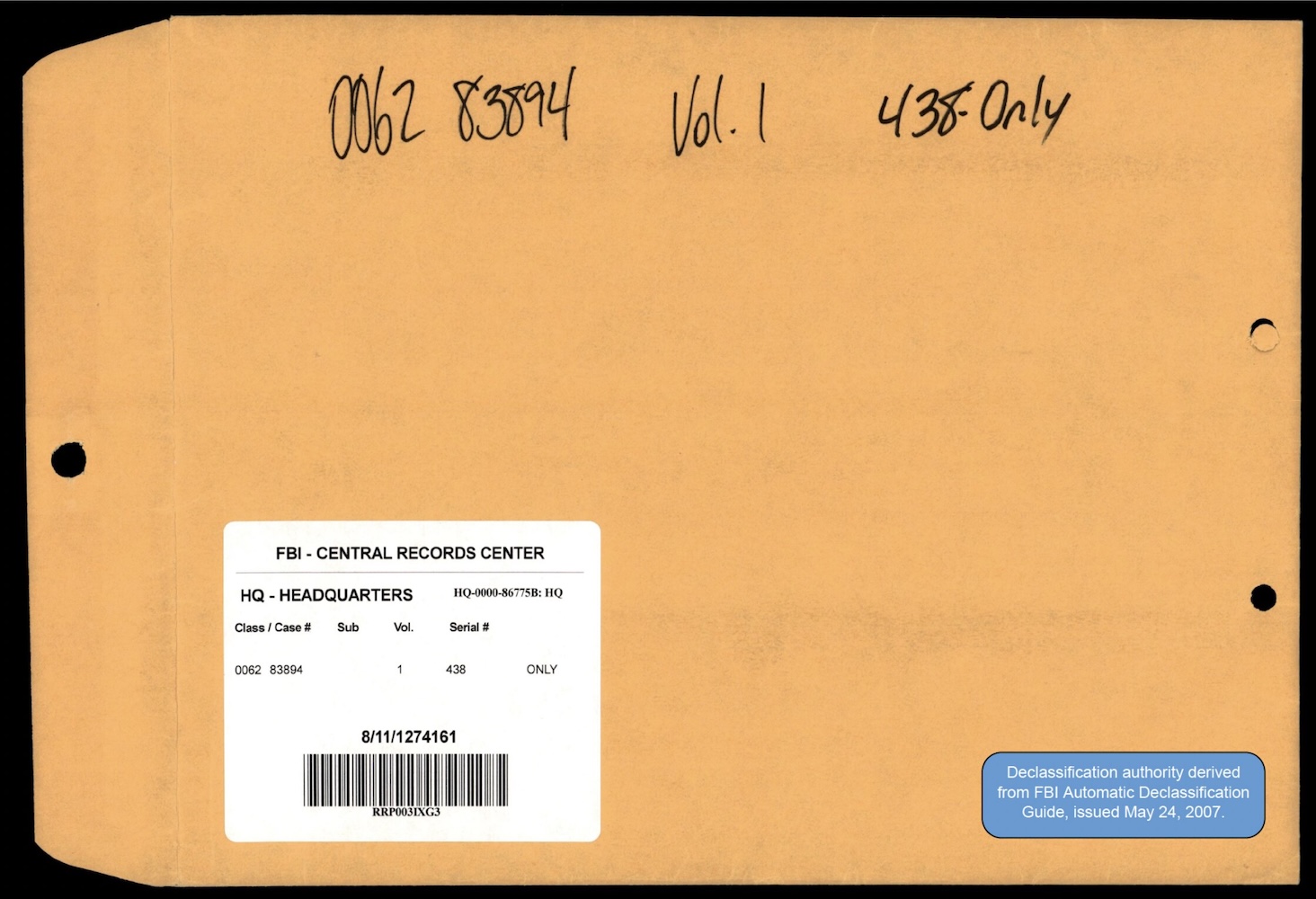
65_HS1-834228961_62-HQ-83894_Serial_438
FBI40 pagesMay 8, 2026RELEASE-01-FILE-014-65-HS1-834228961-62-HQ-83894-SERIAL-438

The FBI's 62-HQ-83894 case file includes investigative records, eyewitness testimonies, and public reports concerning Unidentified Flying Objects and flying discs documented between June 1947 and July 1968. The records include high-profile incident accounts, photographic evidence from sites like Oak Ridge, TN, and technical proposals regarding potential propulsion systems. Additional topics include convention programs, researcher accounts, and extensive media coverage from the period. This file is partially posted on FBI vault with more redactions and some pages missing. Included here is the complete case file with several newly declassified pages and only minor redactions.

🚨 The 1964 Lonnie Zamora UFO Incident occurred on April 24, 1964 near Socorro, New Mexico 👽🛸 Police officer sees a shiny object. Hears a roar. Spots “Two cowboys hanging from a clothesline” beside it. Then it lifts off slowly, shoots into the sky with a blue-orange flame, and vanishes. Ground left with four pod marks. Bushes burning… but ice-cold to the touch. Project Blue Book’s conclusion after checking EVERYTHING up to the White House? “Unidentified, pending additional data.” Best-docum...

From 1947 to 1969, the U.S. Air Force investigated over 12,000 UFO sightings under Project Blue Book. They successfully debunked the vast majority. But hundreds of cases remain officially classified as "Unknown" because the physical evidence simply wouldn't go away. ​Here are 3 of the most baffling historical cold cases that the military couldn't solve: ​1. The Socorro Landing Site (1964) This wasn't just a light in the sky. A police officer in New Mexico interrupted a physical landing. When...

Mention Velocity
30d agoToday
Source Mix
3items
Dr. Dan1
Interstellar1
r/UAP1
Related Signals
0