Probed ingest of: THE MISSING BIN: We Said SETI Couldn’t Hear a Probe. We Spent 163 Hours Reprocessing Their Data.
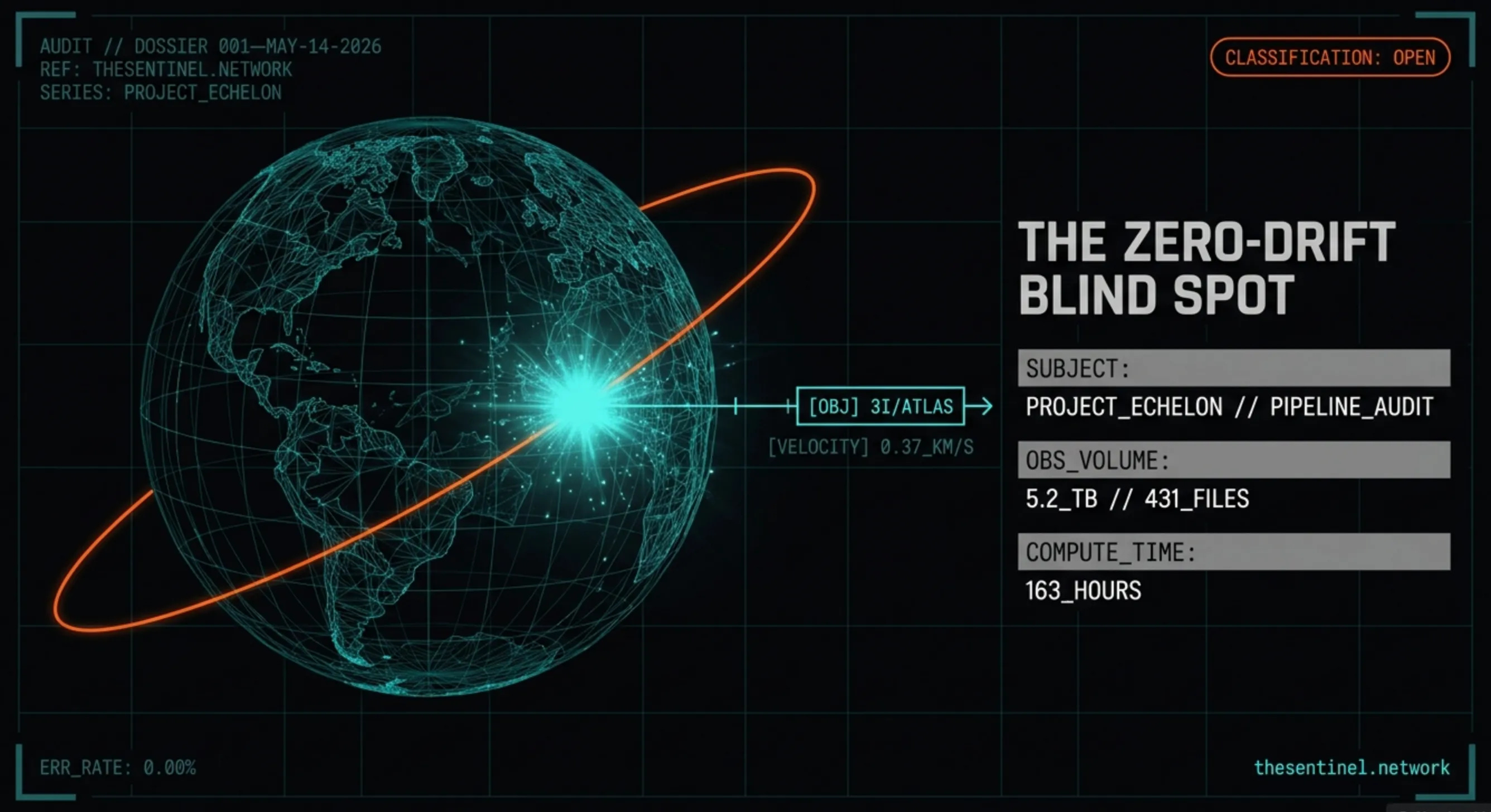
The Sentinel Network says its reprocessing of Breakthrough Listen 3I/ATLAS data found a possible zero-drift blind spot in turboSETI, a cadence-filter failure in its own pipeline, and 111,985 near-resolution-floor hits that it argues remain unchecked. The source says it has not found a signal and frames the issue as an incomplete null search, not a detection.
Source Claims
7- Source reportedAsserted
The Sentinel Network argues that turboSETI has a structural blind spot around zero drift based on its reprocessing of Breakthrough Listen 3I/ATLAS data.
In our pipeline, the cadence filter crashed in every stage.
- InterpretationAsserted
The Sentinel Network reports that 111,985 hits appeared at the resolution floor near zero drift and argues that these hits remain unchecked because the cadence filter failed in its reprocessing pipeline.
111,985 hits sit unchecked at the edge of the gap.
- Source reportedAsserted
The Sentinel Network argues that turboSETI’s drift-rate grid does not include an exact zero-drift bin, making the issue structural rather than a parameter setting.
turboSETI cannot search at zero drift.
- Source reportedAsserted
The Sentinel Network claims that the smallest drift rate turboSETI found was plus or minus 0.007289 hertz per second.
The smallest drift rate it found in the entire dataset was plus or minus 0.007289 hertz per second.
- Source reportedAsserted
The Sentinel Network reports that the cadence filter crashed due to a path mismatch in their pipeline.
The error was a path mismatch.
- Source reportedAsserted
The Sentinel Network reports that the maximum difference between the Eubanks and JPL drift-rate predictions was 0.0000005 Hz/s, and interprets that as eliminating its prior orbital-window hypothesis.
The maximum difference between the two orbits’ drift rate predictions is 0.0000005 hertz per second.
- InterpretationAsserted
The Sentinel Network argues that the search that produced the null result was incomplete in three specific ways.
We are not claiming to have found a signal. We are claiming the search that produced the null result was incomplete in three specific ways.
Structure Across Time
How the key people and organizations in this source are involved as events unfold. Built from the extracted timeline — co-appearance here reflects the source’s narrative, not verified coordination.
Publication of The Missing Bin
The Sentinel Network published The Missing Bin.
Publication of The Narrow Band
The Sentinel Network published The Narrow Band.
RELATED ENTITIES
(6)
Source Material
3Source Documents
3Research Map
Entities are linked when they share a claim or a dated event in this source. Tap any node to see why it’s here.
Deep probes
20Probed ingest of: THE COMPLEX: The Pentagon Just Published the 1949 Green Fireball Files. Our 2026 Coverage Says They Are Returning.
The Sentinel Network · May 27Probed ingest of: THE SIGNAL #007: THE PROBABILITY
The Sentinel Network · May 26Probed ingest of: THE CORPUS: NSA Argued This File Would Damage National Security. Page 236 Reads “Thirteen MIGs Chased One UFO.”
The Sentinel Network · May 21Probed ingest of: THE PRIORS: Kevin Patrick Childress Created a Reddit Account Before AATIP Broke.
The Sentinel Network · May 20Probed ingest of: THE REFRACTOR: A Pentagon Deadline for 46 UAP Videos Lapsed in Silence. The Same 46 Surfaced Elsewhere.
The Sentinel Network · May 7Probed ingest of: THE VIEWPORT: We Built 3I/ATLAS.
The Sentinel Network · May 6Probed ingest of: THE BAIT: A Fabricated Jupiter Impact Reached Our Inbox. Two Weeks of Verification Said No.
The Sentinel Network · May 4Probed ingest of: FIELDCRAFT #007 — THE PAPER WALL
The Sentinel Network · May 2