Probed ingest of: THE ROSTER: In 1927, a Radio Operator Sent a Signal Into the Sky. Something Sent It Back.
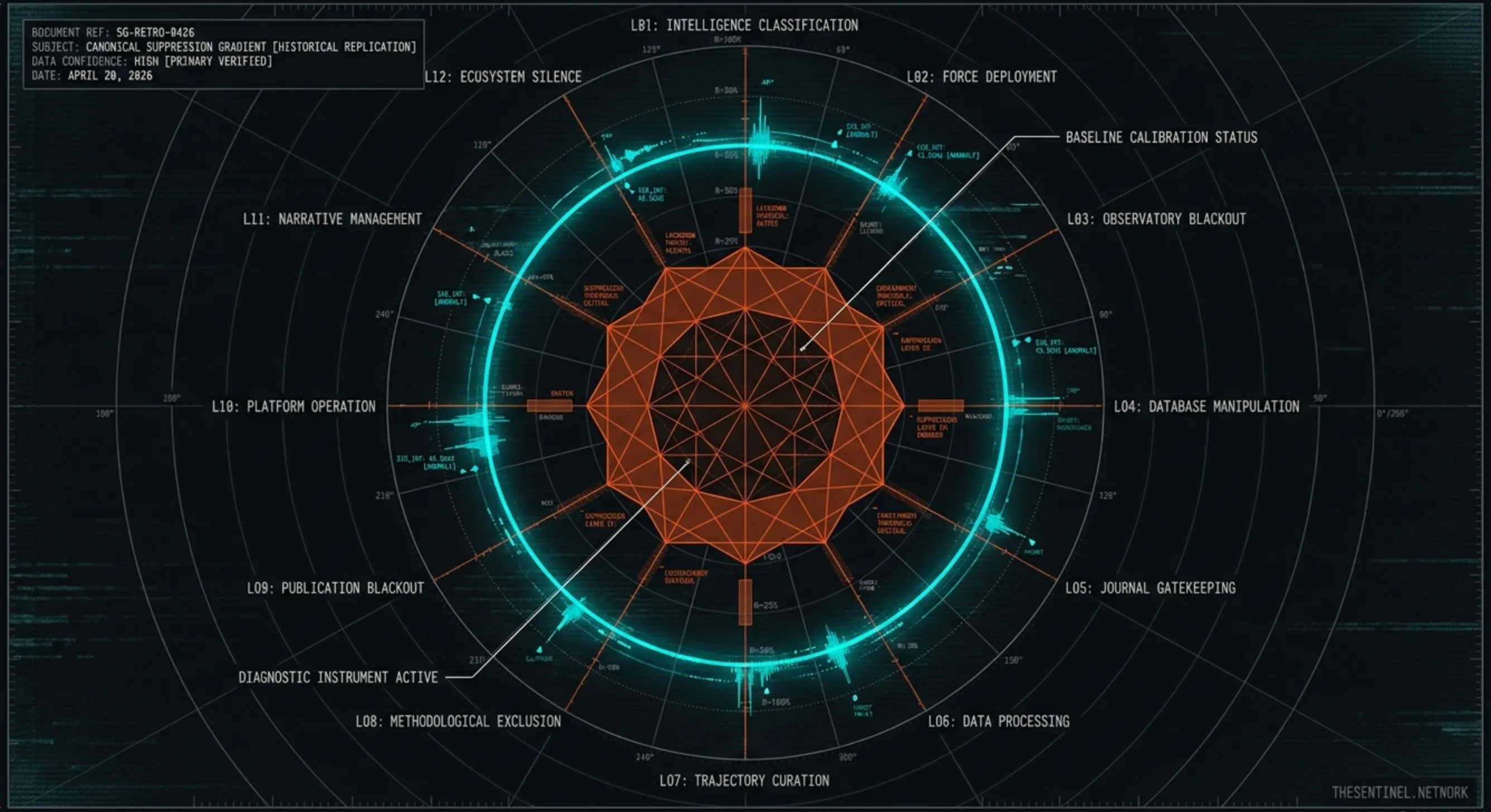
The Sentinel Network applies its “suppression gradient” framework to historical anomalous-signal cases, including long-delayed radio echoes, IM1, and 3I/ATLAS.
Source Claims
10- InterpretationAsserted
The Sentinel Network argues that long-delayed radio echoes documented beginning in 1927 became institutionally neglected after Ronald Bracewell proposed an interstellar-probe hypothesis in 1960.
It is a radio signal from 1927 that kept coming back, for fifty years, until someone proposed what it might be. Then the institutions stopped listening.
- InterpretationAsserted
The Sentinel Network describes its “suppression gradient” as a proposed framework for measuring institutional responses to anomalous data.
What we assert is that the institutional behavioral signature is measurable, repeatable, and diagnostic.
- InterpretationAsserted
The Sentinel Network says the framework is intended to evaluate institutional response patterns, not determine the nature of the underlying object or signal.
The framework does not tell you what an object is. It tells you what the system did when the object showed up.
- Source reportedObserved
The Sentinel Network reports that 3I/ATLAS was discovered on July 1, 2025.
3I/ATLAS was discovered on July 1, 2025.
- Source reportedAsserted
The Sentinel Network says its prior briefings identify twelve layers of institutional response to anomalous data.
Across ten published briefings, we documented twelve distinct layers of institutional response to anomalous data.
- Source reportedObserved
The Sentinel Network reports that IM1, an interstellar meteor, hit Earth on January 8, 2014.
The interstellar meteor that hit Earth. January 8, 2014.
- Source reportedObserved
The Sentinel Network reports that a U.S. Space Command memorandum signed by Lieutenant General John E. Shaw confirmed IM1’s interstellar trajectory.
U.S. Space Command confirmation of IM1’s interstellar trajectory arrived through a March 1, 2022 memorandum signed by Lieutenant General John E. Shaw.
- Source reportedObserved
The Sentinel Network reports that the phenomenon of long-delayed radio echoes was first documented by Jørgen Hals in 1927.
The first documented case was a Norwegian engineer named Jørgen Hals in 1927.
- Source reportedObserved
The Sentinel Network reports that simultaneous observations in Oslo and Eindhoven on October 24, 1928 supported the reality of the long-delayed radio echo phenomenon.
On October 24, 1928, simultaneous observations in Oslo and Eindhoven confirmed the phenomenon was real.
- Source reportedObserved
The Sentinel Network reports that Ronald Bracewell proposed in 1960 that long-delayed echoes might be transmissions from an autonomous interstellar probe.
In 1960, Stanford physicist Ronald Bracewell proposed in Nature that long-delayed echoes might be transmissions from an autonomous interstellar probe.
Structure Across Time
How the key people and organizations in this source are involved as events unfold. Built from the extracted timeline — co-appearance here reflects the source’s narrative, not verified coordination.
3I/ATLAS Discovery
3I/ATLAS was discovered.
IM1 Trajectory Confirmation
A U.S. Space Command memorandum reportedly confirmed IM1’s interstellar trajectory.
IM1 Meteor Impact
IM1 reportedly entered Earth’s atmosphere.
Bracewell Hypothesis
Ronald Bracewell proposed that long-delayed echoes might be transmissions from an interstellar probe.
LDE Confirmation
Simultaneous observations in Oslo and Eindhoven reportedly supported the long-delayed echo phenomenon.
First Long-Delayed Echo
Jørgen Hals documented the first long-delayed radio echo.
RELATED ENTITIES
(7)
Source Material
3Research Map
Entities are linked when they share a claim or a dated event in this source. Tap any node to see why it’s here.
Deep probes
20Probed ingest of: THE COMPLEX: The Pentagon Just Published the 1949 Green Fireball Files. Our 2026 Coverage Says They Are Returning.
The Sentinel Network · May 27Probed ingest of: THE SIGNAL #007: THE PROBABILITY
The Sentinel Network · May 26Probed ingest of: THE CORPUS: NSA Argued This File Would Damage National Security. Page 236 Reads “Thirteen MIGs Chased One UFO.”
The Sentinel Network · May 21Probed ingest of: THE PRIORS: Kevin Patrick Childress Created a Reddit Account Before AATIP Broke.
The Sentinel Network · May 20Probed ingest of: THE MISSING BIN: We Said SETI Couldn’t Hear a Probe. We Spent 163 Hours Reprocessing Their Data.
The Sentinel Network · May 14Probed ingest of: THE REFRACTOR: A Pentagon Deadline for 46 UAP Videos Lapsed in Silence. The Same 46 Surfaced Elsewhere.
The Sentinel Network · May 7Probed ingest of: THE VIEWPORT: We Built 3I/ATLAS.
The Sentinel Network · May 6Probed ingest of: THE BAIT: A Fabricated Jupiter Impact Reached Our Inbox. Two Weeks of Verification Said No.
The Sentinel Network · May 4