DARPA
OrgDARPA
OrgResearch agency developing advanced technologies for UAP detection and analysis.
Research agency developing advanced technologies for UAP detection and analysis.


DARPA is the Defense Advanced Research Projects Agency, the U.S. Department of Defense’s high-risk, high-reward science shop. Founded in 1958 in response to Sputnik’s challenge, it seeks to avoid being surprised by emerging technologies—while also creating technological breakthroughs that can redefine military and civilian capabilities. Its mission is not to build things itself but to fund, guide, and incubate programs across academia, industry, and government to push boundaries—from stealth aircraft and the early internet to neural implants and GPS.
These do more than reshape warfare; they often ripple outward, forming foundations for everyday tech.
The organization is structured around several technical offices, each overseen by program managers who are empowered to pursue ambitious projects often without clear near-term payoff. DARPA does not maintain large internal labs; instead it contracts out work, emphasizing prototyping, demonstration, and transition to users. In recent years it has expanded in areas like biotechnology (e.g. the Biological Technologies Office), which works on everything from brain–computer interfaces to synthetic biology, aiming to combine cutting-edge science with security relevance.
In the context of UAP (Unidentified Anomalous Phenomena), DARPA’s role, as reported, involves supporting or developing advanced detection, sensing, and tracking technologies. For example, its Aerial Dragnet effort was aimed at persistently detecting and tracking small unmanned aerial systems (UAS) in urban terrain. While officially focused on UAS threats, the capabilities overlap with what UAP‐observers say is needed: wide-area surveillance, distinguishing small fast-moving objects against complex backgrounds. DARPA also issues solicitations for spectrum monitoring and awareness programs to detect and attribute radio-frequency signals in contested environments—tasks relevant to identifying anomalous aerial or space phenomena.
What DARPA does not do—based on public records—is claim definitive knowledge about UAP origins, or confirm any recovered materials being non‐terrestrial. Its public work concentrates on what can be measured: sensors, detection, data acquisition, and analytic frameworks. Some researchers outside government attribute motivations to gather evidence, improve national security posture, or explore scientific unknowns. Others propose speculative themes—such as propulsion physics beyond current models—but those remain indirect to DARPA’s verified mission.
DARPA matters to the broader UAP/disclosure landscape because its work can reduce the unknowns. If detection systems get better, data improves, and more anomalies become measurable or reproducible, explanations may tilt toward aerospace, atmospheric, natural phenomena, or technology from other actors. For people tracking disclosure, DARPA sits at a hinge: it holds the capacity to shift debates out of anecdote and folklore and into engineering, sensors, instrumentation, and defense posture.
The precise boundaries of DARPA’s involvement in UAP are still a mix of reporting, speculation, and public contracts. What is on record shows investment in tools for sensing and attribution. What is alleged but not proven touches on recovered materials, anomalous phenomena investigations, or secret programs. DARPA may or may not be leading every effort, but what it does shapes what everyone else—even skeptics—can measure, verify, or doubt.
Special Access Required - the Secrecy of UFO Crash Retrieval Programs [VOL.2]

Another one who's not credible. But hey, Stewart and his claims provide engagement so that's all that really matters, right? An anonymous DARPA scientist. 👌🏼 https://t.co/fgmICgkHEO [Quoted] 🚨 DARPA SCIENTIST WARNING: "They are on their way." 🛸 A stunning claim emerges that DARPA has developed weaponry to brace for an imminent planetary invasion. The threat? They are returning for resources, equipment, and bodies. 👽"They don't care what we think, They are on https://t.co/eMOze5jm59


RT @InterstellarUAP: Bob McGwier: "Less than 10 people know the truth about UFO's & Aliens - I know 2 of those people" 👽🛸 Ex-CIA, NSA & DA…


Bob McGwier: "Less than 10 people know the truth about UFO's & Aliens - I know 2 of those people" 👽🛸 Ex-CIA, NSA & DARPA scientist revealed there are super users with extraordinary access to UFO-related programs. McGwier discusses how only a tiny number of individuals operate at the highest levels of these compartmentalized efforts. "There's 10 of them." He describes special access programs so restricted that even the President isn't briefed, where knowledge is limited to a handful of peopl...

Episode 398 w/ Bob McGwier (@BobMcGwier_N4HY) is available now. Bob is a PhD applied mathematician & engineer known for work with CIA, NSA & DARPA in digital signal processing, software-defined radio & cognitive radio. https://t.co/S3s2z3JdII

The Deep Ocean UFO That Caused the US Navy to Panic | Bob McGwier


"Casimir Inc, a company founded and led by former DARPA-funded NASA warp drive pioneer and founder of the EagleWorks Lab, Harold G. “Sonny” White, has exited stealth mode to announce the pending 2028 commercialization of MicroSparc, a chip that the company claims uses customized microscale geometries to capture unlimited ‘free’ energy from the quantum world." The article mentions this technology is available since 20th century, are we witnessing slow rollout of the zero point energy to the ma...

Free Energy from the Vacuum? Warp Drive Pioneer Unveils Battery-Free ‘MicroSparc’ That Allegedly Draws Power from the Quantum Vacuum
Casimir, founded by NASA & DARPA warp drive scientist Sonny White, has unveiled a chip that allegedly draws energy from the quantum vacuum.

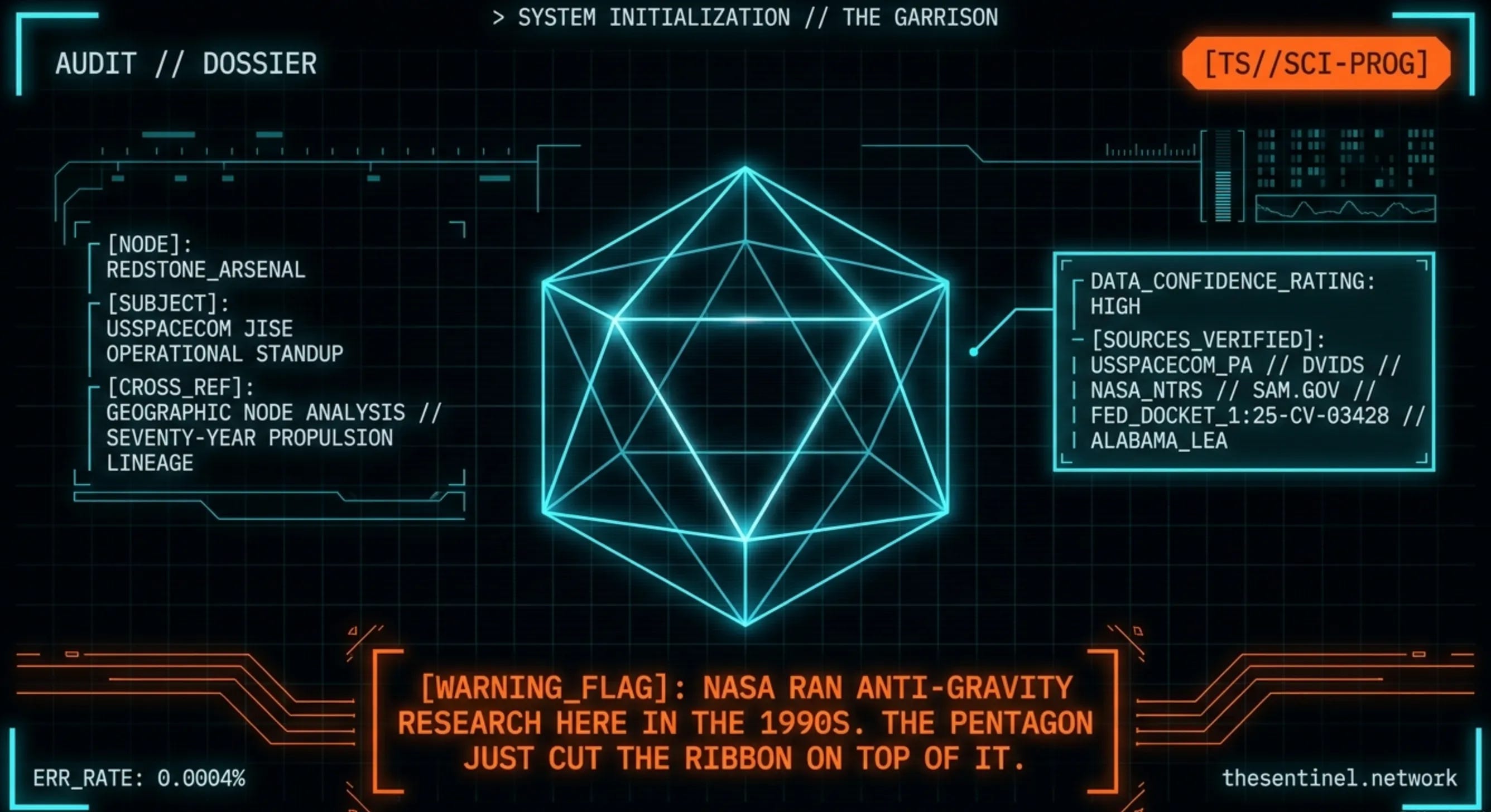
THE GARRISON: NASA Ran Anti-Gravity Research at Redstone in the 1990s. The Pentagon Just Cut the Ribbon on Top of It.
The Sentinel Network maps Redstone Arsenal as a convergence point for propulsion research, missile-and-space intelligence, and recent U.S. Space Command activity.

🚨THE LAYOVER🚨 He was 29. He led the sensors and controls team for the engine that takes humans to Mars. DARPA cancelled the program three weeks before he died. His Tesla sat at Huntsville International for four hours. Then it burned in a Walker County treeline. Our full investigation into Joshua Kyle Leblanc is live. 🔗👇

