A National Preparedness Framework for the Human Consequences of Disclosure
The Disclosure Foundation recommends a federal preparedness framework for the psychological, public-health, educational, and institutional consequences of future UAP disclosure. It proposes an HHS-led task force, an initial unclassified strategy within 120 days, privacy safeguards, clinical neutrality, scenario planning, independent research, and congressional oversight.
Search extracted document text
Probed searches extracted/indexed text and can show matching pages when page indexing is available.
Document Intel
Source status, provenance, and extraction context.
- Source / agency
- Disclosure Foundation
- Type
- Briefing
- Classification
- —
- Reference #
- Policy Brief No. 6
- Published
- 2026-07-30
- Content Type
- application/pdf
- Pages
- 9
Structured Analysis
Claims and source material extracted from the document text. Timeline context is surfaced in document intel.
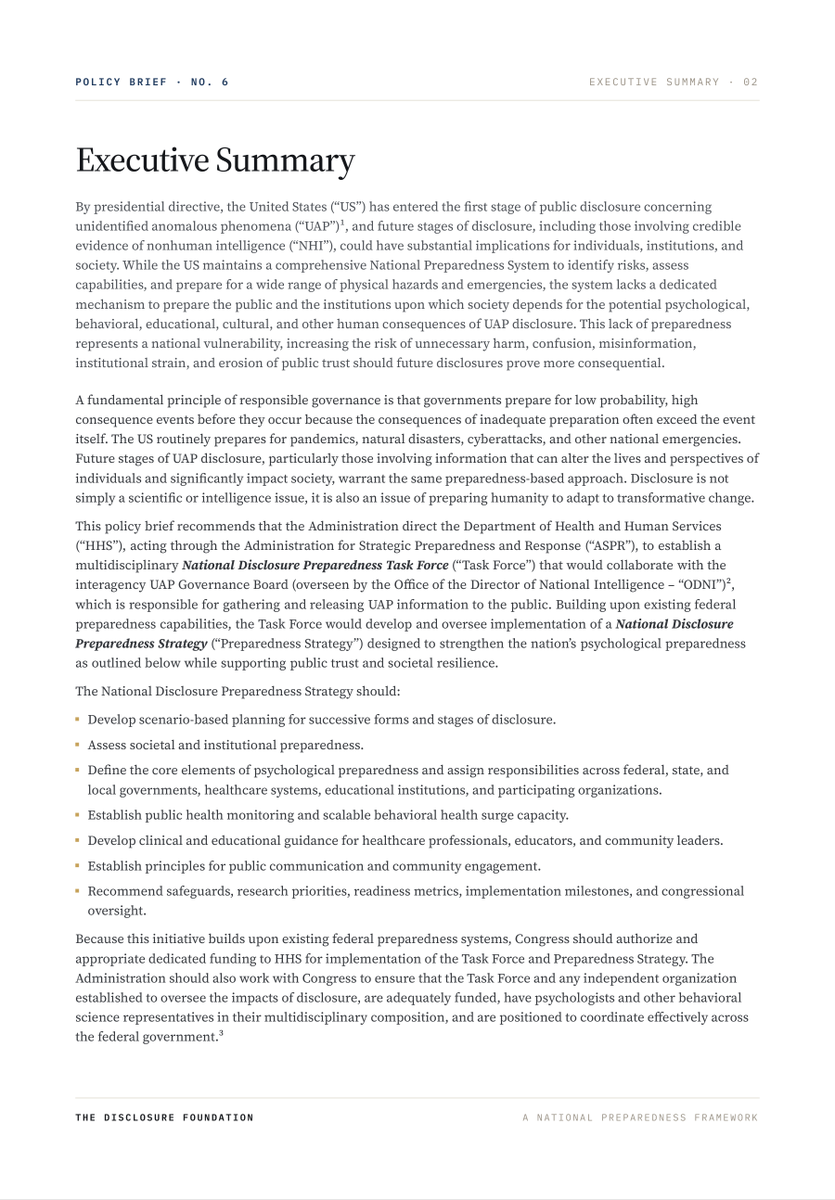
The brief states that a presidential directive has placed the United States in what it calls the first stage of public UAP disclosure.
By presidential directive, the United States (“US”) has entered the first stage of public disclosure concerning unidentified anomalous phenomena (“UAP”)
The authors identify a gap in existing federal preparedness systems for the psychological, behavioral, educational, cultural, and institutional consequences of future UAP disclosure.
the system lacks a dedicated mechanism to prepare the public and the institutions upon which society depends for the potential psychological, behavioral, educational, cultural, and other human consequences of UAP disclosure.
The brief recommends an HHS-led multidisciplinary National Disclosure Preparedness Task Force, operating through ASPR and collaborating with the UAP Governance Board.
This policy brief recommends that the Administration direct the Department of Health and Human Services (“HHS”), acting through the Administration for Strategic Preparedness and Response (“ASPR”), to establish a multidisciplinary National Disclosure Preparedness Task Force
The authors argue that preparedness planning need not endorse any conclusion about the origin, intent, or capabilities of UAP.
a national preparedness framework does not require the government to endorse any conclusion about the origin, intent, or capabilities of UAP.
The brief says a mature disclosure process should combine scientific rigor with intellectual humility.
a mature disclosure process requires both scientific rigor and intellectual humility.
The proposed Task Force would prepare for mental-health, educational, and societal consequences while leaving disclosure decisions to the UAP Governance Board.
The Task Forceʼs responsibility would not be to determine what information is disclosed, but to prepare the nation for the potential mental health, educational, and societal consequences of those disclosures.
The recommended Task Force would include expertise spanning psychology, behavioral science, public health, education, communications, emergency management, and religion.
The Task Force should be multidisciplinary in composition, including expertise in psychology, behavioral science, public health, education, communications, emergency management, religion, and other relevant disciplines.
The brief recommends that the Task Force publish an initial unclassified National Disclosure Preparedness Strategy within 120 days of its establishment.
Within 120 days of its establishment, the Task Force should publish an initial unclassified Preparedness Strategy
The proposed strategy would plan for record releases, disputed evidence, unauthorized disclosures, foreign or private disclosures, credible NHI confirmation, and mass sightings.
The strategy should address scenarios such as planned record releases, inconclusive or disputed evidence, abrupt or unauthorized disclosures, disclosures by foreign governments or private actors, credible confirmation of nonhuman intelligence, mass UAP or extraterrestrial sightings
The brief makes psychological preparedness the strategy’s central objective.
Psychological preparedness is the central objective of the strategy.
The authors caution that preparedness should build on resilience rather than assume widespread destabilization.
Preparedness should build on existing resilience rather than presume widespread destabilization.
The proposed monitoring framework includes privacy protections and would prohibit registries based on beliefs, religious interpretations, anomalous experiences, or lawful speech.
The framework should also protect individual privacy and prohibit registries based on beliefs, religious interpretations, anomalous experiences, or lawful speech
The clinical guidance calls for neutrality, neither reflexively pathologizing people nor uncritically validating contested claims.
Providers should neither pathologize reflexively nor validate contested claims uncritically.
The communications plan would explain the practical meaning of new information while avoiding sensationalism, premature reassurance, and unwarranted certainty.
Communications should explain what new information does and does not mean for immediate safety and daily life. They should avoid sensationalism, premature reassurance, and unwarranted certainty.
The brief recommends protection from ridicule, retaliation, and inappropriate psychiatric labeling for people who report UAP or other anomalous experiences.
The preparedness strategy should also protect people, including military personnel, scientists, and aviators, who report UAP, abductions, or other anomalous experiences from ridicule, retaliation, and inappropriate psychiatric labeling.
The authors conclude that the societal impact of future disclosure may depend more on preparedness than on the information alone.
The ultimate societal impact of future disclosures will depend less on the information itself than on how well the nation is prepared to understand, interpret, and adapt to it.
Chronology extracted from the document text.
Disclosure Foundation publishes Policy Brief No. 6
The Disclosure Foundation publishes its national preparedness framework authored by Jennice Vilhauer, Carlos Eire, and Christopher Mellon.
Government publishes consolidated UAP annual report
The brief cites the consolidated annual UAP report issued by the Office of the Director of National Intelligence and Department of Defense.
ODNI publishes preliminary UAP assessment
The brief cites the Office of the Director of National Intelligence’s preliminary assessment of unidentified aerial phenomena.
RAND publishes UFOs: What to Do?
The brief cites George Kucher’s RAND study as prior work relevant to preparation for extraordinary disclosure.
Brookings study examines the implications of peaceful space activity
The brief cites a Brookings Institution study as earlier work on the human implications of peaceful space activity.
Brief recommends publication of an initial preparedness strategy
The proposed Task Force would publish an initial unclassified National Disclosure Preparedness Strategy within 120 days of its establishment.

Referenced In Coverage
Investigative posts, source items, and other coverage that currently cite this document.

RT @disclosurefound: 🧵 The Disclosure Foundation has released a National Preparedness Framework for the Human Consequences of Disclosure,...
RT @disclosurefound: 🧵 The Disclosure Foundation has released a National Preparedness Framework for the Human Consequences of Disclosure, a…