1954 UFO Sighting
At Woomera in 1954, radar and visual observers reportedly tracked an unusual object during a weapons-range test, later cited in Australian UFO files.
The 1954 UFO Sighting refers to a weapons-range episode usually tied to the Woomera Test Range in South Australia, where military and technical personnel reportedly observed an object during a test involving a Canberra bomber. The case entered UFO history because it is described as a combined visual and radar report from a controlled defense setting, not a casual civilian sighting. That setting gives the story its weight, but it also requires restraint: much of the public account depends on later summaries of Australian defense files and UFO researchers who have interpreted those files.
The basic narrative is that observers at Woomera saw an object near an aircraft test and that radar operators also had an unusual track or return. In UAP literature, the event is often associated with the 1954 Woomera bomber test, a more specific range-test entry that frames the same setting around operations at the site. Woomera mattered because it was a major Anglo-Australian test complex, so an unexplained aerial contact there would have been noticed through a defense lens rather than treated as folklore.
The documented side of the case is the existence of Australian government interest in UFO reports and the presence of archival files that collected unusual sightings, including reports from military contexts. The claimed side is more specific: radar confirmation, multiple trained witnesses, and a strange object moving near or over a restricted weapons range. Those details are the reason the case is often promoted as one of the stronger public Australian reports, but the publicly accessible record still leaves major gaps about sensor configuration, exact timing, chain of reporting, and whether the object was ever matched to aircraft, weather, instrumentation error, or range activity.
The event is also a reminder that a defense range can make both sides of the argument stronger. On one hand, Woomera had trained personnel, instrumentation, and an operational reason to watch the sky closely. On the other hand, it had missile work, aircraft testing, balloons, optical tracking, and other activities that could complicate identification. A sighting in that environment is less likely to be ignored, but it is not automatically anomalous just because it occurred inside a military test area.
The strongest version of the case would require contemporaneous radar plots, observer logs, aircraft mission records, and any follow-up assessment by Australian defense or allied officials. The weaker version is that a later summary has preserved the dramatic parts while stripping out operational context that might explain the track. At present, the case is useful as an index point for Australian defense-era UFO files and the way older range reports circulate in modern disclosure discussion.
Probed read: The Woomera case is worth preserving because it links a named defense site, reported trained observers, and alleged radar confirmation. Its weakness is provenance. Without the full primary file, the public copy should treat the case as a reported range incident, not as established evidence of extraordinary technology.
What would move the assessment: A scan of the original Australian file, plus matching range logs and radar records, would materially improve confidence. A mundane range explanation in the same file would lower it; a clear chain of official handling with unresolved sensor data would raise it.


Two potentially significant cases that may be part of the 6th UFO Files release - Psicoactivo #1146

RT @TheUFOzzie: 🚨 Here is one of the BEST public UFO reports in history. 1954 at the Woomera Test Range in Australia. Radar and multiple wi…
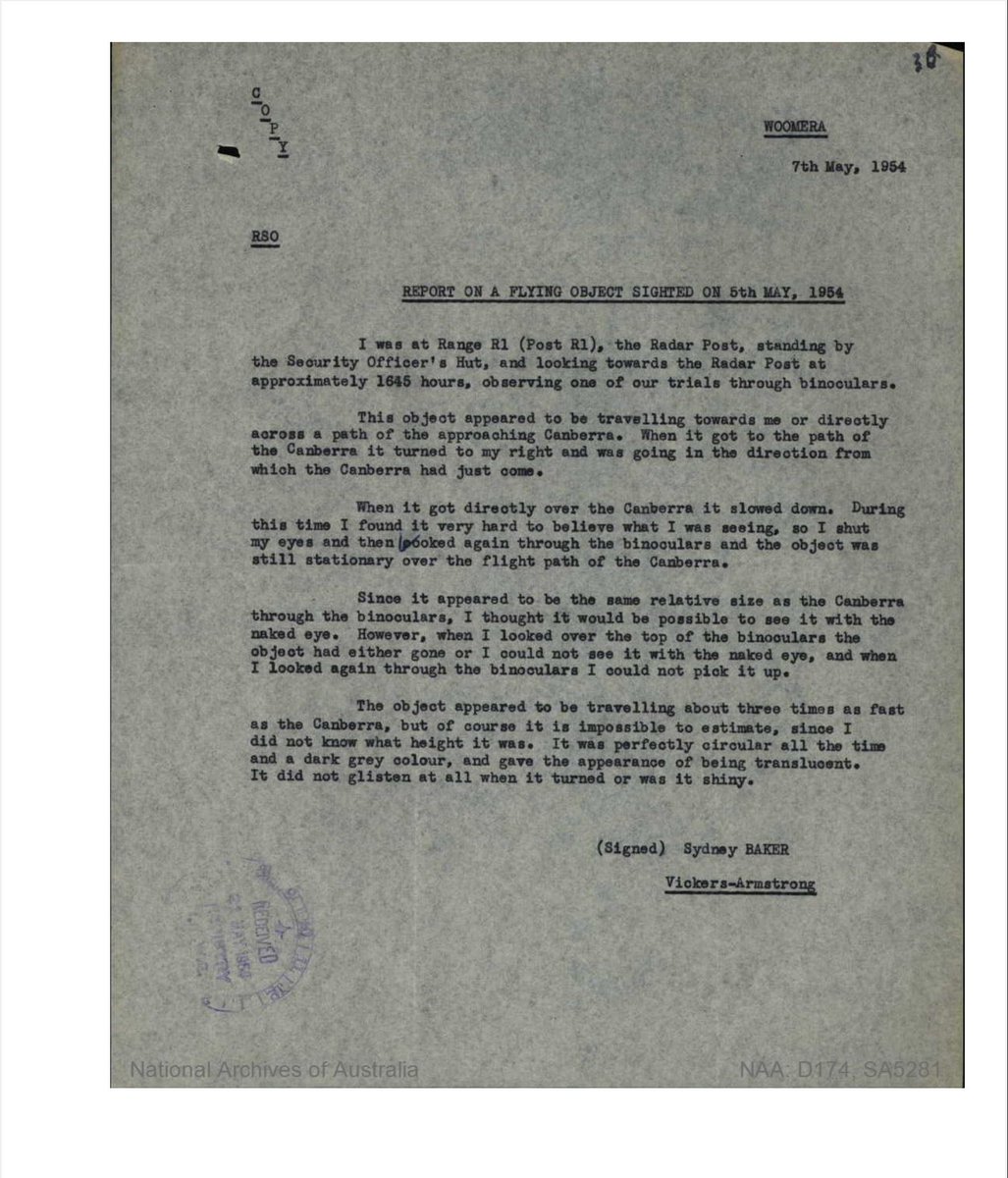

RT @TheUFOzzie: 🚨 Here is one of the BEST public UFO reports in history. 1954 at the Woomera Test Range in Australia. Radar and multiple wi…
