Oak Ridge National Laboratory
OrgResearch OrgOak Ridge National Laboratory
OrgResearch OrgOak Ridge National Laboratory is the Department of Energy's largest science and energy lab. It tested alleged UFO metal for AARO and is named in UFO crash-retrieval claims.
Oak Ridge National Laboratory is the Department of Energy's largest science and energy lab. It tested alleged UFO metal for AARO and is named in UFO crash-retrieval claims.


Oak Ridge National Laboratory (ORNL) is the largest science and energy laboratory of the U.S. Department of Energy, located in Oak Ridge, Tennessee, and managed for the department by the contractor UT-Battelle. It employs more than 7,500 scientists, engineers, technicians and support staff from more than 70 countries, and its work spans neutron science, supercomputing, isotopes, fusion and fission, physical and energy sciences, biology and the environment, and national security.
The laboratory was founded in 1943 as part of the Manhattan Project, beginning as a wartime research site built around a graphite reactor, and it has remained a center of nuclear and materials research ever since. That nuclear role put Oak Ridge on the early map of American UFO reports. In a March 1952 briefing released by the Department of War in September 2026, Air Force UFO investigator Edward J. Ruppelt described concentrations of reports around sensitive installations including Los Alamos, Albuquerque and Oak Ridge, while stressing that the Air Force had no conclusive evidence about the nature or origin of the phenomena.
In the modern era the laboratory has done materials analysis for the Pentagon's All-domain Anomaly Resolution Office. AARO contracted ORNL in 2022 to examine a layered magnesium, zinc and bismuth specimen promoted as debris from a 1947 crash and claimed to have extraordinary properties. ORNL's April 2024 summary, released by AARO that July, found the magnesium and lead isotope ratios within terrestrial values, concluded the material could not work as the claimed waveguide and judged its features consistent with mid-20th-century magnesium-alloy research. In January 2026 AARO published a second ORNL report, on a metallic specimen from private property in Ohio that allegedly had anomalous characteristics.
The laboratory also features in 2026 debates over alleged crash-retrieval programs. Sean Kirkpatrick joined ORNL in December 2023 as chief technology officer for defense and intelligence programs after stepping down as AARO's first director. Researcher UAP Gerb questioned a possible conflict of interest when AARO's 2024 contract for the Ohio specimen went to ORNL and asked why the laboratory's web page on Kirkpatrick's appointment had been removed. UAP Gerb also argues that Department of Energy laboratories run by contractors, including ORNL, are "the missing link in the UFO legacy program structure," able to shield recovered material under Atomic Energy Act secrecy. No released record identifies ORNL as holding such material.
Oak Ridge's place in UAP history is twofold: a nuclear site that drew Cold War sighting reports to Air Force investigators, and a government laboratory whose analysis of a widely publicized alleged crash fragment found ordinary terrestrial metal.

Part 18 of a series reassessing the documentary record behind the 1933 Magenta narrative. TL;DR The public history begins with anonymous shipments in 1996. The claimed 1947 recovery remains unverified. Nolan reported ordinary isotope ratios for Art’s Parts. His unusual-isotope claims concern other specimens. ORNL favors terrestrial manufacture. Puthoff and Davis accept key laboratory findings while disputing the proposed historical origin. Yates’s microscopy adds detail, but the proposed func...

Part 18 of a series reassessing the documentary record behind the 1933 Magenta narrative. TL;DR Anonymous 1996 shipments begin the public history. A 1947 recovery remains unverified. Nolan’s unusual-isotope claims concern other specimens. His 2022 Art’s Parts account reports ordinary ratios; the 2023 Bi/Mg atom-test attempt failed. ORNL favors terrestrial manufacture and rejects the proposed pure-bismuth waveguide. Puthoff and Davis accept technical findings while disputing historical attribu...

[Retweeted] Why did Sean Kirkpatrick delete his About Me page on the ORNL website?! 🙋♀️❔❓ The deletion was more than likely due to this bottom part showing the overlap of Mr. Kirkpatrick working with Glenn Gaffney on the Illegal Black Projects aka Waived Unacknowledged Special Access Program’s WUSAP “PROJECT RUBIK’S (RUBIX) CUBE” & “PROJECT IMMACULATE CONSTELLATION” at CIA / DIA "Dr. Kirkpatrick began his career in Defense and Intelligence related science and technology immediately out of g...

Probed ingest of: I Confront The Secretary of Energy On UFOs


🇺🇸 Rep. Eric Burlison says we are seeing the same UFO's at Oak Ridge, Los Alamos & White Sands 70 years on 🛸👽 In 1952, unexplained objects were being reported around Oak Ridge, Los Alamos, and White Sands. That same year, Project Blue Book chief Capt. Edward J. Ruppelt briefed Air Force investigators on silent, disc shaped objects that were highly maneuverable. He said the silence was the part that stood out, because they had no knowledge of any power plant that would be completely silent...

[Retweeted] In 1952, unexplained objects were being reported around Oak Ridge, Los Alamos, and White Sands. Seventy years later, we’re still asking many of the same questions. Seventy years is long enough. https://t.co/m33CCzWRiO

NEW: The 1952 “Flying Saucer Talk” is now public, and its discussion of nuclear sites deserves attention. Released today, the recording of Air Force Captain Edward J. Ruppelt’s March 26, 1952 briefing documents an investigation already grappling with reports of extraordinary speeds and UFO activity around sensitive American installations. Ruppelt described concentrations of reports around Los Alamos, Albuquerque and Oak Ridge. He also discussed accounts of silent, high-speed flight and radar...
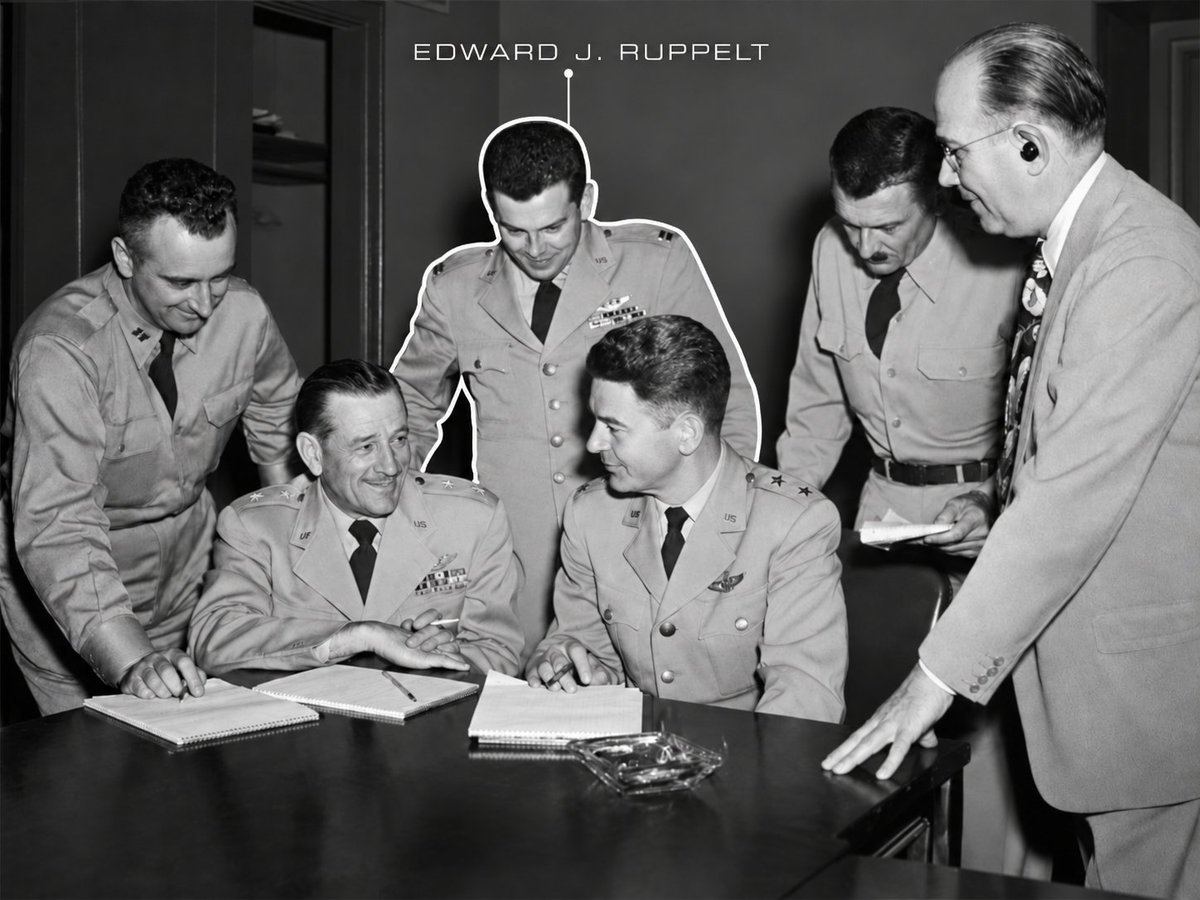

[Retweeted] An hour of Ruppelt's audio. This audio file records a March 1952 presentation by Captain Edward J. Ruppelt, outlining the U.S. Air Force’s reorganized investigation into unidentified flying objects (UFOs). The presentation previews prospective technical methodologies, such as diffraction-grating photography and radar-scope synchronization, that were subsequently incorporated into Project Blue Book, a U.S. Air Force program active from 1952 to 1969 that investigated the nature and...
[Retweeted] 1952: Captain Edward J. Ruppelt outlining the U.S. Air Force’s reorganized investigation into UFOs. 'Ruppelt explains that out of approximately 800 historical cases reviewed by the Air Force, approximately 20% remained unexplained after technical analysis. These unresolved reports were sourced from credible military personnel, commercial pilots, and other qualified technical observers. He highlights geographic report concentrations around sensitive national security and nuclear we...

Sceptics love to believe the U.S. simply shrugged its shoulders at the thought of being technologically outmatched by unknown objects outside its most sensitive [Quoted] 1952: Captain Edward J. Ruppelt outlining the U.S. Air Force’s reorganized investigation into UFOs. 'Ruppelt explains that out of approximately 800 historical cases reviewed by the Air Force, approximately 20% remained unexplained after technical analysis. These unresolved reports were sourced from credible military personnel...
