Pyramids & Megaliths
TopicPyramids & Megaliths
TopicMonumental structures built from stone or earth by diverse ancient societies, often recast in speculative narratives that discount documented human ingenuity.
Monumental structures built from stone or earth by diverse ancient societies, often recast in speculative narratives that discount documented human ingenuity.


Pyramids and megaliths are not one technology or a single cultural tradition. A pyramid is a monumental form built in many regions from different materials and for different purposes; a megalith is simply a large stone used in a structure or setting. Egypt’s royal pyramids, the temples and tombs of Mesoamerica, Andean ceremonial centers, European stone circles, and Göbekli Tepe arose in distinct societies separated by geography and often by millennia. Similar shapes can follow from stability, visibility, religious meaning, and the practical demands of building high with available materials.
Archaeology reconstructs these places through settlement remains, quarries, tools, inscriptions, burials, food waste, radiocarbon dates, and the organization of landscapes around them. Evidence near Giza documents worker communities and transport systems rather than a mysterious absent workforce. Göbekli Tepe demonstrates that hunter-gatherer communities could coordinate demanding stone construction, while Caral in Peru shows early monumental planning independent of Old World traditions. These discoveries revise our picture of ancient social organization without requiring a lost global civilization.
The monuments became central to ancient mysteries because their scale can appear incompatible with modern assumptions about preindustrial people. Ancient-astronaut narratives attribute engineering knowledge, astronomical alignments, or cultural origins to extraterrestrial teachers. Particular claims range from machine-like precision to alleged depictions of vehicles. Some sites do contain sophisticated surveying, quarrying, and celestial orientation, but those are subjects of material study; resemblance, numerical coincidence, or an unexplained construction detail does not establish an external designer.
Their real significance is more substantial than the mystery-market version. Monumental building reveals how communities mobilized labor, formalized ritual, marked authority, and transmitted technical knowledge. It also shows that innovation occurred repeatedly rather than descending from one source. Speculative interpretations remain part of modern media and UAP-and-religion discussion, especially where monuments are cast as beacons or evidence of contact. The distinction to preserve is between open archaeological questions—how a task was sequenced, financed, or symbolized—and claims that bypass the extensive human evidence already present at the sites.

🚨BREAKING🚨: The Pyramids are Chemical Factories “Step Pyramid: methane. Red Pyramid: ammonia… Within the Great Pyramid, we have sulfuric acid; hydrochloric acid within the central pyramid.” “Ammonia is probably one of the most important chemicals that was ever discovered and produced on an industrial scale.” “During the Saharan Humid Period, there were monsoon rains sweeping through the upper eastern Sahara. They were transforming the desert into a vast area of farmland.” “Weather modificat...


🚨BREAKING🚨: New theory suggests the Egyptian pyramids were industrial chemical manufacturing plants intended to produce the products necessary for agriculture and metalworking – the acid residue is still on the walls of the Great Pyramid. Geoffrey Drumm (@TheLandOfChem) is an independent researcher who has spent nine years building the case that the pyramids made fertilizer and industrial acids, powered by the earth's own electrical charge, and the chemistry backs him up. Samples taken from...


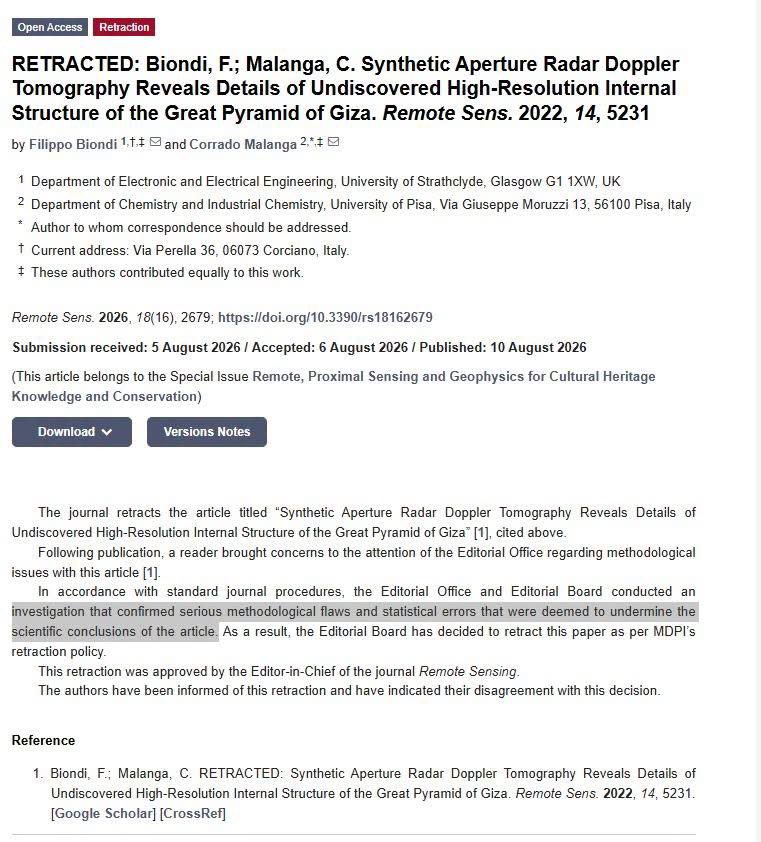
RT @Anyextee: 🚨 BIONDI’S GREAT PYRAMID RADAR PAPER HAS OFFICIALLY BEEN RETRACTED Biondi’s first published Great Pyramid SAR paper has now…