UAP Legislation
TopicUAP Legislation
TopicU.S. laws and legislative proposals governing UAP reporting, investigations, records preservation, whistleblower channels, and congressional oversight.
U.S. laws and legislative proposals governing UAP reporting, investigations, records preservation, whistleblower channels, and congressional oversight.



UAP legislation is the body of federal law and proposed law that moved unidentified-anomaly reporting from an intermittent military concern into a recurring oversight responsibility. Beginning with provisions in annual intelligence and defense authorization acts, Congress defined the subject, required reports, and created offices and procedures rather than legislating any conclusion about what UAP are. The distinction matters: statutory use of terms such as non-human intelligence records a category for inquiry, not a finding that such intelligence has been discovered.
The FY2022 National Defense Authorization Act directed the creation of an office to coordinate UAP collection and analysis; later amendments expanded that mandate into the All-domain Anomaly Resolution Office. Congress required annual unclassified reports, historical review, standardized reporting, and mechanisms for current or former government personnel to provide information. These provisions tied UAP to air safety, intelligence, counterintelligence, and possible technological surprise.
The enacted FY2024 National Defense Authorization Act also created a UAP Records Collection at the National Archives. Agencies must identify and transfer relevant government records, while postponements require stated legal grounds. That enacted framework was narrower than the proposed UAP Disclosure Act, which envisioned an independent review board, broader definitions, and authorities involving alleged recovered material. Similar disclosure and transparency bills have continued to be introduced, but a proposal’s appearance in legislative text should not be confused with passage.
The continuing debate concerns access and enforcement. Sponsors argue that unusual compartmentation and inconsistent recordkeeping can frustrate lawful oversight; agencies answer that sources, methods, and defense capabilities still require protection. Whistleblower safeguards and FOIA and transparency provisions address different channels and do not automatically declassify evidence. UAP legislation is most consequential where it produces durable institutions, preserved records, reporting duties, and deadlines that can be measured against actual agency performance.

Crashed UFOs are public property. https://t.co/JCIwTPegqK

[Retweeted] In 2023, the UAP Disclosure Act passed the Senate. Then conference stripped its teeth: the independent review board, subpoena power, gone. This year both chambers can send it to conference intact. That only happens if the Senate acts NOW. Tell your Senators to Pass the UAPDA in its current form. Use the link in the comments to take less than 1 minute to do so.

Mike Gold challenges secrecy surrounding UAP information

UAP Insiders Get Legal Green Light to Reveal Classified Information to PURSUE

Lue Elizondo Files Federal Lawsuit Against Former Friend & Business Partner

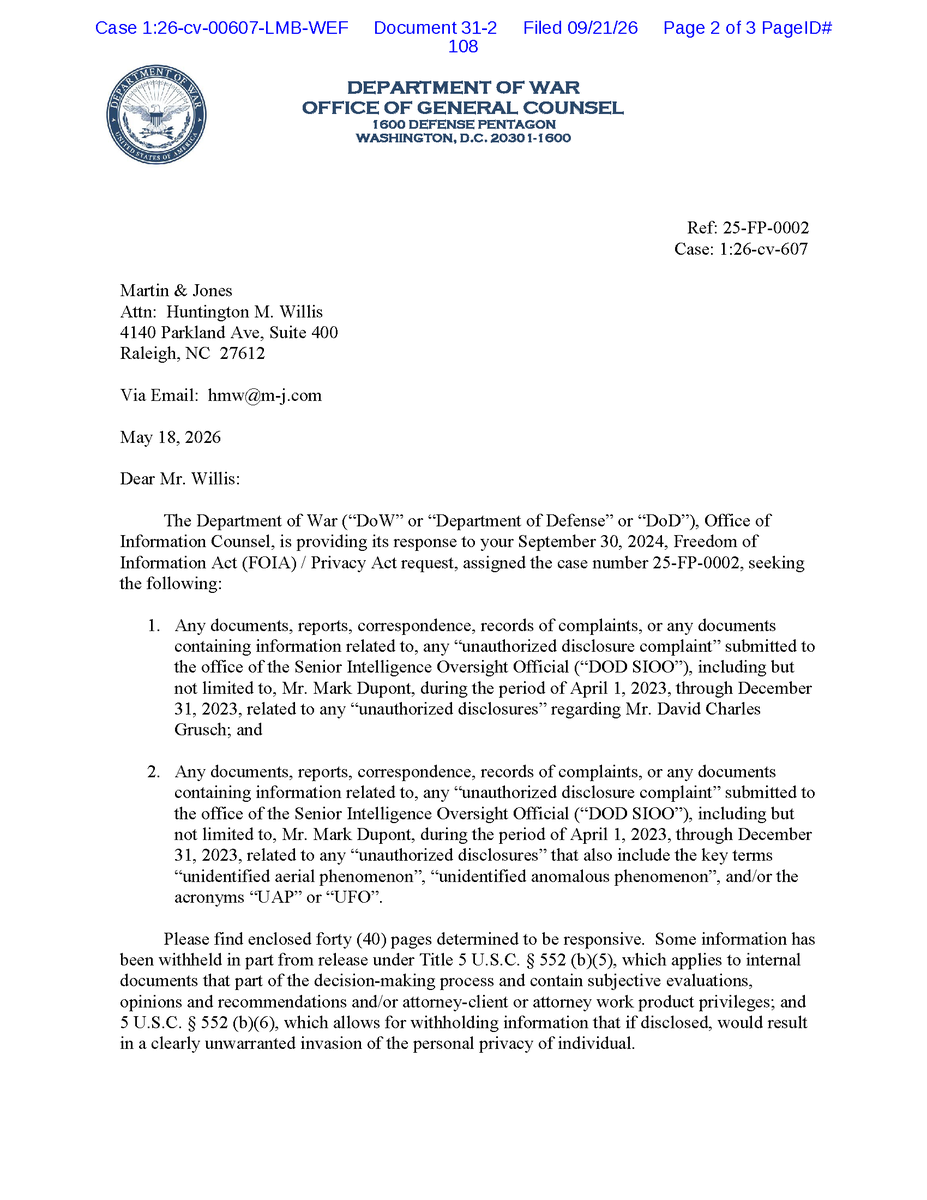
David Grusch's FOIA lawsuit update, compliments of @ddeanjohnson. See below. 👇 https://t.co/Pc3wCqjIRs [Quoted] UPDATE ON DAVID GRUSCH FOIA LAWSUIT The Department of Justice (DOJ), representing the Department of Defense (AKA Department of War) today (September 21, 2026) filed a motion for summary judgment in federal court, which if granted by the judge would end David Grusch's federal FOIA lawsuit against the Department of Defense. In his March 2026 lawsuit (Grusch v. Department of Defense,...

Tim Burchett says Stephen Miller called him from The White House & said bad people in the deep state are blocking the release of the UFO files. 🛸👽🇺🇸 “I've talked to Stephen Miller about this. He called me at the house, which was unusual” Congressman Tim Burchett just dropped a major update on the UFO and UAP files. Stephen Miller reached out to him directly and told him some people inside the departments are blocking the release. Burchett said Miller told him, “there's some people that ar...

Democratic allies must join forces in a consolidated global UAP disclosure movement 🌎🇯🇵🇺🇸 https://t.co/RcqiYfiZ0G [Quoted] DEMOCRATIC ALLIES MUST JOIN FORCES IN THE RACE FOR UAP DISCLOSURE REP. ERIC BURLISON, YASUKAZU HAMADA AND YOSHIHARU ASAKAWA·SEPTEMBER 16, 2026·6 MIN READ https://t.co/j9J6NG3GTx UFO問題は、オカルトではありません。 安全保障・危機管理の問題。自然科学・科学技術の課題。航空の安全の問題。情報公開・民主主義の問題。そして偏見や差別と戦う人権問題です。 日本オカルト協会は、オカルトマニアの方の会に見えますが、実は代表自ら情報会請求をしてもいます。そして私に最高顧問にという依頼をいただきました。 今の科学で解明出来ないこと、政府が開示しない情報に立ち向かうこと...
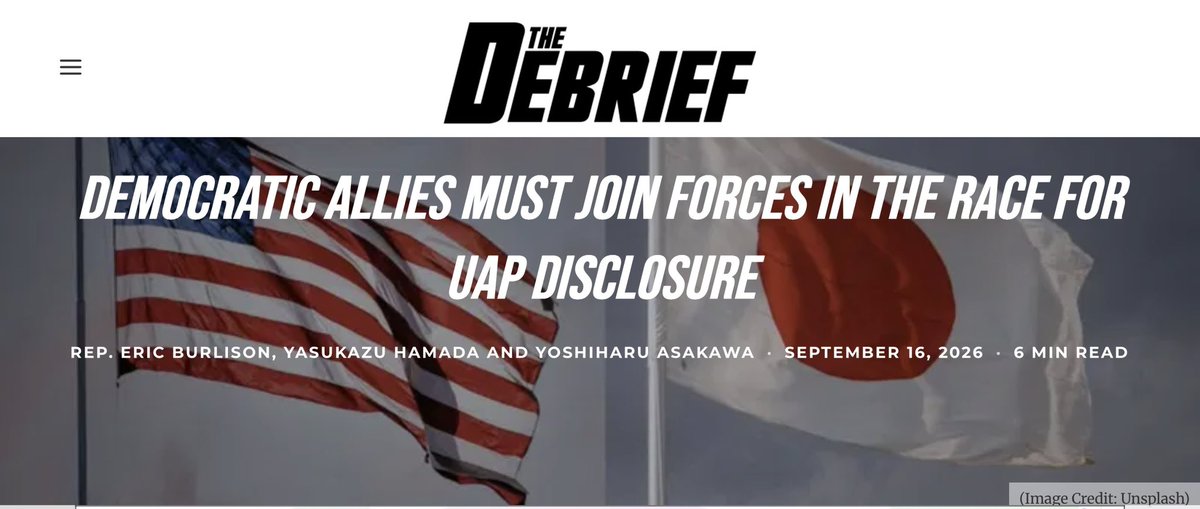
[Retweeted] DEMOCRATIC ALLIES MUST JOIN FORCES IN THE RACE FOR UAP DISCLOSURE REP. ERIC BURLISON, YASUKAZU HAMADA AND YOSHIHARU ASAKAWA·SEPTEMBER 16, 2026·6 MIN READ https://t.co/j9J6NG3GTx UFO問題は、オカルトではありません。 安全保障・危機管理の問題。自然科学・科学技術の課題。航空の安全の問題。情報公開・民主主義の問題。そして偏見や差別と戦う人権問題です。 日本オカルト協会は、オカルトマニアの方の会に見えますが、実は代表自ら情報会請求をしてもいます。そして私に最高顧問にという依頼をいただきました。 今の科学で解明出来ないこと、政府が開示しない情報に立ち向かうこと、これらの動きを政治が無視すれば、3.11の悲劇を繰り返すことになります。 あの大地震は想定されていました。国会議員は誰一人関心を待たず想定外と責任逃れをしました。 最新鋭のドローンかもしれないものを見つけた時に、国民はどこに情報を...

84% of Americans think the government is hiding what it knows about UAP. The House just passed legislation to address it. The Senate has weeks to act.
