
DOW-UAP-D048, Department of the Air Force Report, 1996
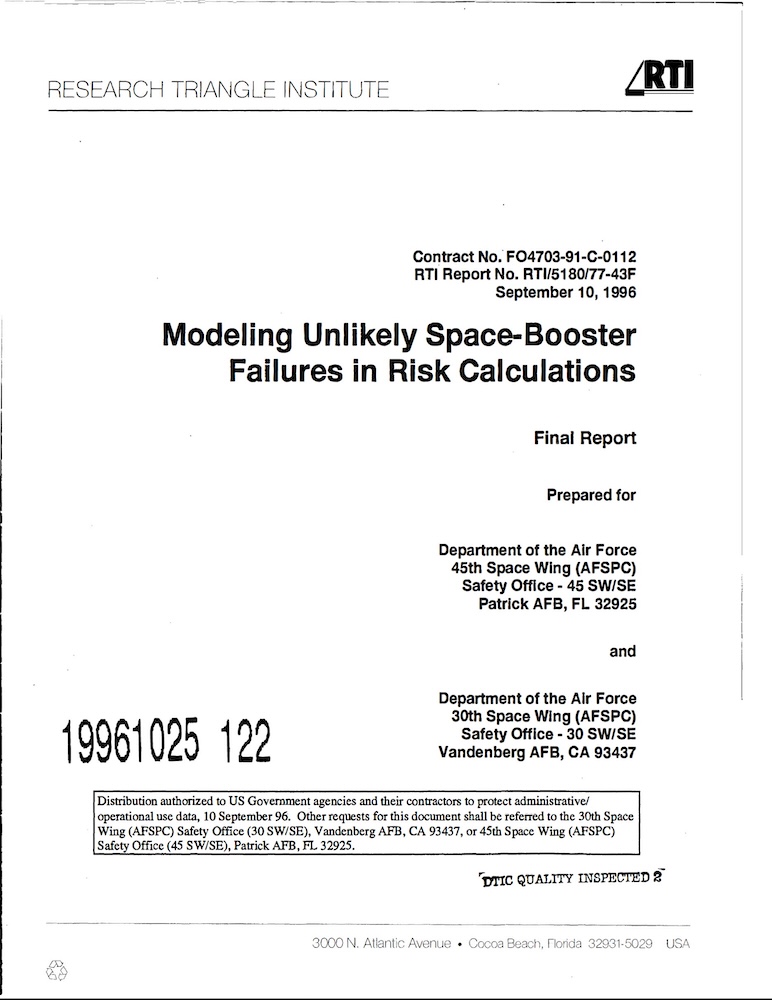
The report describes the modeling of unlikely space-booster failures in risk calculations. File: DOW-UAP-D048, Department of the Air Force Report, 1996. DOW-UAP-D048, Department of the Air Force Report, 1996 combines an official, downloadable document, 15 extracted claims, 4 evidence records, and 2 timeline entries across 181 source pages, and file-level provenance that can be compared with related release records.
- File
- Document · Release 01
- Date
- Sep 10, 1996
- Extent
- 181 pages
- Agency
- Department of War
Search This File
Probed Assessment
The report describes the modeling of unlikely space-booster failures in risk calculations. File: DOW-UAP-D048, Department of the Air Force Report, 1996.
Key takeaways
- The released record says mode-5 failure responses are much less likely to occur than those that result in impacts near the flight line.
- The report contains a listing and brief narrative failure history of the Atlas, Delta, and Titan missile and space-vehicle launches
- The released record says the Mode-5 impact-density function was developed to reflect unlikely vehicle failures causing impacts uprange or away from the intended flight line.
Why it matters
DOW-UAP-D048, Department of the Air Force Report, 1996 combines an official, downloadable document, 15 extracted claims, 4 evidence records, and 2 timeline entries across 181 source pages, and file-level provenance that can be compared with related release records.
Corroboration
For DOW-UAP-D048, Department of the Air Force Report, 1996, the release establishes official provenance but does not independently verify the record's statement that the report describes the modeling of unlikely space-booster failures in risk calculations.
Open questions
- • Which companion records, if any, independently corroborate the source claims extracted from this 181-page document?
Probed separates this editorial assessment from the source claims below. It summarizes what the released artifact supports; it is not independent verification.
Official Description from War.gov
This report describes the Modeling of Unlikely Space-Booster Failures in Risk Calculations, documenting historical launch failure modes and recommending corrective actions to address them using novel modelling techniques.
Preserved verbatim as source metadata. This wording is separate from Probed’s file-specific description and assessment.
File Context
Related entities
Release provenance
- Release
- Release 01
- Official ID
- release-01-file-056-dow-uap-d048-department-of-the-air-force-report-1996
- Cleared
- May 8, 2026
Referenced Timeline
End of Launch History Period
The end date for the launch history period covered in the report.
Report Date
The date the final report was completed.
Source Claims
Claims are attributed to the released source and remain distinct from Probed’s assessment and tracker findings.
The report describes the modeling of unlikely space-booster failures in risk calculations.
September 10, 1996 Modeling Unlikely Space-Booster Failures in Risk Calculations
Mode-5 failure responses are much less likely to occur than those that result in impacts near the flight line.
Although Mode-5 failure responses are much less likely to occur than those that result in impacts near the flight line, risk-analysis studies are incomplete without them.
The report contains a listing and brief narrative failure history of the Atlas, Delta, and Titan missile and space-vehicle launches.
An appendix to the report contains a listing and brief narrative failure history of the Atlas, Delta, and Titan missile and space-vehicle launches.
The Mode-5 impact-density function was developed to reflect unlikely vehicle failures causing impacts uprange or away from the intended flight line.
The Mode-5 failure-response, theoretical though it is, was developed to reflect the facts that: (1) unlikely vehicle failures
The document records that potentlal Future Investigations Because of contract limitations on funds and the deadline for publishing the report, certain interesting facets of the Mode-5 modeling process could not be fully investigated.
Potentlal Future Investigations Because of contract limitations on funds and the deadline for publishing the report, certain interesting facets of the Mode-5 modeling process could not be fully investigated.
The harness was pulled apart, so flight-control avionics was unable to maintain vehicle stability: Missile appeared normal until the IP stopped at 200 seconds.
The harness was pulled apart, so flight-control avionics was unable to maintain vehicle stability: Missile appeared normal until the IP stopped at 200 seconds.
The document records that since a good data match within ±40° of the flight line was not found, the effect of this on ship-hit calculations was investigated.
Since a good data match within ±40° of the flight line was not found, the effect of this on ship-hit calculations was investigated.
The document records that flight appeared normal until 102.7 seconds when the lube oil pressure on the B2 booster engine suddenly dropped.
Flight appeared normal until 102.7 seconds when the lube oil pressure on the B2 booster engine suddenly dropped.
The flight appeared normal to the safety officer until about this time when roll and pitch rates increased.
The flight appeared normal to the safety officer until about this time when roll and pitch rates increased.
The radar tracked till about 360 - 380 seconds, indicating a ballistic- type trajectory veering to the right.
The radar tracked till about 360 - 380 seconds, indicating a ballistic- type trajectory veering to the right.
The document records that booster stage and flight appeared normal until after booster staging at guidance enable at about 157 seconds.
Booster stage and flight appeared normal until after booster staging at guidance enable at about 157 seconds.
The effects of such changes can only be assessed objectively by further flight testing.
The effects of such changes can only be assessed objectively by further flight testing.
The vehicle continued flight till 221 seconds when erratic attitude rates were noted.
The vehicle continued flight till 221 seconds when erratic attitude rates were noted.
RTI has been tasked to estimate the probabilities of occurrence of less-likely failures.
Consequently, RTI has been tasked to estimate the probabilities of occurrence of these less-likely failures.
The document records that booster engines continued thrusting until about 123 seconds when the IIP stopped moving and radar operator reported multiple pieces.
Booster engines continued thrusting until about 123 seconds when the IIP stopped moving and radar operator reported multiple pieces.
Source Material & Evidence
RTI Report No. RTI/5180/77-43F
RTI Report No. RTI/5180/77-43F
Appendix A. Failure Response Modes in Program DAMP
Appendix A
Appendix D. Launch and Performance Histories
Appendix D
Table 6. Failure Probabilities for Atlas, Delta, and Titan
Table 6
Research Map
Lines appear only when two entities share a row-level source claim or dated timeline event. Unconnected nodes remain visible without implying a relationship.