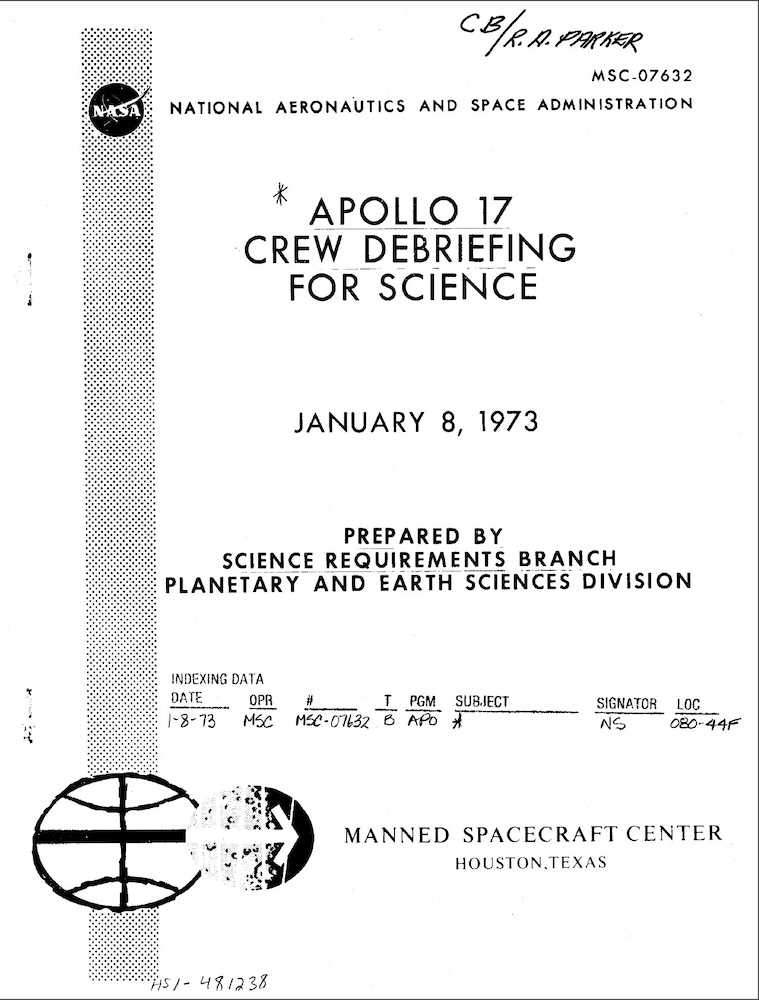

NASA-UAP-D005, Apollo 17 Crew Debriefing for Science, 1973
This Apollo 17 science-debriefing excerpt discusses unexpected ultraviolet and X-ray background observations and several possible interpretations. The speakers distinguish reflected hot-star light from a possible extragalactic component and separately discuss Lyman-alpha hydrogen measurements associated with OGO-5.
- File
- Document · Release 01
- Date
- Jan 8, 1973
- Extent
- 3 pages
- Agency
- NASA
Search This File
Probed Assessment
Key takeaways
- An X-ray background was observed over the sky that nobody had expected.
- The spectrum observed looks like the spectrum of a hot star, but there were no hot stars within the field of view.
- The most conservative interpretation is that the observed light is from hot stars in the galactic plane reflecting off interstellar dust.
Why it matters
NASA-UAP-D5, Apollo 17 Crew Debriefing for Science, 1973 is an officially released 3-page record with searchable page text, page-specific claim locators, dated events where supported, and document-level provenance.
Corroboration
The release establishes official provenance for NASA-UAP-D5, Apollo 17 Crew Debriefing for Science, 1973, but its reported observations, judgments, and interpretations remain source claims unless supported by independent records.
Open questions
- • Which companion records or contemporaneous sources, if any, independently corroborate the document’s key claims?
Probed separates this editorial assessment from the source claims below. It summarizes what the released artifact supports; it is not independent verification.
Official Description from War.gov
Apollo 17 was the ninth crewed U.S. mission to the Moon, and the sixth to land Astronauts on the lunar surface. This document is an excerpt from the Apollo 17 Crew Debriefing for Science on January 8, 1973, in which Dick Henry, co-investigator on the ultraviolet experiment on Apollo 17, discusses seeing results that were unexpected. • Pages 119-120. “One of the most exciting results of X-ray astronomy was the fact that an X-ray background was observed over the sky that nobody had expected, and part of this is the gamma-ray background that Dr. Trombka talked about. In the UV, nobody knows, but you never know until you look. You do have to deal with this background of stars that we know is there. So, we did look at a large number of different points at high galactic latitudes, both north and south. The spectrum that we see is above this dark count. In other words, this abnormally high dark current did not, in fact, interfere with that experiment. The spectrum that we see looks like the spectrum of the hot star; however, we know that there were no hot stars within our field of view. Therefore, the most conservative interpretation, I think, is that what we're seeing is light from hot stars in the galactic plane going up out of the plane and reflecting off interstellar dust. There are certain characteristics of the spectrum, though, that don't fit that theory, and it's at least possible that this is extragalactic radiation. I'm looking forward very much to the detailed computer study of this, but it's going to take a long time.”
Preserved verbatim as source metadata. This wording is separate from Probed’s file-specific description and assessment.
File Context
Related entities
Release provenance
- Release
- Release 01
- Official ID
- release-01-file-143-nasa-uap-d005-apollo-17-crew-debriefing-for-science-1973
- Cleared
- May 8, 2026
Referenced Timeline
Apollo 17 Crew Debriefing for Science
The cover page dates the science debriefing to January 8, 1973.
Source Claims
Claims are attributed to the released source and remain distinct from Probed’s assessment and tracker findings.
An X-ray background was observed over the sky that nobody had expected.
One of the most exciting results of X-ray astronomy was the fact that an X-ray background was observed over the sky that nobody had expected.
The spectrum observed looks like the spectrum of a hot star, but there were no hot stars within the field of view.
star; however, we know that there were no hot stars within (CONT'D) our field of view. Therefore, the
The most conservative interpretation is that the observed light is from hot stars in the galactic plane reflecting off interstellar dust.
Therefore, the most conservative interpretation, I think, is that what we're seeing is light from hot stars in the galactic plane going up out of the plane and reflecting off interstellar dust.
It is possible that the observed spectrum is extragalactic radiation.
There are certain characteristics of the spectrum, though, that don't fit that theory, and it's at least possible that this is extragalactic radiation.
Lyman-alpha hydrogen radiation is a separate problem observed from OGO-5.
Lyman-alpha hydrogen radiation is a completely separate problem, and Gary Thomas at the University of Colorado and Charles Barthum [?] observed this from OGO-5.
Hydrogen inside our solar system is sunlight reflecting off it.
This is hydrogen that is inside our solar system. It's sunlight reflecting off this.
Hydrogen from interstellar space is streaming through the solar system.
The hydrogen, Gary Thomas thinks, is hydrogen from interstellar space streaming through the solar system.
Source Material & Evidence
Research Map
Lines appear only when two entities share a row-level source claim or dated timeline event. Unconnected nodes remain visible without implying a relationship.