Robertson Panel

Event

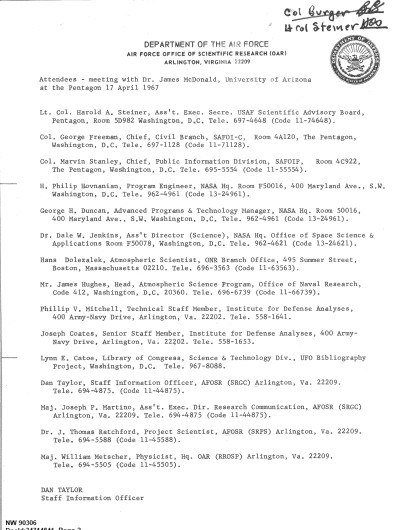
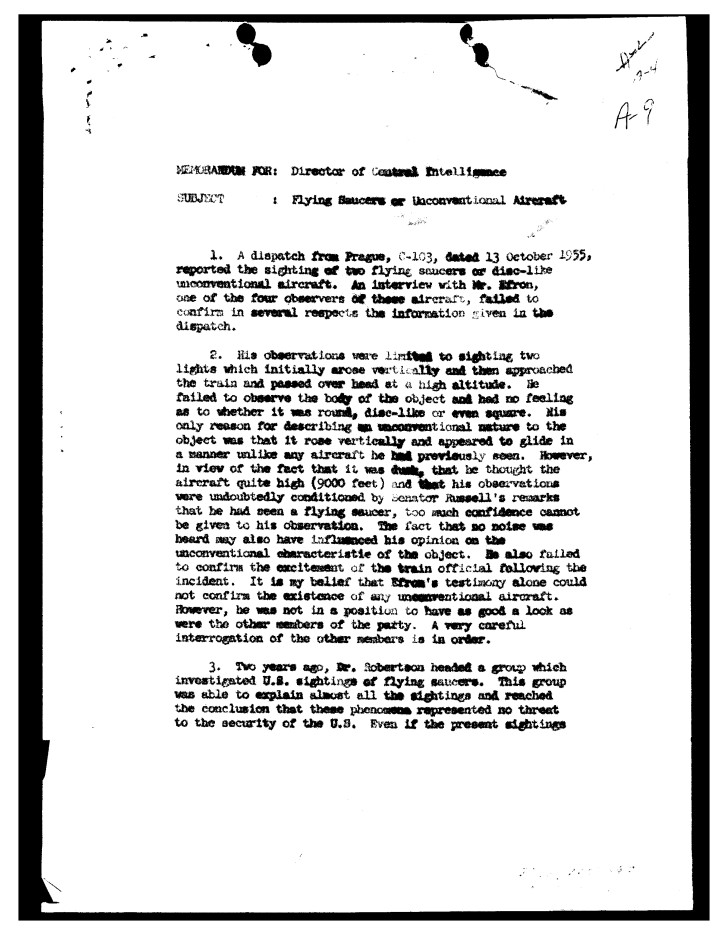
In January 1953, the CIA convened the Robertson Panel to review major UFO reports and assess national-security implications. Its recommendations—rapid debunking, media “education,” and monitoring civilian UFO groups—shaped U.S. policy and disclosure

CIA Headquarters, Langley, Virginia, USA
investigation
7
Mentions (30d)
1
Active Signals
11
Sources
167
Co-mentions
30-Day Activity7 mentions
May 26Jun 24
Source material mix
Opinion9Named sources2Official doc2
Event LocationCIA Headquarters, Langley, Virginia, USA
Probed Analysis

The Robertson Panel was a CIA-convened scientific advisory review held in January 1953 to examine major UFO reports and weigh any national-security implications. It matters less as a forensic adjudication of individual sightings than as an inflection point in how the U.S. security state chose to manage the UFO topic as an information problem. On-record, the panel is associated with recommendations that prioritized rapid debunking, public “education” through media channels, and the monitoring of civilian UFO groups. Those recommendations—whether read as prudent counterintelligence hygiene or as the first formalization of “perception management” around UFOs—became a durable reference point for both policy history and later disclosure debates.

For analysts, the panel is a case study in how ambiguous, high-volume reporting can be reframed into a governance issue: not “what is it,” but “what does widespread belief do to readiness, public trust, and information control.”

The basic facts are narrow and stable: the panel was convened by the CIA in January 1953, and its remit was to review prominent UFO reports with national-security in view. Beyond that, discussions often drift into interpretation—what the panel “really” believed about anomalous cases, and whether its posture was driven by genuine threat assessment or institutional convenience. The most defensible reading stays close to the observable output: a set of recommendations about debunking and shaping public understanding, and a posture toward civilian UFO organizations as entities worth watching. That alone signals that the CIA treated the UFO subject as a potential vector for broader effects, not merely an eccentric public fascination.

What the panel did not do, at least in the way it is often portrayed, was “solve” UFOs. The available framing emphasizes review and assessment rather than definitive explanation of every report. The panel’s relevance comes from its downstream influence: it provided a logic for handling UFO claims that could be applied regardless of whether any given case was mundane, misperceived, or genuinely unresolved. That policy utility is precisely why the Robertson Panel is repeatedly invoked in disclosure discourse: it sits at the junction where uncertainty meets state preference for controllable narratives.

Information-control as national security policy is the panel’s most distinctive signature. The recommendations attributed to it—rapid debunking and media “education”—imply a belief that belief itself can be operationally consequential. Even without assuming malice or a hidden agenda, this reflects a common intelligence posture: when a phenomenon generates noise at scale, the system seeks to reduce noise, triage attention, and deter mass distraction. In UFO terms, the panel becomes an early exemplar of “debunk first, investigate selectively,” a stance that can be defended as pragmatic but that also carries predictable costs in public credibility.

The recommendation to monitor civilian UFO groups is especially revealing, because it is not about lights in the sky; it is about people on the ground. On-record, this suggests concern that organized civilian networks could amplify rumors, create panics, or be leveraged—deliberately or inadvertently—by hostile actors. This is an attributed rationale; it does not require the panel to have concluded that UFOs were extraterrestrial, advanced foreign technology, or anything else. It only requires a judgement that UFO communities were information multipliers operating outside official control channels.

Analytically, the panel’s output can be separated into three policy moves that are often conflated:

  • A debunking posture meant to collapse ambiguous reports into benign explanations quickly.
  • A media-facing “education” posture meant to shape public interpretation and dampen spread.
  • A counterintelligence posture toward civilian groups as nodes to be monitored, not partnered with.

Each move has different implications for how a state treats anomalous reporting. Debunking reduces workload; education reduces demand for answers; monitoring reduces uncertainty about the human network that carries the story. Together, they amount to a containment strategy.

The contested terrain begins when observers treat containment as proof of concealment. Some interpret the panel as evidence that the government had extraordinary information and chose deception; others view it as evidence that the government had uncertainty and chose risk management. The provided bio supports the latter at minimum: it specifies review of major reports and assessment of national-security implications, then points to recommendations about debunking and monitoring. Claims beyond that—such as the panel suppressing conclusive evidence of non-human technology—are not established by what is on-record here and should be treated as speculative unless independently documented.

Still, it is reasonable to note an institutional asymmetry that the panel helped formalize. Once a government adopts rapid debunking as a default public posture, it creates an environment where unresolved cases are handled quietly and resolved cases are publicized loudly. That asymmetry does not prove a cover-up; it does, however, predict persistent suspicion. It also incentivizes self-selection: witnesses who expect dismissal report less, and citizen researchers interpret official dismissals as performative, reinforcing parallel epistemic communities.

The Robertson Panel also sits inside a recurring pattern in intelligence governance: when a phenomenon produces high report volume with low signal clarity, institutions often prefer narrative stability over open-ended inquiry. In that sense, the panel’s legacy is not a single memo or meeting but a framework for managing ambiguity. The framework tolerates unanswered questions as long as the social and operational consequences are kept within acceptable bounds. In public memory, this can look like evasion; internally, it can look like discipline.

For an intelligence-focused disclosure platform, the panel is best treated as a hinge point rather than a smoking gun. The hinge is the explicit alignment of UFO handling with national-security objectives that are not purely technical—public perception, media channels, and civilian organization mapping. That alignment is an observable choice, regardless of what one believes about the underlying phenomenon. It also establishes a baseline assumption that persists in later debates: that UFO discourse itself can be a threat surface.

The open analytical questions are less about what flew overhead in any specific case and more about how policy choices shaped long-term collection and trust. If rapid debunking becomes the public-facing norm, what internal mechanisms ensure that genuinely anomalous reports still receive competent review? If civilian groups are monitored as potential risks, what channels—if any—remain for constructive external reporting without stigma? The Robertson Panel is where those tensions become visible, and it remains a reference point because it captures a government deciding that managing the story was part of managing the sky.

Event Timeline
23h ago
When the state made ridicule official policy
NewsNation
1d ago
The impact of disclosure: John Priestland, Dr. Martin Abbas on psychology of contact | Reality Check
NewsNation
4d ago
Hollywood, The CIA & UFOs: The History Beyond Spielberg
American Alchemy
5d ago
Special Access Required - the Secrecy of UFO Crash Retrieval Programs [VOL.2]
UAP Gerb
Jun 4
Steven Spielberg and Close Encounters of the Third Kind
Red Panda Koala
May 31
The CIA's January 1953 Robertson Panel put the word "debunking" in quotation marks in its formal recommendations. Five physicists in four days designed the public posture the government has used on UFOs ever since.
r/UAP
May 28
aliens.gov is the biggest attempt at narrative control in the history of UFOs
r/UFOs
May 13
The UFO topic was deliberately stigmatized by the U.
Disclosure Party
May 12
RT @MvonRen: H.
Jesse Michels (American Alchemy)
May 12
RT @MvonRen: H.
UAP News Center
Apr 21
The CIA Robertson Panel and Hollywood?
Stellar Productions
Apr 16
Disney is the number one producer of content about aliens with Marvel, Star Wars, Aliens, Avatar, X-Files, etc.
Bryce Zabel
Apr 16
#9 MAJIC KINGDOM — Ad Free! — Sound, Light & Frequency
Stellar Productions
Filters
Time Range
media23h ago

When the state made ridicule official policy

media1d ago

The impact of disclosure: John Priestland, Dr. Martin Abbas on psychology of contact | Reality Check

independent4d ago

Hollywood, The CIA & UFOs: The History Beyond Spielberg

independent5d ago

Special Access Required - the Secrecy of UFO Crash Retrieval Programs [VOL.2]

independentJun 4

Steven Spielberg and Close Encounters of the Third Kind

I spent eight years in the Navy as an Operations Specialist, four of them running the Fleet Air Defense Identification Zone in the Eastern Pacific. The job was contact resolution. I've been working through the declassified UAP record the way I'd work a watch, by reading what the documents actually say. On July 2, 1952, Navy Chief Warrant Officer Delbert C. Newhouse, a career Navy photographer, filmed about a minute of bright objects moving in formation over the Bonneville Salt Flats in Utah....

The mods deleted my other post so I am testing another angle. Today the White House launched an immigrant arrest tracker after teasing "aliens.gov", while they are also engaged in an unprecedented release of documents and videos related to UAP. One of the recurring themes in the history of UFOs is narrative control. The 1953 Robertson Panel recommended reducing public interest in flying saucers, because public fascination IN ITSELF was viewed as a potential national security problem. Since th...

The UFO topic was deliberately stigmatized by the U.S. government, as documented in the 1953 CIA Robertson Panel, which means that public skepticism about this topic was manufactured by the state. https://t.co/fpA8vufRxy

RT @MvonRen: H.P. Robertson led the CIA panel* that made “debunking” UFOs official U.S. policy. *Largely unknown: Robertson studied “foo f…

RT @MvonRen: H.P. Robertson led the CIA panel* that made “debunking” UFOs official U.S. policy. *Largely unknown: Robertson studied “foo f…

Mention Velocity
30d agoToday
Source Mix
13items
NewsNation2
Stellar Productions2
American Alchemy1
UAP Gerb1
Red Panda Koala1
r/UAP1
r/UFOs1
Other Sources (4)4