
CIA-UAP-D021 — Analysis of Unconventional Aircraft Sightings, 1955
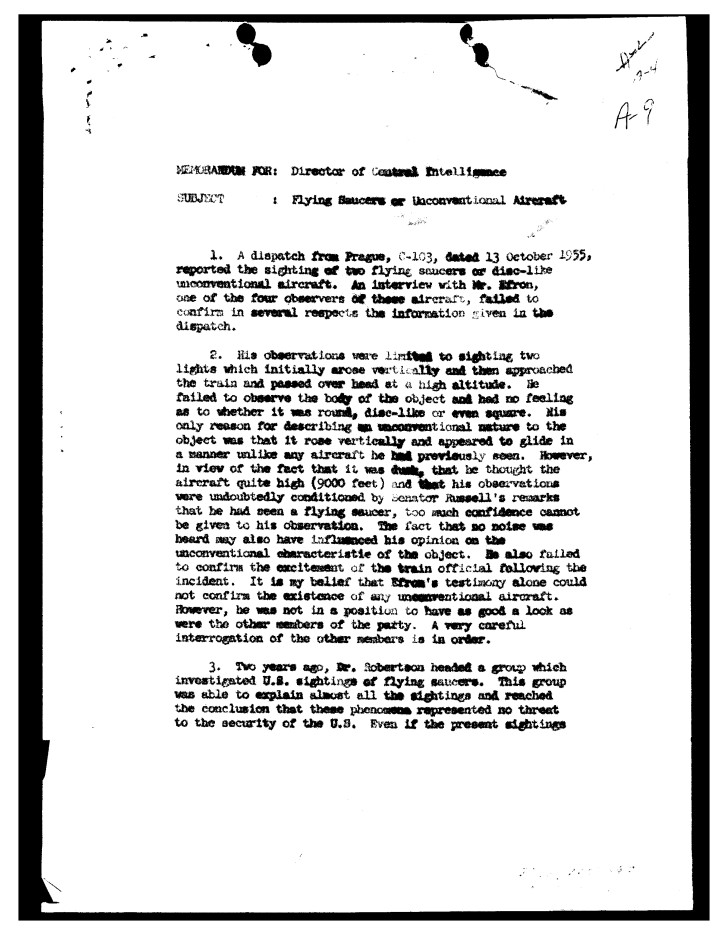
A 1955 CIA analysis says Ruben Efron’s account of two lights could not confirm an unconventional aircraft and may have been conditioned by Senator Richard Russell’s remarks. It separately discusses the Robertson Panel and early Project Y work at Avro Canada; that saucer-like design language describes the project, not the observed object’s established shape.
- File
- Document · Release 04
- Date
- 1955
- Extent
- 4 pages
- Agency
- CIA
Search This File
Probed Assessment
A 1955 CIA analysis found that train-passenger testimony about two lights in the Soviet Union could not confirm an unconventional aircraft, urged better witness questioning, and separately noted early Canadian work on a saucer-like Avro design.
Key takeaways
- The principal witness described approaching lights that rose and passed overhead, but could not clearly see a physical body and may have been influenced by another observer’s comments.
- CIA analysts said the testimony alone could not establish an unconventional aircraft and called for careful interviews of the remaining witnesses.
- The memorandum cited the Robertson Panel’s no-security-threat assessment and distinguished the sighting from Avro Canada’s still-early aircraft-development work.
Why it matters
The analysis illustrates a disciplined evidentiary distinction between ambiguous lights, incomplete testimony, and documented but immature circular-aircraft engineering.
Corroboration
The document corroborates the CIA’s reasoning and the existence of the referenced review and Avro project. It does not independently identify the lights or validate every conclusion attributed to earlier panels.
Open questions
- • Did later interviews resolve differences among the train passengers’ accounts?
- • What source material did the CIA use for its description of the Avro project at this stage?
Probed separates this editorial assessment from the source claims below. It summarizes what the released artifact supports; it is not independent verification.
Official Description from War.gov
Sections 1 and 2 of this memorandum document a 1955 analysis of reports of “flying saucers” or “unconventional aircraft,” referencing the incident described in observer debriefings contained within CIA-UAP-D020. The memo summarizes the incident as consisting of two lights rising vertically, then passing above the observers. The memo contains caveating language that suggests the author concluded that the reports, as described, did not indicate the presence of an “unconventional aircraft.” Section 3 cites a previous finding by Dr. [Howard] Robertson (of the 1953 Robertson Panel) that “almost all the sightings […] represented no threat to the U.S.” Section 4 discusses the state of then-current research into “saucer-like aircraft” under Project “Y,” a contemporary joint U.S.-Canadian aerospace development program.
Preserved verbatim as source metadata. This wording is separate from Probed’s file-specific description and assessment.
File Context
Related entities
Tracker findings
CIA said Russell’s remarks may have conditioned Efron’s account
CIA-UAP-D021 names Ruben Efron as the interviewed member of the four-person group and says Senator Richard Russell’s flying-saucer remarks may have conditioned Efron’s observation. The analyst concluded that Efron’s testimony alone could not confirm an unconventional aircraft.
Release provenance
- Release
- Release 04
- Official ID
- release-04-file-012-cia-uap-d021-analysis-of-unconventional-aircraft-sightings-1955
- Cleared
- Jul 10, 2026
Referenced Timeline
Robertson Panel assessment referenced
The memorandum referred to the Robertson group's earlier review of U.S. flying-saucer sightings.
Prague dispatch reported the sighting
A dispatch from Prague reported two flying saucers or disc-like unconventional aircraft.
Source Claims
Claims are attributed to the released source and remain distinct from Probed’s assessment and tracker findings.
A Prague dispatch dated October 13, 1955 reported two flying saucers or disc-like unconventional aircraft, but an interview with Ruben Efron failed to confirm the dispatch in several respects.
An interview with Mr. Efron, one of the four observers of these aircraft, failed to confirm in several respects the information given in the dispatch.
Efron reported two lights that rose vertically, approached the train, and passed overhead at high altitude.
His observations were limited to sighting two lights which initially arose vertically and then approached the train and passed over head at a high altitude.
Efron did not see the object's body and expressed no view as to whether it was round, disc-like, or square.
He failed to observe the body of the object and had no feeling as to whether it was round, disc-like or even square.
The analyst cautioned that Efron's observation may have been conditioned by Senator Russell's statement that he had seen a flying saucer.
his observations were undoubtedly conditioned by Senator Russell's remarks that he had seen a flying saucer
The memorandum said Efron's testimony alone could not confirm an unconventional aircraft and called for careful questioning of the other witnesses.
It is my belief that Efron's testimony alone could not confirm the existence of any unconventional aircraft.
The memorandum cited the Robertson group as having explained almost all the sightings it reviewed and concluded the phenomena presented no threat to U.S. security.
This group was able to explain almost all the sightings and reached the conclusion that these phenomena represented no threat to the security of the U.S.
The USAF-backed Project Y at Avro Canada was described as an early-stage effort to develop a saucer-like aircraft, not as evidence of the train observers' object shape.
The USAF is supporting a Project "Y" at Avro Aircraft Ltd. in Canada for the development of unconventional saucer-like aircraft.
John Frost directed Project Y, and the memorandum suggested that General Samford report on the project's progress.
Project Y is being directed by John Frost.
Source Material & Evidence
Research Map
Lines appear only when two entities share a row-level source claim or dated timeline event. Unconnected nodes remain visible without implying a relationship.