
DOW-UAP-D092 — Air Force Committee Review of Project Blue Book, 1966–1967
Air Force records trace the 1966 review of Project Blue Book, the decision to seek an independent scientific study, and appended Robertson Panel findings on weak case data, misidentification, radar interference, and public-education concerns. The collection connects multiple stages of federal UFO review and shows how methodological weakness, institutional credibility, and air-defense reporting concerns shaped policy as much as individual cases did.
- File
- Document · Release 04
- Date
- Apr 17, 1967
- Location
- Various
- Extent
- 85 pages
Search This File
Probed Assessment
Air Force records trace the 1966 review of Project Blue Book, the decision to seek an independent scientific study, and appended Robertson Panel findings on weak case data, misidentification, radar interference, and public-education concerns.
Key takeaways
- The Scientific Advisory Board review led Secretary Harold Brown to support an external scientific team for selected cases rather than relying only on the existing Blue Book process.
- The file documents practical concerns about university participation, public communication, and investigative resources, alongside the Air Force’s historical case-disposition figures.
- Appended Robertson Panel material rejected several extraordinary interpretations, identified radar and instrumental effects, found no direct threat in the reviewed evidence, and recommended better recognition training.
- Later correspondence treated the Condon study and National Academy review as the institutional outcome of the 1966 recommendation for independent examination.
Why it matters
The collection connects multiple stages of federal UFO review and shows how methodological weakness, institutional credibility, and air-defense reporting concerns shaped policy as much as individual cases did.
Corroboration
The records corroborate the committee process, official recommendations, and conclusions recorded in the appended reviews. Case counts and unexplained classifications do not by themselves establish an extraordinary cause.
Open questions
- • Which specific cases did the 1966 committee regard as most suitable for independent study?
- • How did resource and follow-up limitations affect Blue Book’s unresolved-case rate?
Probed separates this editorial assessment from the source claims below. It summarizes what the released artifact supports; it is not independent verification.
Official Description from War.gov
This file documents the 1966-1967 deliberations and recommendations of the U.S. Air Force (USAF) Scientific Advisory Board’s Ad Hoc Committee to Review Project Blue Book. Project Blue Book was a 1952-1969 USAF program to investigate the nature and origin of unidentified flying objects (UFO). The Committee recommended that the USAF contract a scientific team composed of university-affiliated representatives to investigate selected UFO sightings. The USAF subsequently adopted the Committee’s recommendation.
Preserved verbatim as source metadata. This wording is separate from Probed’s file-specific description and assessment.
File Context
Related entities
Tracker findings
Air Force leadership supported an outside scientific team for selected UFO cases
A memorandum forwarding the Scientific Advisory Board committee's report recommended accepting its proposals and contracting a scientific team to investigate selected reported sightings in depth. War.gov notes that the Air Force subsequently adopted the recommendation.
The Blue Book review linked radar interference to some apparent high-speed tracks
The committee recognized that pulses from one radar station could appear on another station's screen as a high-speed track or series of dots and said this likely explained a number of UFO reports. It also recommended radar-scope cameras to document unusual echoes and improve understanding of interference.
Release provenance
- Release
- Release 04
- Official ID
- release-04-file-017-dow-uap-d092-department-of-the-air-force-committee-to-review-project-bluebook-1966-1967
- Cleared
- Jul 10, 2026
Referenced Timeline
Robertson Panel met
A scientific panel reviewed selected UFO cases and national-security implications.
LinkedRobertson PanelScientific Advisory Board review held
The committee reviewed Project Blue Book resources, methods, findings, and case files.
LinkedProject Blue BookBlue Book committee report issued
The ad hoc committee recommended deeper scientific investigation of selected reports.
LinkedProject Blue BookHarold Brown accepted recommendations
The Secretary of the Air Force directed planning for an independent scientific team.
Implementation meeting held
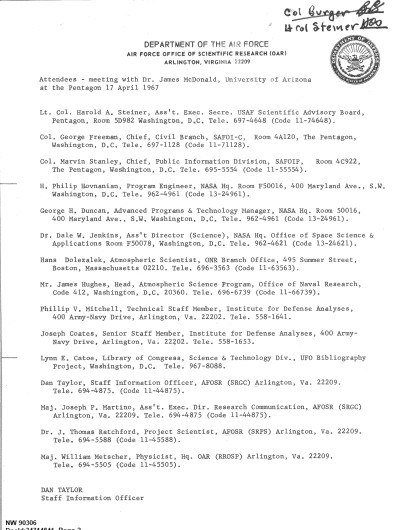
Air Force and scientific advisers discussed contracting, university participation, and public communication.
University participation reviewed
Robert Stever reported mixed informal reactions from university presidents.
Condon Report completed
The independent University of Colorado study followed the general approach recommended in 1966.
LinkedCondon CommitteeCommittee members commented on Condon Report
Correspondence described the report and National Academy review as a comprehensive outcome.
LinkedCondon Committee
Source Claims
Claims are attributed to the released source and remain distinct from Probed’s assessment and tracker findings.
An April 1966 meeting was convened specifically to determine how to implement recommendations from the Scientific Advisory Board committee reviewing Project Blue Book.
To discuss how best to implement the recommendations made by the SAB Ad Hoc Committee to Review Project Blue Book
The February 1966 review brought together scientists and Air Force personnel including Brian O’Brien, Jesse Orlansky, Carl Sagan, Willis Ware, and Project Blue Book chief Hector Quintanilla.
To review the resources, methods and findings of Air Force Project Blue Book
Secretary of the Air Force Harold Brown accepted the committee’s recommendations and directed arrangements for a scientific team to investigate selected sightings in depth.
Secretary of the Air Force Harold Brown … stated that the Committee's recommendations should be accepted and arrangements made for a scientific team to investigate in depth certain selected sightings of UFOs.
Implementation discussions treated public relations and university participation as major practical problems, including whether institutions would accept government UFO work.
Since we are dealing with an emotional phenomenon
A May 1966 memorandum recorded mixed reactions from university presidents and considered how to approach institutions for independent scientific investigations.
mixed reactions to its request to universities
Brown’s formal memorandum recommended contracting with a scientific team rather than relying only on the existing Air Force investigation.
contract for a scientific team to investigate in depth certain selected reported sightings
The Air Force stated that it had investigated 9,267 reports through June 30, 1965, of which 663 remained unexplained; those figures describe case disposition and do not establish an extraordinary cause.
a total of 9267 reports had been investigated by the Air Force. Of these 9267 reports, 663 cannot be explained
J. Allen Hynek was identified as Project Blue Book’s scientific consultant and as willing to assist a review panel.
Doctor J. Allen Hynek who is the Chairman of the Dearborn Observatory
A 1969 letter described the Condon Report as the type of independent study the 1966 committee had recommended and cited the National Academy of Sciences endorsement.
The fine endorsement of his work by the National Academy of Sciences confirms that Condon has done what was needed
The appended Robertson Panel material criticized the lack of sound data and slow follow-up in most case histories, attributing part of the problem to limited Air Technical Intelligence Center staffing.
lack of sound data in the great majority of case histories
The panel rejected a contractor’s conclusion that the Tremonton film showed self-luminous objects, listing reflection, camera, and analytical shortcomings.
they could not accept the conclusions reached
The panel found no direct threat in the sightings but warned that misidentification, overloaded reporting channels, and public hysteria could impair air-defense intelligence.
evidence of any direct threat from these sightings was wholly lacking
The report said mutual radar interference could appear as high-speed tracks or dots and probably accounted for a number of UFO reports.
pulse signal from station A may be picked up on the screen of station B and show as a high-speed track
The panel rejected an asserted UFO–cosmic-ray correlation after attributing the Los Alamos counter behavior to instrumental effects.
recorded data were undoubtedly due to instrumental effects
The Robertson Panel concluded that the evidence showed no direct physical threat and no indication of hostile foreign artifacts in the reviewed residual cases.
no indication that these phenomena constitute a direct physical threat to national security
The panel recommended removing UFOs’ special aura of mystery and using intelligence training and public education to improve recognition of genuine hostile activity.
strip the Unidentified Flying Objects of the special status they have been given
Source Material & Evidence
Research Map
Lines appear only when two entities share a row-level source claim or dated timeline event. Unconnected nodes remain visible without implying a relationship.