Probed ingest of: THE DIAGNOSTIC GAP: The ISS cannot tell if your brain is bleeding.
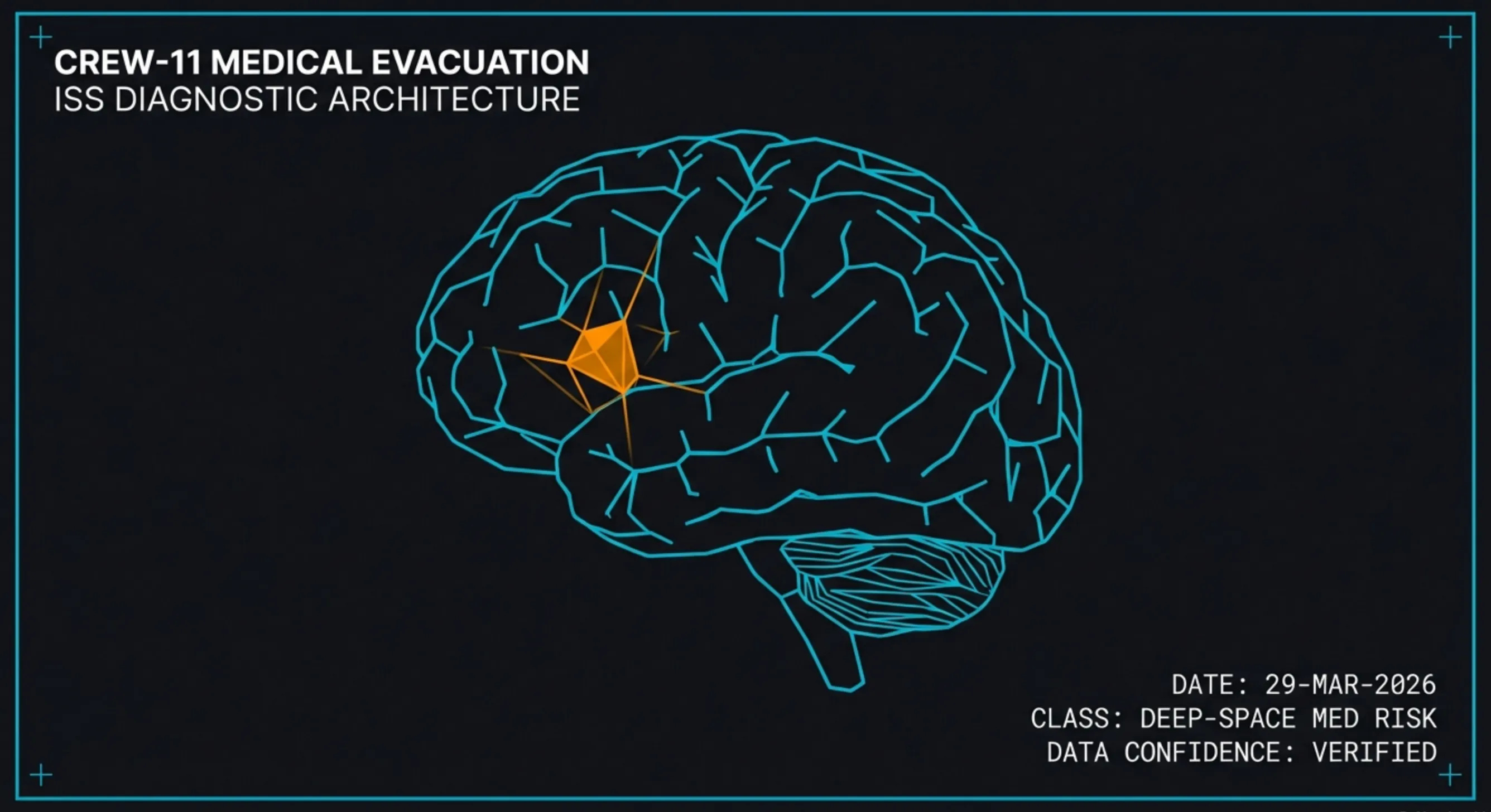
An astronaut temporarily lost the ability to speak in orbit. Sentinel argues the incident exposed a diagnostic gap in ISS medical capability for transient neurological events.
Source Claims
6- Source reportedAsserted
Mike Fincke claims he lost the ability to speak for twenty minutes while on the ISS.
Then his voice stopped working. No warning. No pain. He was awake. He was aware. He knew he wanted to speak. He could not.
- Source reportedAsserted
The source says the ISS lacks onboard CT and MRI capability for direct intracranial imaging.
The ISS has no MRI. No CT scanner. No way to look inside an astronaut’s head under any circumstances.
- Source reportedAsserted
The article states that NASA does not screen for Patent Foramen Ovale (PFO) in astronaut candidates.
NASA has never performed routine screening or evaluation for PFOs in astronaut candidates.
- InferenceAsserted
The article suggests that microgravity can cause blood clots due to venous stasis.
Microgravity fundamentally breaks how blood drains from your head. On Earth, gravity pulls blood downward. In orbit, it does not.
- Source reportedObserved
The article states that the Crew-11 medical evacuation was the first in the 25-year history of the ISS.
It was the first medical evacuation in the 25-year history of the International Space Station.
- InterpretationAsserted
The article suggests that the diagnostic gap on the ISS poses a significant risk for deep-space missions.
The ISS medical suite can stabilize you. It cannot diagnose you. And until that changes, every astronaut who flies beyond LEO accepts a risk that cannot be identified, cannot be treated, and cannot be evacuated from.
Structure Across Time
How the key people and organizations in this source are involved as events unfold. Built from the extracted timeline — co-appearance here reflects the source’s narrative, not verified coordination.
AP Interview with Mike Fincke
Mike Fincke discusses his speech loss incident with the Associated Press.
Crew-11 Splashdown
Crew-11 astronauts return to Earth and splash down off the coast of San Diego.
Speech Loss Incident
Mike Fincke loses the ability to speak for twenty minutes on the ISS.
Delivery of GE Vivid q Ultrasound
The GE Vivid q ultrasound machine is delivered to the ISS aboard Space Shuttle Atlantis.
RELATED ENTITIES
(12)Source Material
5Source Documents
2Research Map
Entities are linked when they share a claim or a dated event in this source. Tap any node to see why it’s here.
Deep probes
20Probed ingest of: THE COMPLEX: The Pentagon Just Published the 1949 Green Fireball Files. Our 2026 Coverage Says They Are Returning.
The Sentinel Network · May 27Probed ingest of: THE SIGNAL #007: THE PROBABILITY
The Sentinel Network · May 26Probed ingest of: THE CORPUS: NSA Argued This File Would Damage National Security. Page 236 Reads “Thirteen MIGs Chased One UFO.”
The Sentinel Network · May 21Probed ingest of: THE PRIORS: Kevin Patrick Childress Created a Reddit Account Before AATIP Broke.
The Sentinel Network · May 20Probed ingest of: THE MISSING BIN: We Said SETI Couldn’t Hear a Probe. We Spent 163 Hours Reprocessing Their Data.
The Sentinel Network · May 14Probed ingest of: THE REFRACTOR: A Pentagon Deadline for 46 UAP Videos Lapsed in Silence. The Same 46 Surfaced Elsewhere.
The Sentinel Network · May 7Probed ingest of: THE VIEWPORT: We Built 3I/ATLAS.
The Sentinel Network · May 6Probed ingest of: THE BAIT: A Fabricated Jupiter Impact Reached Our Inbox. Two Weeks of Verification Said No.
The Sentinel Network · May 4 The Sentinel Network