
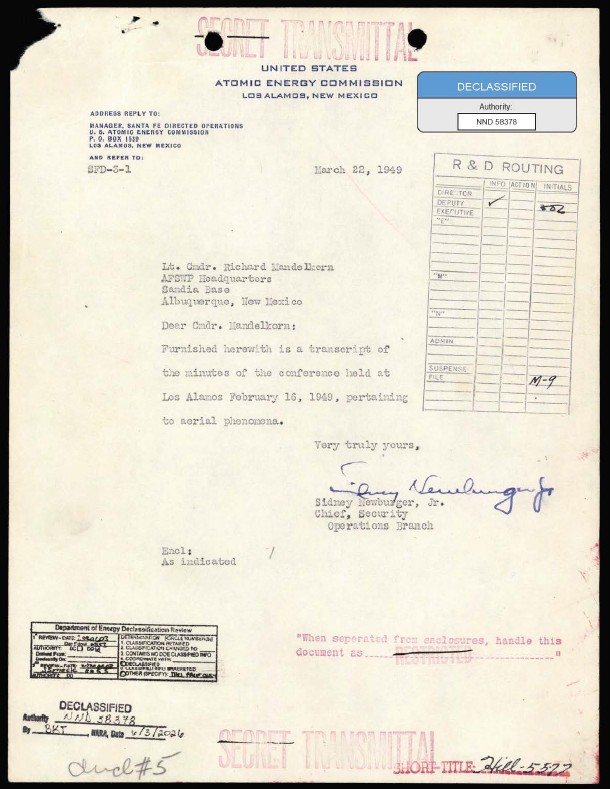
A 1949 Los Alamos conference transcript records scientists and federal officials comparing green-fireball reports, conventional precedents, and competing meteor, material-body, and electrical explanations without reaching an identification. The transcript is valuable primary evidence for how early atomic-era scientists evaluated unusual aerial observations: as an unresolved technical problem requiring better photography and measurements, not as proof of an extraordinary origin.

Los Alamos, New Mexico
LocationLos Alamos, New Mexico
LocationProbed ingest of: The Japanese Monk That Stole NASA’s UFO Footage! [BANNED FROM THE U.S.]
Part 23 of a series reassessing the documentary record behind the 1933 Magenta narrative. TL;DR The FBI marked its January 1949 memo Confidential. Inside, it reported that Army and Air Force intelligence officers considered the subject “top secret.” The green fireballs prompted searches and a camera program. Investigators found copper in samples taken both before and after the fireball they were studying. Project Twinkle filmed daylight objects after a missile test. Holloman gave little weigh...
Part 23 of a series reassessing the documentary record behind the 1933 Magenta narrative. TL;DR: The FBI’s 31 January 1949 memo was marked Confidential but reported that Army and Air Force intelligence officers considered the subject “top secret.” San Antonio said it was not investigating; G-2 and OSI were. The reports prompted conferences, searches and Project Twinkle’s camera program. Russian weapons were a hypothesis, not an identification. Copper particles were collected, including in sam...
Part 17 of a series reassessing the documentary record behind the 1933 Magenta narrative. TL;DR: Aztec’s public source trail runs through Scully, Newton and GeBauer; Cahn reported ordinary aluminum in Newton’s alleged saucer sample, and Newton and GeBauer were convicted in an oil-fraud case. Only the 31 March 1950 FBI memo explicitly names Newton; the informant behind Hottel’s 22 March memo remains unidentified. The FBI’s Newton-file description says he revised his claim in 1952, denying firs...
Lazar’s account has a stable headline but an uneven evidentiary history. The candle experiment, ominous interior, and briefing skepticism were described long ago. More consequential changes concern whether he personally walked beneath the craft, how confidently he understood its mechanism, and what he knew about its recovery. Modern UAP allegations do not settle those questions. Part 1 found a real Los Alamos contractor connection and practical technical ability, alongside unverified elite de...
Part 10 of a series reassessing the documentary record behind the 1933 Magenta narrative. TL;DR Before Project Sign, Hynek was Supervisor of Technical Reports at Johns Hopkins’ Applied Physics Laboratory (APL), 1942–1946, working inside the secret proximity-fuze program. A newspaper account says he led a briefing and reported that captured dud fuzes had been recovered. That does not establish that he commanded their recovery. The fuze program collaborated with Los Alamos. No evidence presente...
I tried to create a dashboard for all 270 PDFs (11,268 pages) of the Pentagon's PURSUE releases: every file sorted into relevant, background or junk, with page-level citations Between May 8 and September 18, 2026, the US Department of War published six batches of declassified UAP documents on war.gov/UFO under the name PURSUE (Presidential Unsealing and Reporting System for UAP Encounters). I downloaded every file and went through it page by page. 2,488 pages were scans and had to be run thro...
I tried to create a dashboard for all 270 PDFs (11,268 pages) of the Pentagon's PURSUE UAP releases: every file sorted into relevant, background or junk, with page-level citations Between May 8 and September 18, 2026, the US Department of War published six batches of declassified UAP documents on war.gov/UFO under the name PURSUE (Presidential Unsealing and Reporting System for UAP Encounters). I downloaded every file and went through it page by page. 2,488 pages were scans and had to be run...