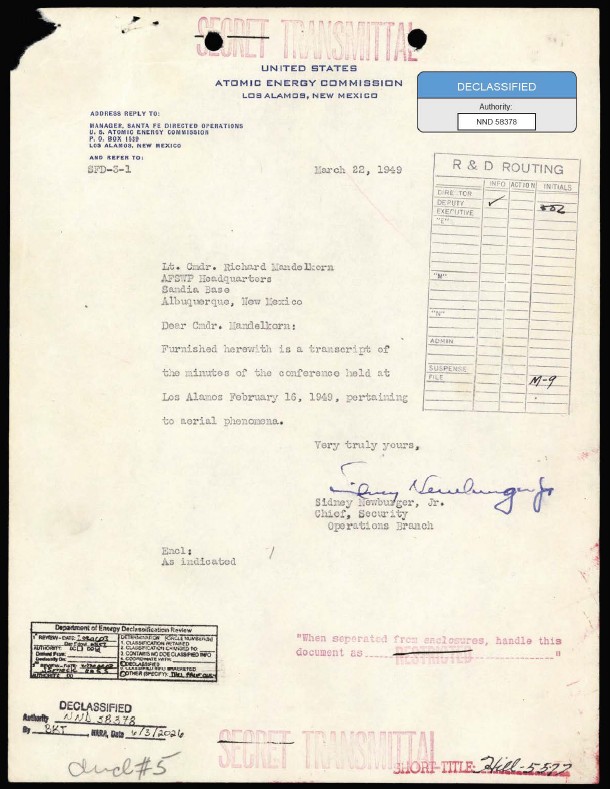

DOE-UAP-D004 — Los Alamos Conference on Aerial Phenomena, 1949
A 1949 Los Alamos conference transcript records scientists and federal officials comparing green-fireball reports, conventional precedents, and competing meteor, material-body, and electrical explanations without reaching an identification. The transcript is valuable primary evidence for how early atomic-era scientists evaluated unusual aerial observations: as an unresolved technical problem requiring better photography and measurements, not as proof of an extraordinary origin.
- File
- Document · Release 04
- Date
- Mar 22, 1949
- Location
- New Mexico
- Extent
- 25 pages
Search This File
Probed Assessment
A 1949 Los Alamos conference transcript records scientists and federal officials comparing green-fireball reports, conventional precedents, and competing meteor, material-body, and electrical explanations without reaching an identification.
Key takeaways
- The February 1949 meeting assembled military, Atomic Energy Commission, university, and laboratory participants to compare observations rather than announce a settled conclusion.
- Lincoln LaPaz emphasized the reports’ long, nearly horizontal paths, unusual green color, and lack of persistent trains as departures from familiar meteor observations.
- The discussion preserved multiple hypotheses, including unusual meteor phenomena, a material body, and an electron phenomenon, while also recalling previously unexplained balloon flashes that received a conventional explanation.
Why it matters
The transcript is valuable primary evidence for how early atomic-era scientists evaluated unusual aerial observations: as an unresolved technical problem requiring better photography and measurements, not as proof of an extraordinary origin.
Corroboration
The document corroborates that the conference occurred and what participants said. It does not independently establish the reported objects’ physical properties, and the underlying observations remain historical witness accounts.
Open questions
- • Do surviving instrument logs or original observation reports permit a stronger reconstruction of the cited fireball paths?
- • Were the proposed sensitive-camera observations ever implemented, and did they capture comparable events?
Probed separates this editorial assessment from the source claims below. It summarizes what the released artifact supports; it is not independent verification.
Official Description from War.gov
This document is a transcript of a 1949 conference held at Los Alamos Scientific Laboratory (now Los Alamos National Laboratory), Los Alamos, New Mexico. Attendees included several eminent scientists and physicists, many of whom had contributed to the development of the first nuclear weapons during the Manhattan Project. The purpose of the conference was to discuss and gather hypotheses to account for the nature and origin of a phenomenon involving “green fireballs” that had been reported over a period of several months in the vicinity of the laboratory. The group did not come to a consensus on a likely attribution for the phenomenon, though a leading hypothesis was that the observations may have been related to meteors entering the atmosphere at a shallow angle and high altitude. Dr. Edward Teller suggested that if not a “material body,” an “electron phenomenon” might be the cause, while Dr. Lincoln LaPaz, an expert specializing in meteorics, expressed that “nothing like this, to [his] knowledge, has ever been observed in the case of meteorite drops.”
Preserved verbatim as source metadata. This wording is separate from Probed’s file-specific description and assessment.
File Context
Related entities
Tracker findings
LaPaz distinguished the Starvation Peak fireball from a conventional meteorite fall
At the Los Alamos conference, meteorics specialist Lincoln LaPaz said the December 1948 Starvation Peak event was not a conventional meteorite fall. He emphasized its instant full intensity, green or yellow-green color, nearly horizontal path, and green fragmentation. This was his interpretation of the observation, not a settled attribution by the conference.
Teller and LaPaz left the green-fireball mechanism unresolved
Edward Teller suggested that, if the conference reports were accepted together, the phenomenon ought to involve a material body but might instead be an electron phenomenon. LaPaz replied that he knew of no comparable behavior in meteorite drops. Other participants still considered meteoric and chemical-light explanations, showing that the group did not reach consensus.
Release provenance
- Release
- Release 04
- Official ID
- release-04-file-001-doe-uap-d004-los-alamos-conference-on-aerial-phenomena-1949
- Cleared
- Jul 10, 2026
Related coverage
Referenced Timeline
Green fireball observed near Los Alamos
The conference discussed a yellow-green fireball reported on the night of December 30, 1948.
Long-path green fireball cited
LaPaz used a January 30 green-fireball report as an example of an unusually long apparent path.
Los Alamos aerial-phenomena conference held
Military, scientific, federal, and university representatives met to compare observations and possible explanations.
Conference transcript forwarded
The Atomic Energy Commission correspondence accompanying the transcript is dated March 22, 1949.
Source Claims
Claims are attributed to the released source and remain distinct from Probed’s assessment and tracker findings.
The conference convened at Los Alamos on February 16, 1949, with representatives from the Army, FBI, Atomic Energy Commission, University of New Mexico, and University of California.
Conference on AERIAL PHENOMENA Held at 1300, 16 February 1949
Lincoln LaPaz described the Starvation Peak observation as lasting about two seconds and emphasized that the low apparent path could be compared with visible mountain peaks.
the object was so low over the horizon it was possible to compare it not only to the stars but with respect to mountain peaks
LaPaz said the reported green fireballs appeared to maintain nearly constant velocity over long, approximately horizontal paths and displayed an unusual green color not familiar from conventional meteorite falls.
it reserves nearly constant velocity over paths say of the order of 25 to over 100 miles
A participant confirmed the green hue of the December 30, 1948 fireball, while the discussion considered and questioned a Geminid-meteor explanation.
confirmed the green hue of the green fireball he had seen on the night of December 30, 1948
The transcript records Joseph Kaplan as judging that the observations could not be conventional meteorite falls, although abnormal meteor phenomena remained among the possibilities discussed.
Kaplan is one of the charter members of the American Meteor Society, and he said certainly these could not be conventional meteorite falls
LaPaz said the green-fireball reports lacked the persistent trains normally sought in meteor observations and counted multiple incidents he considered analogous.
In the case of the green fireballs, to my knowledge, no such train has been observed
The group discussed historical Japanese balloon self-destruct flashes as an example of apparently stationary fireballs that ultimately received a conventional explanation.
those stationary fireballs turned out to be the self-destructive devices on Japanese paper balloons
Participants discussed Harvard meteor-camera equipment and the possibility that sufficiently sensitive cameras could photograph a bright green fireball.
with one of those, a bright green fireball might be photographed
Edward Teller concluded that accepting the reports together suggested a material body, but he also raised an electron phenomenon; LaPaz replied that he knew of no comparable meteorite-drop behavior.
it ought to be a material body - might be an electron phenomenon
Source Material & Evidence
Research Map
Lines appear only when two entities share a row-level source claim or dated timeline event. Unconnected nodes remain visible without implying a relationship.