
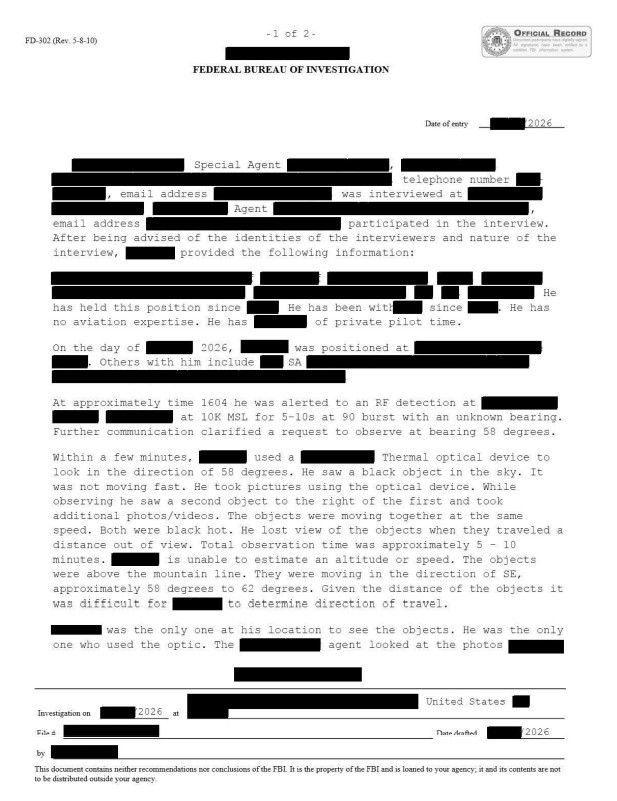
An FBI FD-302 records a 2026 thermal-optics observation of two slow-moving dark-hot objects above a mountain line. The witness could not estimate altitude or speed, reported approximately five to ten minutes of observation, and provided photographs to an FBI agent.

Western United States
LocationWestern United States
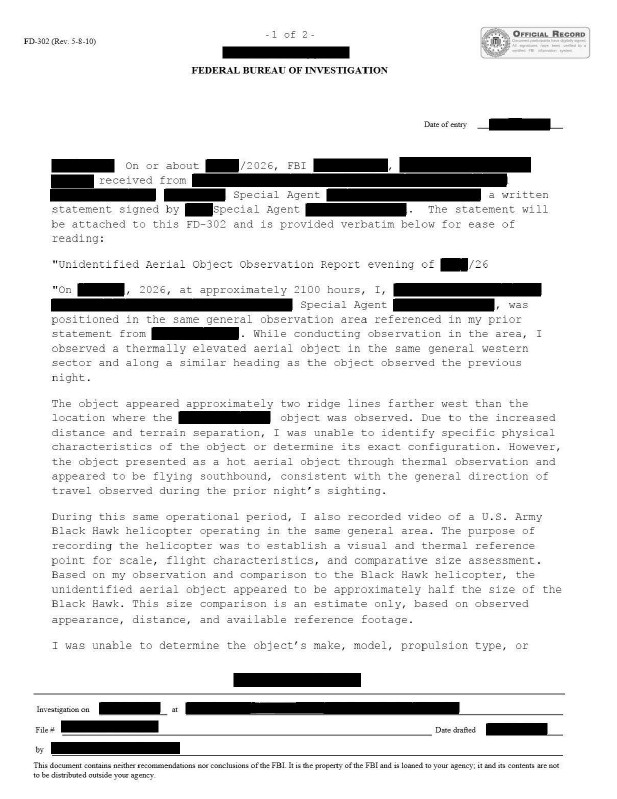
LocationAn FBI FD-302 preserves a signed account of a thermally elevated aerial object observed in 2026. The witness reported a southbound object farther west than a prior sighting, compared its apparent size with a Black Hawk helicopter, and stated that distance and terrain prevented identification of configuration or propulsion.
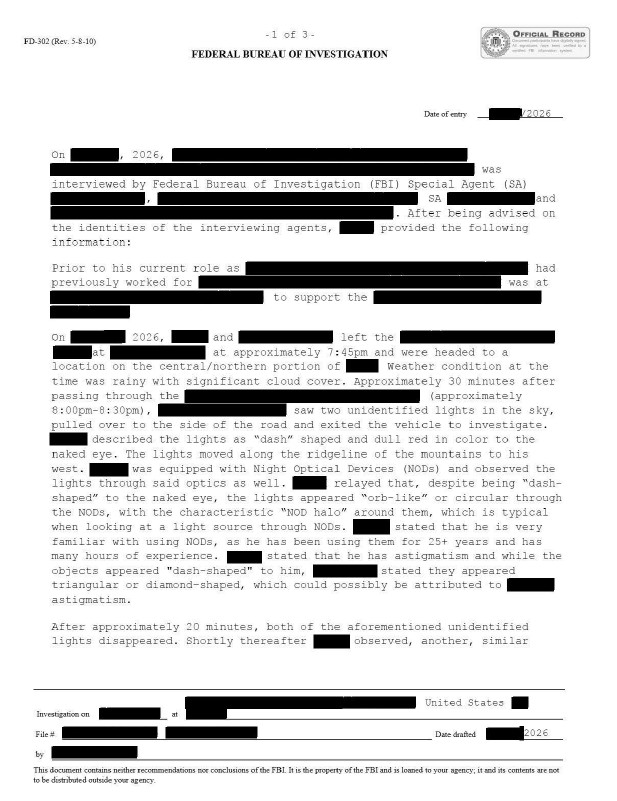
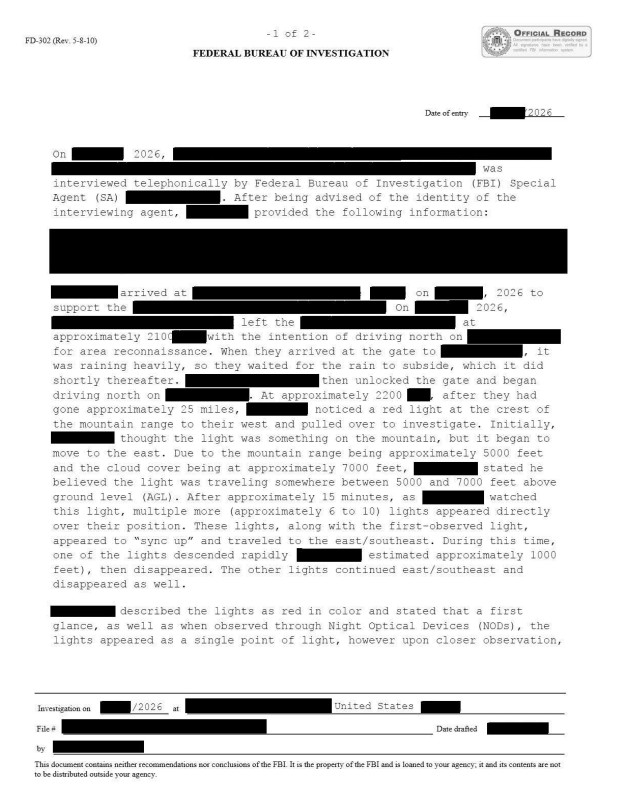
An FBI FD-302 records a 2026 night observation of multiple red lights through both unaided vision and night optical devices. The witness described changing positions and elevations, later low-level lights, a 25-minute discrepancy affecting one mechanical watch, and no reported physiological effects.
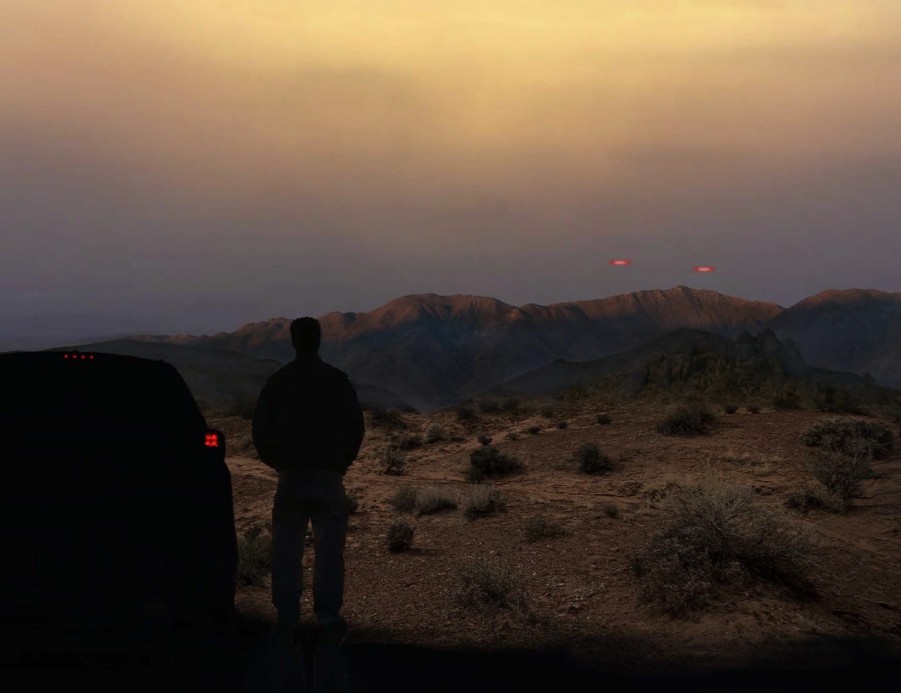
A single digital rendering depicts two small red lights above a desert mountain ridge at dusk, viewed from beside a parked vehicle. The image is an illustrative reconstruction and does not independently establish the lights’ distance, altitude, size, or source.
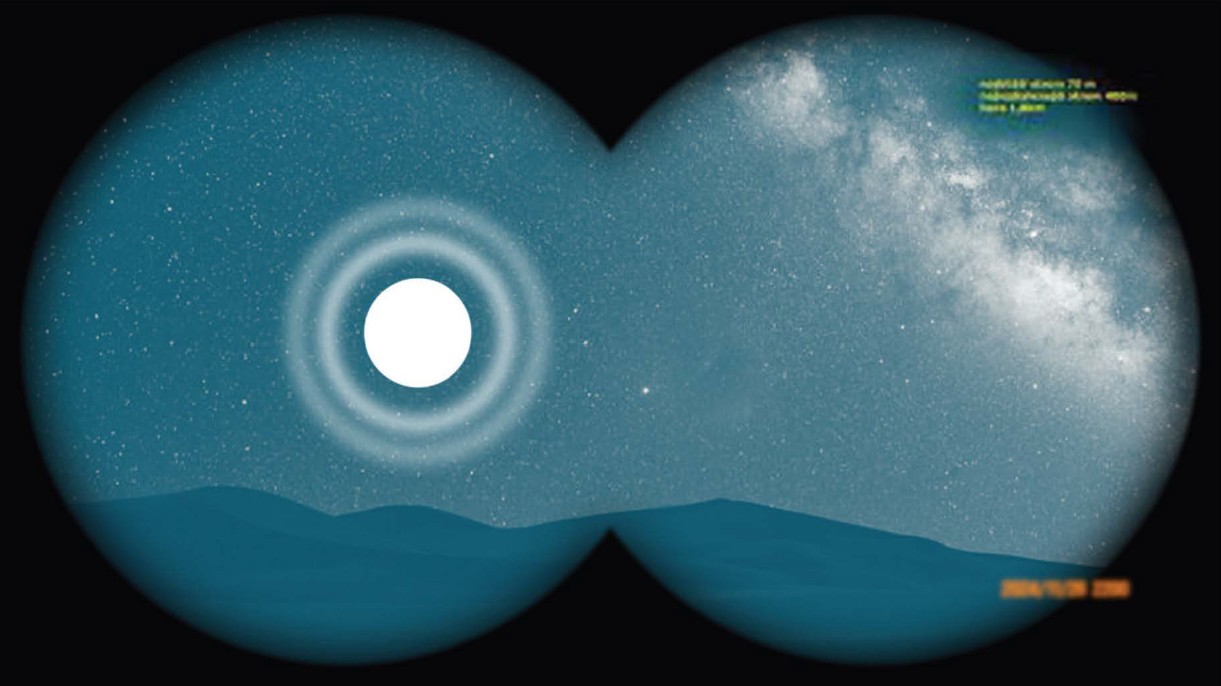
Three digital renderings present a bright circular light through a binocular or night-optics field, with concentric halo rings and a mountainous horizon. The repeated frames illustrate an optical appearance rather than independently measuring the light’s range, size, or motion.
An FBI FD-302 records a second witness account of multiple red lights during a rainy 2026 nighttime observation. The source describes clusters of three lights moving together, later low-level lights visible through night optics, a rapidly moving peripheral streak, and the same reported 25-minute analog-watch discrepancy.
A six-frame digital sequence depicts red lights appearing in increasing numbers above a desert mountain ridge while an observer stands beside a vehicle. The rendering illustrates the reported arrangement and progression but cannot establish physical distance, altitude, or object identity.
A single digital rendering shows a narrow luminous streak rising above a mountainous horizon within a binocular or night-optics field. It is an illustrative reconstruction and does not independently determine the streak’s source, trajectory, distance, or duration.
FBI-UAP-PR007, “Slow-moving Objects,” 2026
A U.S. Government Special Agent captured this video footage via hand-held optical thermal imaging device during a 2026 incident in the western United States, as described in FBI-UAP-D032. The footage features two, slow-moving “black-hot” areas of contrast, visible in infrared imaging.
DOW-UAP-PR108, Unresolved UAP Report, Western United States, 2020
The United States Northern Command submitted a report of an unidentified anomalous phenomenon to the All-domain Anomaly Resolution Office (AARO) consisting of 2 minutes and 16 seconds of video footage from an infrared sensor aboard a U.S. military platform in 2020. Video Description: 00:01-00:15: No content. 00:16-00:19: The footage flashes between normal operation and a black screen several times as the sensor changes display modes. 00:20-00:27: No content. 00:28-00:33: The sensor zooms in and pans to track an area of contrast, keeping it generally within the center of the frame. 00:34-00:57: An auto-tracking reticle surrounds the area of contrast as the sensor continues to track it against the background. 00:58-01:10: The sensor adjusts its zoom level and contrast settings several times. 01:11-01:34: The area of contrast leaves the sensor field-of-view to the left of the frame. The sensor adjusts its zoom level and contrast settings several times. No content. This video description is provided for informational purposes only. Readers should not interpret any part of this description as reflecting an analytical judgment, investigative conclusion, or factual determination regarding the described event’s validity, nature, or significance.