This Project Blue Book file preserves Delbert C. Newhouse’s account and film submission from the 2 July 1952 Tremonton incident. Newhouse said the sky supplied no fixed reference for estimating distance, size, altitude, or speed. Navy analysts favored an unidentified light-source interpretation under disputed assumptions, while later reviews considered balloons, birds, insects, and mirage; one 1956 study remained inconclusive before an Air Force memo adopted a seabird explanation.

Air Technical Intelligence Center
OrgAir Technical Intelligence Center
OrgLatest UAP PURSUE files release out today: https://t.co/lHk908qt0f My chum @AlchemyAmerican is going to love P85 of DOW-UAP-D105. The Bertrandias–Townsend Brown document, 16 October 1952. https://t.co/rAehs8504f • Major Dewey Fournet, then deeply involved in the Pentagon's UFO investigation, sends material to ATIC/Project Blue Book that had originated with the Office of Naval Research and reached the Air Force through OSI. • The memorandum explicitly records: “the Townsend Brown Foundation wa...
This Air Force correspondence file follows film-analysis requests, witness statements, interservice coordination and physical-evidence inquiries during 1952. It includes Newhouse’s explicit limits on estimating the Tremonton objects, the effort to recover a misplaced Mariana film copy, and FBI examination of a reportedly burned cap. Questions and proposed explanations remain distinct from established identifications.
"The aerospace symbol on the upper left represents the interest of ATIC in aerospace equipment, manned and unmanned, vehicles, etc." Was the 1948 sighting and photograph of a boot heal-shaped UFO the inspiration for the Air Technical Intelligence Center emblem created in 1951? The exact same emblem continued in use after a name change to the Foreign Technology Division. The theme of our emblem symbolizes our mission, "Aerospace Technical Intelligence, Worldwide." The polar projection of the E...

Air Force records trace the 1966 review of Project Blue Book, the decision to seek an independent scientific study, and appended Robertson Panel findings on weak case data, misidentification, radar interference, and public-education concerns. The collection connects multiple stages of federal UFO review and shows how methodological weakness, institutional credibility, and air-defense reporting concerns shaped policy as much as individual cases did.
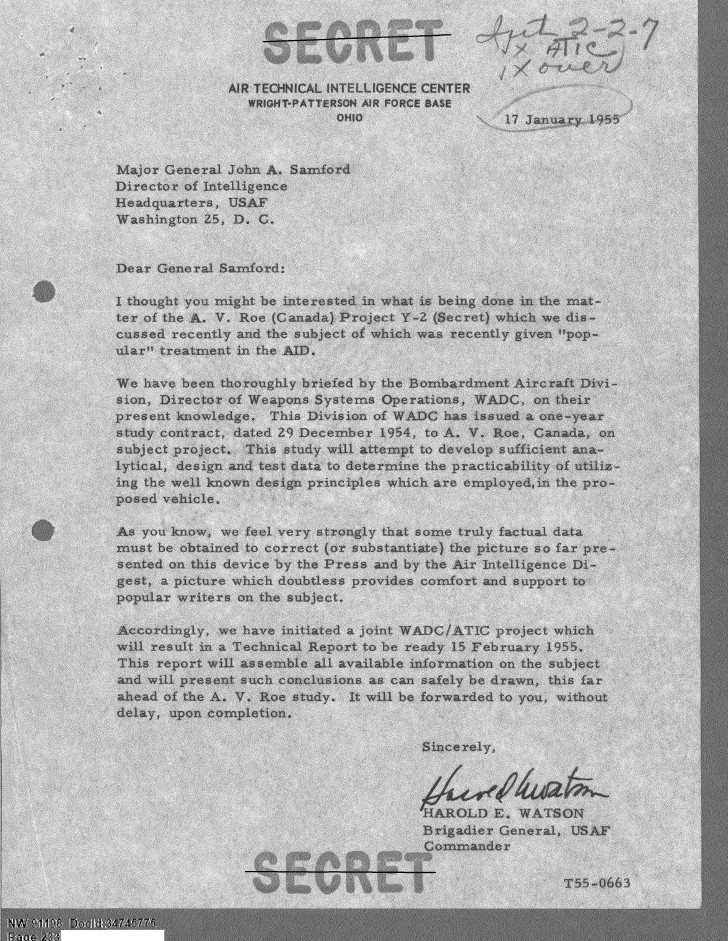
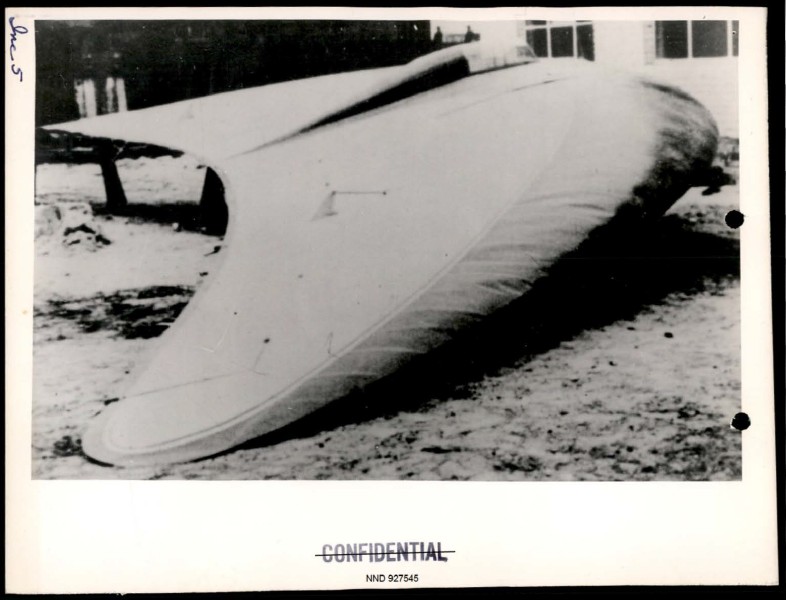
The file links U.S.–Canadian review of Avro circular-aircraft concepts, skeptical technical assessments, intelligence concern about foreign vertical-takeoff work, and a separately reported 1955 KC-97 radar-and-visual incident near Newfoundland. The collection is important for separating documented circular-aircraft research from speculative foreign-program reporting and from an unresolved operational sighting that happened in the same policy environment.
A 220-page Project Blue Book correspondence file documents public requests, interagency routing, overseas reports, standardized sighting collection, program statistics, and at least one reported object later identified as an upper-air sounding device. The collection reveals the administrative infrastructure behind Project Blue Book and shows why a case file can mix useful program records, resolved incidents, public speculation, and unresolved reports.
The 1948 Project Sign progress report tabulated sighting shapes, sounds, speeds, formations, photographs, and technical references, mixing unresolved witness reports with a documented hoax and known circular-aircraft engineering studies. The report demonstrates that early Air Force inquiry combined statistical cataloging, case-level skepticism, photographic review, and conventional aeronautical research rather than treating the sightings as a single phenomenon.
This released document records that the results of the panel's studies have moved CIA to conclude that no National Security Council Intelligence Directive on this sub-~ ject is warranted. The file preserves the source account or analysis but does not independently establish interpretations beyond the cited record. This document is useful as an officially released artifact because it preserves the file's provenance and lets its claims be compared with related Release 03 records.
This released document records that reports of unidentified aerial objects have been received by the U.S. Air Force since mid-1947. The file preserves the source account or analysis but does not independently establish interpretations beyond the cited record. This document is useful as an officially released artifact because it preserves the file's provenance and lets its claims be compared with related Release 03 records.