
DOW-UAP-D095 — U.S.–Canadian Aviation Projects and UFO Reports, 1954–1955
The file links U.S.–Canadian review of Avro circular-aircraft concepts, skeptical technical assessments, intelligence concern about foreign vertical-takeoff work, and a separately reported 1955 KC-97 radar-and-visual incident near Newfoundland. The collection is important for separating documented circular-aircraft research from speculative foreign-program reporting and from an unresolved operational sighting that happened in the same policy environment.
- File
- Document · Release 04
- Date
- 1955
- Location
- Various
- Extent
- 57 pages
Search This File
Probed Assessment
The file links U.S.–Canadian review of Avro circular-aircraft concepts, skeptical technical assessments, intelligence concern about foreign vertical-takeoff work, and a separately reported 1955 KC-97 radar-and-visual incident near Newfoundland.
Key takeaways
- Air Force scientific reviewers examined Project Y/Y2’s radial-flow engine and hovering concept but challenged its claimed advantages and recommended against further U.S. support without better evidence of feasibility.
- Intelligence memoranda cataloged postwar disc-aircraft stories and possible Soviet capability while labeling some reports low reliability or potentially fabricated.
- The project drew broad defense and intelligence interest because a saucer-like aircraft had possible military applications, not because the released review proved successful extraordinary technology.
- War.gov’s description also identifies a 1955 KC-97 case that officials could not reconcile with known systems, but that unresolved report remains distinct from the Avro engineering record.
Why it matters
The collection is important for separating documented circular-aircraft research from speculative foreign-program reporting and from an unresolved operational sighting that happened in the same policy environment.
Corroboration
The records corroborate official technical review and intelligence interest in Avro concepts. They do not validate every postwar German claim, prove a foreign saucer program, or resolve the KC-97 incident.
Open questions
- • What original radar, crew, and committee records survive for the July 1955 KC-97 report?
- • How did later Avro testing compare with the performance assumptions criticized in these reviews?
Probed separates this editorial assessment from the source claims below. It summarizes what the released artifact supports; it is not independent verification.
Official Description from War.gov
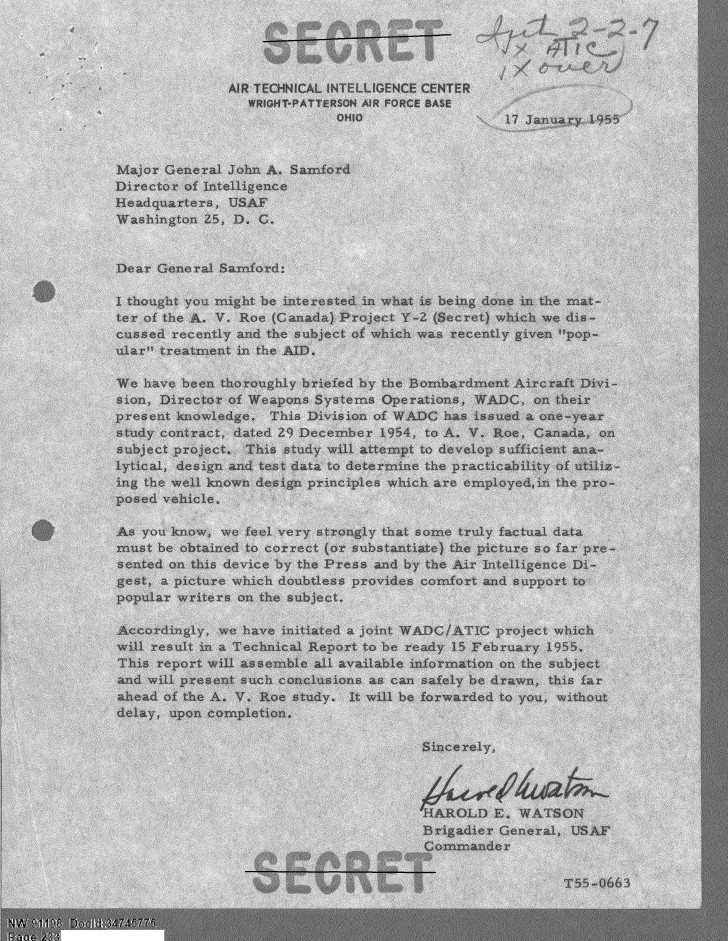
This file contains reports, memoranda, and correspondence concerning various then-developmental vertical take-off and landing (VTOL) aircraft. The file includes assessments of the experimental potential of the “Avro Project Y2,” a joint U.S.-Canadian near-circular VTOL aircraft that is similar in appearance to contemporary popular descriptions of unidentified flying objects (UFO). A 1954 memorandum opines that VTOL aircraft with a circular planform may be mistaken for UFOs to observers unfamiliar with such technologies. It also recommends that UFO reports in the vicinity of Soviet military operations or assets be re-examined to assess whether they may be attributable to previously unknown advanced VTOL aircraft of foreign design. The file also contains correspondence relating to a UFO incident involving a U.S. Air Force (USAF) KC-97 flying near Newfoundland, Canada in July 1955. A USAF committee found that the characteristics described in the report were inconsistent with those of known Soviet, American, or Canadian military systems. The committee was also “unable to explain the simultaneous ground radar returns and aircrew visual sightings.” It also contains correspondence relating to the potential value of data from incidental radar collection of meteors entering the atmosphere. USAF Air Research and Development Command recommended using that data to improve the performance of the AN/FPS-17 radar system. Finally, the file contains correspondence indicating support for the Communications Instructions for Reporting Vital Intelligence Sightings (CIRVIS) program, a joint U.S.-Canadian civil-military program to standardize reporting methods for unusual or unidentified airborne and maritime hazards and threats.
Preserved verbatim as source metadata. This wording is separate from Probed’s file-specific description and assessment.
File Context
Related entities
Tracker findings
A 1954 memo warned that circular VTOL aircraft could be mistaken for UFOs
War.gov says the file evaluates the joint U.S.-Canadian Avro Project Y2, a near-circular vertical-takeoff aircraft. A 1954 memorandum proposed that unfamiliar circular VTOL designs could explain some UFO reports and recommended reexamining reports near Soviet military activity for possible foreign aircraft.
A USAF committee could not explain simultaneous radar and visual reports near Newfoundland
The file includes a July 1955 KC-97 incident near Newfoundland. War.gov says a USAF committee found the reported characteristics inconsistent with known Soviet, American, or Canadian military systems and could not explain the simultaneous ground-radar returns and aircrew visual sightings. That conclusion marks the case unresolved; it does not identify the reported phenomenon.
Release provenance
- Release
- Release 04
- Official ID
- release-04-file-019-dow-uap-d095-joint-u-s-canadian-aviation-projects-and-ufo-sighting-reports-1954-1955
- Cleared
- Jul 10, 2026
Referenced Timeline
Avro project drew U.S. intelligence attention
A newspaper account and official visit were cited as prompting interest in saucer-like vertical-takeoff aircraft.
LinkedAvro CanadaScientific Advisory Board reviewed Project Y2
Air Force scientific panels and a select committee evaluated technical feasibility and U.S. support.
U.S. personnel visited Avro Canada
Bollum and Wainwright reviewed Project Y and related engineering demonstrations in Toronto.
Soviet-capability memorandum prepared
The memorandum summarized the project, briefings, intelligence concerns, and recommendations.
Source Claims
Claims are attributed to the released source and remain distinct from Probed’s assessment and tracker findings.
Scientific Advisory Board panels initially concluded that the Avro project warranted no more than limited support and appointed a select committee for further review.
the tentative conclusions of both panels were to the effect that this project warranted no more than limited support
The technical review described Y2 as an approximately circular aircraft built around a radial-flow turbojet, with exhaust deflected downward for takeoff and hovering.
is an airplane of cire around a radial flow turbojet
Reviewers challenged several claimed forward-flight advantages and warned that emphasis on hovering might compromise ordinary aircraft performance.
we are compelled to take exception to all three of these claims
The committee recommended against additional U.S. support until Avro demonstrated greater potential through its own analysis and development work.
We recommend against further support
A 1954 intelligence memorandum assigned an inquiry into Soviet capability to develop a vertical-takeoff aircraft that could resemble a flying saucer.
investigating possible Soviet capabilities for developing and producing a Vertical Take-Off Aircraft
The memorandum cataloged postwar German disc-aircraft stories involving George Klein, Otto Habermohl, Rudolf Schriever, and Robert Miethe, presenting them as reports and claims rather than verified programs.
claims to have been chief engineer of all flying disc projects
The project was briefed to personnel from the Army, Marine Corps, CIA scientific intelligence, Strategic Air Command, Air Defense Command, and RAND, showing broad defense interest despite technical disagreement.
Key Personnel of CIA-OSI
The memorandum records that Air Technical Intelligence Center personnel considered Project Y2’s success doubtful and recommends separating intelligence on terrestrial saucer-shaped aircraft from ordinary UFO processing.
success of Project "Y2" is very doubtful
The briefing’s stated purpose was to explain the U.S.-funded project and argue that another nation might fly such an aircraft first.
there is a very good possibility that we may not be the nation to successfully fly such an aircraft
The briefing described Avro Canada as beginning fabrication work on related configurations and anticipated a first flight test in spring 1956.
A.V. Roe Canada, Limited at this time are starting fabrication
The design briefing described a large radial-flow gas turbine and claimed a ground-effect lift increase, while the earlier scientific review remained skeptical of overall performance.
Tests have shown that the jet lift is increased several times over that of a flat disc near the ground
The concept study considered guns, rockets, radar, guided missiles, and a larger bomber version, demonstrating that the project was evaluated as a potential military aircraft.
Guns or rockets may be mounted in the nose
The intelligence briefing discussed two explicitly low-reliability reports and acknowledged that they might have been fabricated.
Two particular reports, although of low reliability, are of interest
Source Material & Evidence
Research Map
Lines appear only when two entities share a row-level source claim or dated timeline event. Unconnected nodes remain visible without implying a relationship.