Probed ingest of: THE WIDE ANGLE: Princeton's 64 Telescopes Just Broke the Comet Model
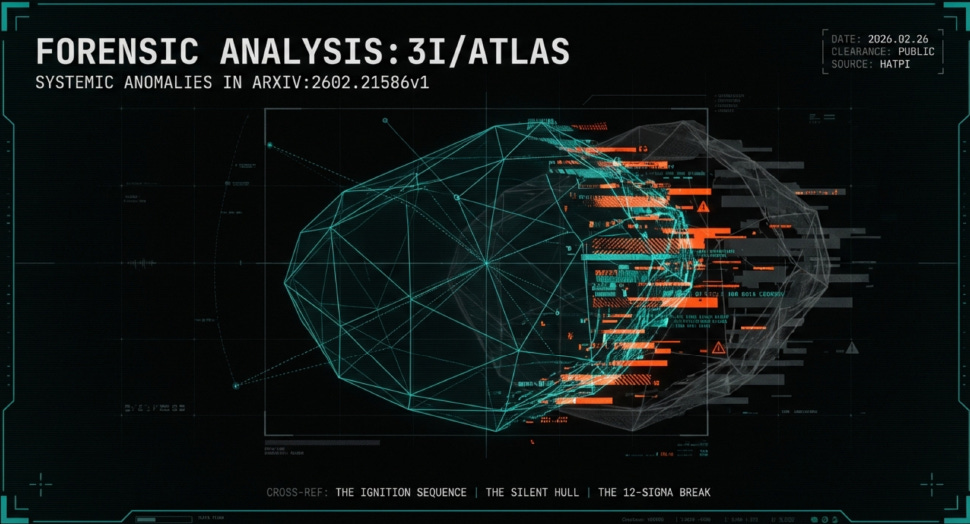
Sentinel argues that Princeton’s HATPI observations of 3I/ATLAS contain photometric features and model tensions that are difficult to reconcile with a standard comet interpretation.
Source Claims
6- Source reportedAsserted
The article states that four teams have independently confirmed that the exterior of 3I/ATLAS is driving the interior.
Four teams have now independently confirmed the exact same thing.
- Source reportedAsserted
The article states that Princeton's data shows 3I/ATLAS brightens faster when more of the outer structure is included in the frame.
Princeton just measured it the simplest way possible: they widened their camera lens. And they found that the more of the outer structure they included in the frame, the faster the object was brightening.
- Source reportedAsserted
Sentinel argues that the Princeton team widened uncertainty treatment in a way that reduced the apparent tension with a standard comet model.
Buried in Section 3 is a staggering admission: the data didn’t fit the comet model, so the authors artificially inflated their own error bars until the mathematical discrepancy disappeared.
- Source reportedAsserted
Sentinel argues that a pre-discovery brightness outlier identified in archival HATPI data was not carried forward into the published presentation of the object’s light curve. 
On May 23, 2025, while digging through these archives, HATPI detected 3I. According to their own models, the object should have been incredibly faint. Instead, it was 5.6-sigma brighter than expected.
- Source reportedAsserted
Sentinel reports that the Princeton team found no significant intra-night variability across the nights it analyzed.
Once 3I was bright enough to measure clearly, the Princeton team examined twelve straight nights of data looking for short-term flickering or pulsing. They found nothing.
- Source reportedAsserted
Sentinel reports that inbound observations showed several species associated with heating activity, while C2 remained absent until later in the object’s evolution. 
During the inbound heating phase, 3I released Cyanide (CN), Nickel, and Iron. But the Princeton team confirmed there was no Carbon (C2) in the envelope.
Structure Across Time
How the key people and organizations in this source are involved as events unfold. Built from the extracted timeline — co-appearance here reflects the source’s narrative, not verified coordination.
Official discovery of 3I/ATLAS
3I/ATLAS was officially discovered.
5.6-sigma brightness spike
HATPI detected 3I with a significant brightness spike.
Princeton's HATPI observations
Princeton team extracted observations of 3I spanning this period.
RELATED ENTITIES
(12)Source Material
5Source Documents
1Research Map
Entities are linked when they share a claim or a dated event in this source. Tap any node to see why it’s here.
Deep probes
20Probed ingest of: THE COMPLEX: The Pentagon Just Published the 1949 Green Fireball Files. Our 2026 Coverage Says They Are Returning.
The Sentinel Network · May 27Probed ingest of: THE SIGNAL #007: THE PROBABILITY
The Sentinel Network · May 26Probed ingest of: THE CORPUS: NSA Argued This File Would Damage National Security. Page 236 Reads “Thirteen MIGs Chased One UFO.”
The Sentinel Network · May 21Probed ingest of: THE PRIORS: Kevin Patrick Childress Created a Reddit Account Before AATIP Broke.
The Sentinel Network · May 20Probed ingest of: THE MISSING BIN: We Said SETI Couldn’t Hear a Probe. We Spent 163 Hours Reprocessing Their Data.
The Sentinel Network · May 14Probed ingest of: THE REFRACTOR: A Pentagon Deadline for 46 UAP Videos Lapsed in Silence. The Same 46 Surfaced Elsewhere.
The Sentinel Network · May 7Probed ingest of: THE VIEWPORT: We Built 3I/ATLAS.
The Sentinel Network · May 6Probed ingest of: THE BAIT: A Fabricated Jupiter Impact Reached Our Inbox. Two Weeks of Verification Said No.
The Sentinel Network · May 4 The Sentinel Network