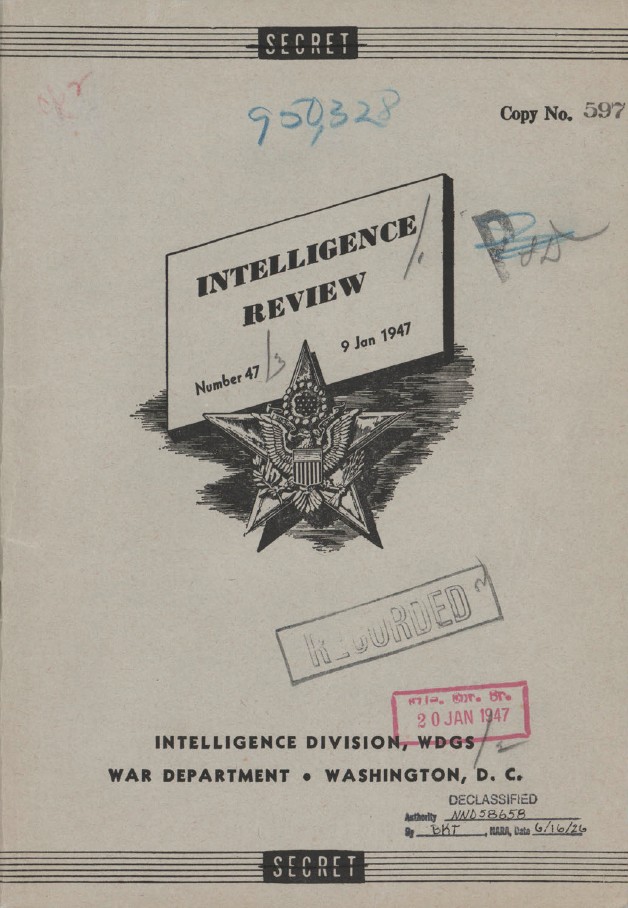

DOW-UAP-D099, Intelligence Review of “Ghost Rocket” Incidents, 1947
A January 1947 War Department intelligence review assesses the 1946 Scandinavian “ghost rocket” reports. It contrasts highly variable witness accounts with official investigations, notes the absence of recovered direct evidence, and concludes that only a small number may have involved low-flying V-1-type missiles while many high-altitude reports were likely meteors or fireworks.
- File
- Document · Release 05
- Date
- Jan 9, 1947
- Location
- Sweden
- Extent
- 8 pages
Search This File
Probed Assessment
Key takeaways
- The review traces press reports of “ghost rockets” from southern Sweden in May 1946 to later reports in Finland and Denmark.
- The two most common descriptions were a fireball with a tail and a shiny cigar-shaped object; reported directions varied widely.
- The review highlights an observation attributed to a Swedish Air Force pilot as one of its more detailed cases.
Why it matters
This 8-page official record adds page-located primary-source material to the public history represented in Release 05. Its value lies in what the document records, not in independent confirmation of every reported event or estimate.
Corroboration
The assessment is grounded in the official PDF, reviewed page text, and faithful source excerpts. Statements attributed to witnesses or agencies remain source claims unless separately corroborated in the record.
Open questions
- • Which reported observations or technical estimates can be independently corroborated from contemporaneous records?
Probed separates this editorial assessment from the source claims below. It summarizes what the released artifact supports; it is not independent verification.
Official Description from War.gov
This document is a U.S. Department of War General Staff intelligence review assessing incidents involving unidentified “Ghost Rockets” reported over Sweden and other Scandinavian countries beginning in May 1946. The review includes an analysis of observational reports, statements from the Swedish government, and reporting from the U.S. military attaché in Stockholm. The review highlights the inconclusive nature of the contemporary evidence available to substantiate reports from civilian and military observers. The review also documents a change in the public stance of the Swedish Defense Staff, which privately attributed the objects to Soviet V-1 missile tests launched from Peenemünde. Peenemünde is a then-occupied municipality in northeastern Germany that had been associated with the development of the V-1 and V-2 rocket program during World War II. The Swedish assessment publicly shifted from an unknown technological origin to one of a “celestial origin.” The review suggests that this shift was a deliberate effort to avoid diplomatic conflict with the Soviet Union. The report’s final assessment concludes that while most reported incidents were likely misidentified natural phenomena, the “best evidence” suggested a small number of “real incidents” involving low-flying V-1 type missiles, likely attributable to Soviet tests of captured German technology.
Preserved verbatim as source metadata. This wording is separate from Probed’s file-specific description and assessment.
File Context
Related entities
Tracker findings
The review states that U.S. military and naval personnel in Sweden had not
The record states: The review states that U.S. military and naval personnel in Sweden had not seen fragments, impact points, or other direct physical evidence.
The two most common descriptions were a fireball
The record states: The two most common descriptions were a fireball with a tail and a shiny cigar-shaped object; reported directions varied widely.
Ghost rocket reports spread across Scandinavia in 1946
The record states: The review traces press reports of “ghost rockets” from southern Sweden in May 1946 to later reports in Finland and Denmark.
Pilot account described no wings, rudder, flame, or light
The record states: That pilot account described an object without visible wings, rudder, projecting parts, flame, or light.
Swedish assessment shifted toward celestial explanations
The record states: It records a Swedish assessment that most reported incidents were celestial in origin, reversing an earlier position.
Review allowed that a few reports might involve V-1-type missiles
The record states: The review judged that only a small number of reports might have involved low-flying V-1-type missiles.
High-altitude reports were assessed as meteors or fireworks
The record states: It assessed the reported high-altitude incidents as meteors or fireworks.
Release provenance
- Release
- Release 05
- Official ID
- release-05-file-014-dow-uap-d099-intelligence-review-of-ghost-rocket-incidents-1947
- Cleared
- Aug 7, 2026
Related coverage
Referenced Timeline
First southern Sweden reports
The review dates the first press reports of flying missiles over southern Sweden to late May 1946.
Intelligence review published
The War Department Intelligence Division publication is dated January 20, 1947.
Source Claims
Claims are attributed to the released source and remain distinct from Probed’s assessment and tracker findings.
The review traces press reports of “ghost rockets” from southern Sweden in May 1946 to later reports in Finland and Denmark.
FEATURE SECTION "GHOST ROCKETS" OVER SCANDINAVIA Flying missiles were first reported over southern Sweden in late May 1946 by the press, which gave the missiles the name of "Ghost Rockets." In June, the missiles also had been reported over Finland and Denmark.
The two most common descriptions were a fireball with a tail and a shiny cigar-shaped object; reported directions varied widely.
Missile The two most common descriptions of the missiles were "a ball of fire with a tail" and a "shiny cigar-shaped object." The reported direction of flight covered all points of the compass, with a northerly direction bei ng slightly pre dominant.
The review highlights an observation attributed to a Swedish Air Force pilot as one of its more detailed cases.
GHOST ROCKETS ..sBORB'F layman is that of a Swedish Air Force pilot.
That pilot account described an object without visible wings, rudder, projecting parts, flame, or light.
The missile had no visible wings, rudder, or other projecting part; and there was no indication of any flame or Jight as has been reported in the majority of other sightings.
The review states that U.S. military and naval personnel in Sweden had not seen fragments, impact points, or other direct physical evidence.
To date, no United States military or naval personnel in Sweden have seen any frag ments, points of impact, or other direct evidence to prove that guided missiles have appeared over Sweden.
It records a Swedish assessment that most reported incidents were celestial in origin, reversing an earlier position.
that the great majority of the reported incidents were of celestial origin, which is a complete change from the one of 6 August when it was reported that, except in a few cases, they could not be meteorites.* Attitude of Swedish Officials
The review judged that only a small number of reports might have involved low-flying V-1-type missiles.
The best evidence, at present, is that there have been only 2 or 3 real incidents, perhaps as many as 5 or 10, of low-flying missiles of the V-1 type.
It assessed the reported high-altitude incidents as meteors or fireworks.
The high-altitude missiles reported seem definitely to have been meteors or fireworks.
Source Material & Evidence
Research Map
Lines appear only when two entities share a row-level source claim or dated timeline event. Unconnected nodes remain visible without implying a relationship.