
DOW-UAP-D100, Air Materiel Command Report on Unidentified Flying Objects
This 245-page historical file assembles 1947-1948 Air Force correspondence, sighting reports, investigative requests, policy memoranda, and analytical papers associated with flying-disc inquiries and Project SIGN. It documents how Air Materiel Command gathered reports, coordinated intelligence collection, evaluated possible explanations, and considered the problem unresolved despite identifying some reports as balloons or astronomical objects.
- File
- Document · Release 05
- Date
- 1947-1948
- Extent
- 245 pages
- Agency
- Department of War
Search This File
Probed Assessment
Key takeaways
- A December 1947 directive required Air Materiel Command to establish Project SIGN.
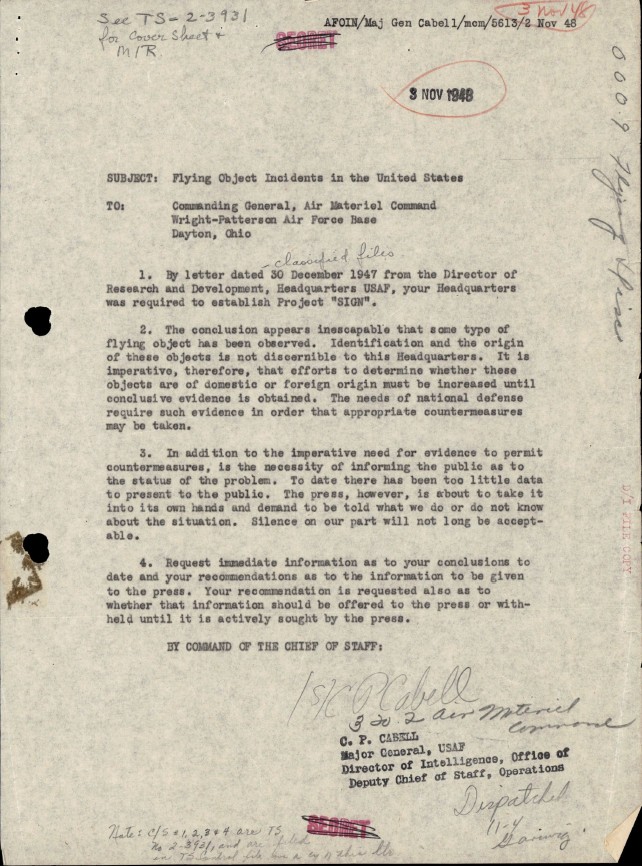
- A headquarters memorandum said many incidents had ordinary explanations but that some reports still lacked a reasonable everyday explanation.
- The same memorandum stated that the available record did not conclusively establish unknown objects, apart from known balloons, as aircraft.
Why it matters
This 245-page official record adds page-located primary-source material to the public history represented in Release 05. Its value lies in what the document records, not in independent confirmation of every reported event or estimate.
Corroboration
The assessment is grounded in the official PDF, reviewed page text, and faithful source excerpts. Statements attributed to witnesses or agencies remain source claims unless separately corroborated in the record.
Open questions
- • Which reported observations or technical estimates can be independently corroborated from contemporaneous records?
Probed separates this editorial assessment from the source claims below. It summarizes what the released artifact supports; it is not independent verification.
Official Description from War.gov
This file is a collection of U.S. Government memoranda and correspondence relating to “Project Sign,” a 1948 U.S. Air Force program to investigate reports of high-performance airborne objects. The documents characterize some of these reports as being consistent with “real” objects rather than fabrications or resulting from perceptual errors. The U.S. Air Force cites the reported characteristics of the phenomena, e.g., high speed and maneuverability, as exceeding known performance envelopes of U.S. military aircraft and thereby presenting a potential national security threat, if validated. This potential threat prompted the Air Force to call on the Air Materiel Command (AMC), the Service’s Major Command for logistics and procurement from 1946 to 1961, to gather further evidence to assess the validity of the reports. The Air Force emphasized that there was an “imperative need” for such evidence to enable appropriate countermeasures. The stated urgency of this request reflects the strategic environment of the early Cold War, a period characterized by heightened national defense concerns amid rapid global advancements in aerospace design and development. In framing the call for an investigation, the Air Force noted that sustained public interest and persistent inquiries from the press may eventually require an official statement in response. AMC’s investigation found that observers were generally not mistaken when reporting that they had seen an airborne object, but that their characterizations of those objects as unusual was likely a reflection of the “limits of their personal experience.” It identified “a great many” of the objects reported with a rounded appearance as “weather or upper air scientific balloons of some type.” It also identified several cases in which the reported objects were most likely celestial phenomena, such as Venus. AMC found that a small number of reports lacked a “reasonable everyday explanation,” but that “so far, no physical evidence of the existence of the unidentified sightings has been obtained.” AMC expressly considered whether the phenomena may have been “vehicles from another planet,” but found no evidence supporting such an origin. Ultimately, AMC found that “there is as yet no conclusive proof that unidentified flying objects, other than those which are known to be balloons, are real aircraft.” In light of these findings, AMC recommended that the Department of War should avoid publicly commenting on the subject of “flying discs.” Responding to the Air Force’s anticipated concerns regarding public interest in the subject, AMC recommended that the Department should reply in terms that minimize the investigation’s inconclusive findings, focusing on positive determinations in cases assessed to be weather balloons and celestial phenomena.
Preserved verbatim as source metadata. This wording is separate from Probed’s file-specific description and assessment.
File Context
Related entities
Tracker findings
The same memorandum stated that the available record did not conclusively
The record states: The same memorandum stated that the available record did not conclusively establish unknown objects, apart from known balloons, as aircraft.
A pilot report places an unidentified object south of Anacostia Naval Air
The record states: A pilot report places an unidentified object south of Anacostia Naval Air Station at about 5,500 feet.
December 1947 directive required creation of Project SIGN
The record states: A December 1947 directive required Air Materiel Command to establish Project SIGN.
Some reports still lacked an ordinary explanation
The record states: A headquarters memorandum said many incidents had ordinary explanations but that some reports still lacked a reasonable everyday explanation.
Civilian letter described a July 4, 1948 night-sky observation
The record states: A civilian letter describes a July 4, 1948 observation made while the writer and his wife watched the night sky.
Project charter defined collection and evaluation duties
The record states: The project charter called for collecting, collating, evaluating, and distributing reports of unusual atmospheric sightings.
Planning paper sought priority, classification, and a code name
The record states: A planning document recommended assigning priority, a security classification, and a code name to a detailed study of the reports.
Intelligence paper proposed action on flying-disc reports
The record states: An intelligence action paper proposed recommendations concerning problems raised by “flying disc” reports.
Air Force intelligence analyzed reports from the United States and abroad
The record states: The file records Air Force intelligence efforts to analyze reports from the United States and abroad and request Air Materiel Command support.
Analysis considered flying-wing and foreign-control hypotheses
The record states: One analysis considered flying-wing aircraft designs and the possibility of control by a foreign power among several hypotheses.
Release provenance
- Release
- Release 05
- Official ID
- release-05-file-015-dow-uap-d100-air-materiel-command-report-on-unidentified-flying-objects-1947-1948
- Cleared
- Aug 7, 2026
Related coverage
Referenced Timeline
Air Materiel Command project directed
Air Force correspondence records instructions to establish a project to collect and evaluate flying-disc reports.
Project SIGN correspondence issued
Air Materiel Command correspondence identifies the investigation as Project SIGN.
Flying-object report forwarded
The file includes a November 1948 Air Materiel Command assessment forwarded to Air Force leadership.
Source Claims
Claims are attributed to the released source and remain distinct from Probed’s assessment and tracker findings.
A December 1947 directive required Air Materiel Command to establish Project SIGN.
By letter dated 50 December 1947 from the Director of Research and Development, Headquarters USAF, your Headquarters was required to establish Project "SIGN".
A headquarters memorandum said many incidents had ordinary explanations but that some reports still lacked a reasonable everyday explanation.
to CG, AMC, "Flying Object Incidents in the United States" 6, Although explanation of many of the incidents can be obtained from the investigations described above, there remains a certain number of re- ports for which no reasonable everyday explanation is available.
The same memorandum stated that the available record did not conclusively establish unknown objects, apart from known balloons, as aircraft.
lst Ind Basic ltr fr Hq USAF, 3 Nov 48 to CG, AMC, "Flying Object Incidents in the United States" be There is as yet no conclusive proof that unidentified flying objects, other than those which are known to be balloons, are
One section discusses the investigation and possible identification of reported “flying saucers.”
saucers 2 ,o the identification of some of thes sbijects as The investigation of such reported Materiel Command, Wright-Patterson Air
The collection includes an October 7, 1948 Project SIGN memorandum to the Chief of Staff of the Air Force.
7 October 1948 SUBJETT: Project "SIGN" TO: Chief of Staff, USAF Washington 25, D.C.
A civilian letter describes a July 4, 1948 observation made while the writer and his wife watched the night sky.
TO WHOM IT MAY CONCERN: Dear Sir: On the Fourth of July (July ), 1948) my wife and I were sitting on a bench on our lawn and we were watching the stars, planes, etc., At 11:15 P.M.
A pilot report places an unidentified object south of Anacostia Naval Air Station at about 5,500 feet.
At approximaely 1015 local time, at an altitude of about 5500 feet, on a magnetic Leading of about 180 degrees, j st south of Anacostia Naval Air Station, an object was sighted ahead to the left and about 1000 feet below af
An April 13, 1948 memorandum records Air Materiel Command interest in interrogating the Horten brothers.
MCIAXD/HWS /dw’ Wright Field, Dayton, Ohio Apr 13, 1948 REFERENCE A 4062 Interrogation of Horten Brothers Chief of Staff United States Air Washington 25, D.
A January 23, 1948 memorandum addresses Project SIGN from Air Materiel Command to Air Force headquarters.
In reply address both communication and en- MCIA/ACL/amb velope to Commanding Wright Field, Dayton, Ohio General, Air Materiel Command, Attention 23 January 19,8 following office symbol: MCIA Project "SIGN" Chief of Staff United States Air Force Washington 25, D.
A Swedish aviation source described local guided-missile development difficulties and consultation with a German specialist.
Wilkenson descrived efforts of the Swedish government and his company to perfect V-l type guided missiles and stated that they were experiencing considerable difficulty in matters of fuel ‘consumption and that they had called in &@ German scientist who was an expert
The project charter called for collecting, collating, evaluating, and distributing reports of unusual atmospheric sightings.
above, the Commanding General, Air Materiel Command was instructed to "set up a project whose purpose is to collect, collate, evaluate and distribute to interested government agencies end contractors all information concerning sightings and phenomena in the atmosphere which can be construed
A planning document recommended assigning priority, a security classification, and a code name to a detailed study of the reports.
Ae 60OsdaE%jysdis recommended thatie~ &@e Headquarters, Aruy Air Forces issue a directive assigning & priority, security classifiestion and Code Name for a detailed study of this miter to inc.iude the preparation of -comlete sete of all available and pertinent date which will
An intelligence action paper proposed recommendations concerning problems raised by “flying disc” reports.
To prepare for signature of the Director of Intelligence an R&R for the Director of Research and Development outlining available information and recommendations concerning problems proposed by "flying discs.* ACTS AND DISCUSSION: 2.
The file records Air Force intelligence efforts to analyze reports from the United States and abroad and request Air Materiel Command support.
In addition to amalyszing the reperts concerning flying diecs and other phenomena observed both in the United States and eleewhere in the world, the lirectorate of Intelligence, USAT, hase taken the follow ing eetien: (1) Requested the “ir Material Coumend te conduct
One analysis considered flying-wing aircraft designs and the possibility of control by a foreign power among several hypotheses.
Ste (>) The BP~130, a long range bouber, was a flying wing design that could satisfy the few indicated features of the "flying discs," (7) Analysed the possibility that the flying objects wore operated or controlled by representatives of a foreign principal
Source Material & Evidence
Research Map
Lines appear only when two entities share a row-level source claim or dated timeline event. Unconnected nodes remain visible without implying a relationship.