Probed ingest of: THE OPERATOR: A Counterintelligence Officer Built the UFO Disclosure Movement. He Never Left the Payroll.
The architecture of managed disclosure, mapped from Wright-Patterson to your social media feed.
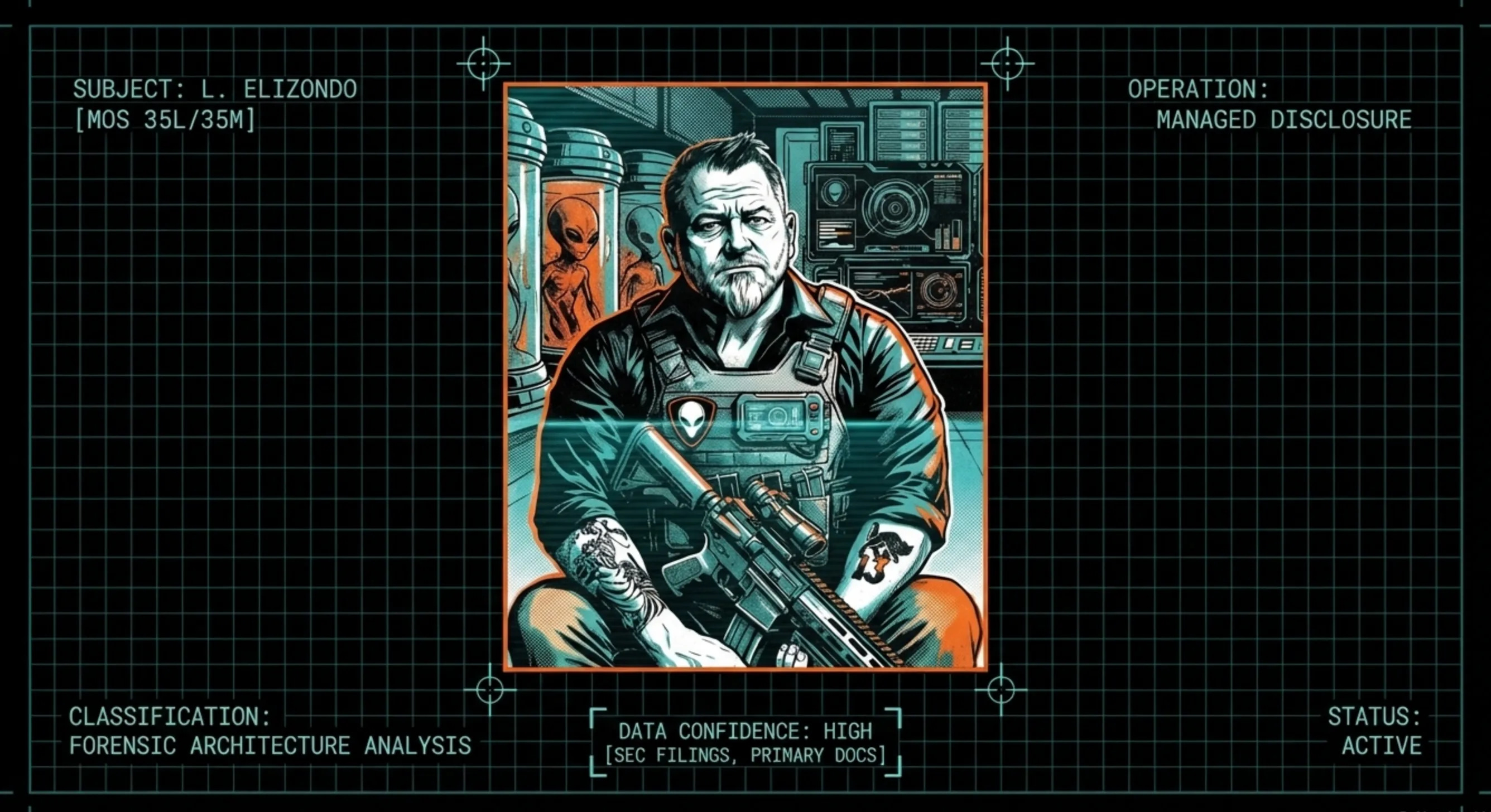



Key Claims
28- Luis Elizondo was confirmed in August 2022 to be on the government payroll.factual
In August 2022, Pentagon spokesperson Susan Gough confirmed that Elizondo provided technical advice on a variety of classified topics for the United States Space Force.
- The article argues that Elizondo helped shape a public-facing UAP narrative while maintaining ties to the defense establishment. interpretation
The article’s central thesis is that Elizondo helped shape what the public believes about UAPs while still maintaining an operational relationship with the defense establishment.
- Elizondo’s military background was in Army counterintelligence.factual
The article says Elizondo enlisted in 1995, served for roughly two decades, and held Army counterintelligence designations including MOS 35L and 35M.
- The article characterizes Elizondo’s background as involving counterintelligence tradecraft, including deception and influence-related functions. inference
The article characterizes his background as involving threat identification, asset recruitment, deception operations, information campaigns, and neutralization of disruptors.
- Elizondo’s 2016 performance review praised his management of highly classified programs.factual
The article says his final DoD performance evaluation praised his ability to manage highly classified programs on a global scale.
- Elizondo’s performance review referenced insider-threat and covert-action policy work.factual
Citing Keith Kloor’s reporting, the article says the evaluator noted Elizondo’s office had identified and neutralized six insider threats and co-authored four national-level policies involving covert action.
- Elizondo gave multiple explanations for leaving the Pentagon.factual
The article says he cited a fleeting job opportunity on October 3, a resignation letter to Secretary Mattis on October 4, and family stress on October 6.
- Elizondo drafted a transition memo before resigning.factual
The article says that on September 25, 2017, he sent an email attaching a draft memo titled “AATIP-DDI TCSP” to help transfer responsibilities.
- The article argues that the documentary record suggests Elizondo’s departure was planned rather than spontaneous. interpretation
The article argues that the documentary record points to an orderly, pre-coordinated exit rather than a sudden act of whistleblowing.
- Elizondo later said his exit was coordinated with Jay Stratton.factual
The article says Elizondo later confirmed in his memoir that the resignation was coordinated in advance with Jay Stratton.
- The article argues that inconsistencies in Elizondo’s resignation narrative suggest a staged public-facing exit. interpretation
The article argues that inconsistencies in Elizondo’s resignation narrative suggest a staged public-facing exit.
- Elizondo’s resignation letter to Mattis was delivered by an unnamed third party.factual
The article says the letter was delivered to the USDI Chief of Staff’s office by an unnamed third party of uncertain provenance after Elizondo had already left the building.
- FOIA-recovered emails indicate that Elizondo remained in contact with Brennan McKernan after his departure from the Pentagon.factual
The article says FOIA-recovered emails showed regular and casual communication between Elizondo and Brennan McKernan after the DoD said Elizondo’s own emails had been destroyed.
- The article argues that Elizondo’s later access to classified spaces may reflect ongoing institutional ties. inference
The article argues that Elizondo’s ability to brief Congress in SCIFs is evidence of continuing access through an active operational relationship with the defense establishment.
- Elizondo joined To The Stars Academy shortly after resigning.factual
Days after his October 2017 resignation, Elizondo joined To The Stars Academy of Arts and Science as Chief of Security and Special Programs.
- TTSA raised capital through a Regulation A+ offering.factual
The article says TTSA used a Regulation A+ offering to sell shares directly to non-accredited retail investors without a traditional IPO.
- TTSA insiders granted themselves stock options and restricted stock units before the public offering.factual
Before the offering ever opened to the public, the company’s officers and directors granted themselves 9,000,000 stock options and 2,500,000 restricted stock units.
- TTSA’s public shareholders were warned they would be diluted.factual
The article says TTSA’s SEC filings warned that the ownership percentage of existing stockholders would be diluted as insiders exercised their options.
- The article argues that TTSA ultimately functioned more as an entertainment vehicle than as a developer of breakthrough aerospace technology. interpretation
The article argues that the company’s real product became entertainment content, including Unidentified on the History Channel, rather than advanced aerospace engineering.
- Elizondo’s book Imminent went through the Pentagon’s manuscript clearance process.factual
Elizondo published Imminent through HarperCollins in August 2024, and the book went through the Pentagon’s Defense Office of Prepublication and Security Review.
- The article argues that the redactions in Imminent may reflect curation rather than straightforward suppression. interpretation
The article argues the redactions do not prove suppression but instead preserve mystique and signal hidden knowledge without forcing official confirmation.
- Elizondo has publicly supported amnesty for defense contractors tied to alleged UAP programs.factual
The article says Elizondo has repeatedly advocated legal frameworks that would grant immunity to private aerospace defense contractors and managers allegedly involved in hidden reverse-engineering efforts.
- The article argues that broad amnesty proposals would primarily benefit defense contractors rather than the public. interpretation
The article argues that the beneficiaries of blanket amnesty would be defense contractors rather than the public or genuine whistleblowers.
- The article alleges coordinated harassment targeting critics of Elizondo’s narrative.interpretation
The article says multiple independent researchers who publicly questioned the Elizondo narrative were subjected to coordinated digital harassment, doxxing, and threats.
- The article argues that the harassment pattern appears more organized than ordinary fan behavior and may reflect a suppression effort. interpretation
The article argues that the clean strategic layer and deniable tactical layer of the network are consistent with organized suppression rather than random fan behavior.
- The Sentinel Network alleges that its reporting has been met with what it describes as coordinated suppression, bot-pattern amplification, and identity-focused attacks.inference
The article says that since December 2025, its reporting on 3I/ATLAS has been met with coordinated suppression, bot-pattern amplification, and identity-focused attacks.
- The article argues that some experiencers may be especially vulnerable to recruitment and manipulation.interpretation
Citing research on fantasy proneness, absorption, dissociativity, and susceptibility to false memories, the article says experiencers could be especially useful to a handler seeking loyal assets.
- The article argues that the Elizondo-centered disclosure movement functions as a limited hangout. interpretation
The article argues that the movement reveals enough to satisfy public curiosity while protecting deeper institutional interests and maintaining narrative control.
Evidence
8Source Documents
4Event Timeline
The Sentinel Network publishes “The Operator”
The article argues that Elizondo’s role in modern UFO disclosure reflects a managed information architecture rather than a rogue whistleblower narrative.
Recovered Elizondo emails are published
John Greenwald of The Black Vault publishes recovered emails between Elizondo and Brennan McKernan obtained through lateral FOIA requests.
Article cites identity-focused attacks
The article points to public attacks it says were part of an effort to expose and discredit The Sentinel Network.
Article says attacks shift toward unmasking
The article says online comments moved away from attacking the data and toward demanding the real identities behind the publication.
Article alleges shift in attack tactics
The article alleges that hostile accounts stopped arguing the data and shifted toward identity exposure and messenger-focused attacks.
William McCasland disappears
McCasland is last known to have interacted normally with a repairman before vanishing from his Albuquerque home within a narrow 54-minute window.
Early public identity attacks are archived
The article says it preserved examples of public posts framing The Sentinel Network as suspicious, anonymous, or inauthentic.
“The Suppression Gradient” briefing is published
The Sentinel Network says the briefing documented what it describes as a coordinated suppression campaign tied to its reporting on 3I/ATLAS.
The Sentinel says suppression campaign begins
The article says its reporting on 3I/ATLAS began drawing what it describes as coordinated suppression efforts starting in December 2025.
Jay Anderson discusses harassment allegations on Joe Rogan
Anderson appears on The Joe Rogan Experience and argues that Elizondo’s public posture encouraged aggressive supporter behavior that functioned as a control mechanism.
“Imminent” is published
Elizondo’s memoir is published through HarperCollins after going through the Pentagon’s DOPSR manuscript clearance process.
Space Force employment is publicly confirmed
Pentagon spokesperson Susan Gough confirms that Elizondo provides technical advice on a variety of classified topics for the United States Space Force.
TTSA insider options become vested and exercisable
SEC filings cited in the article say more than five million insider options had vested by this point.
Elizondo gives a family-stress explanation for resigning
According to the article, Elizondo tells a superior by phone that he resigned because the job was too stressful on his family.
Elizondo resigns from the Pentagon
The article treats the resignation letter to Secretary Mattis as central to the public narrative surrounding Elizondo’s departure.
The Mattis resignation letter is delivered by a third party
The article says the letter was not personally submitted by Elizondo and was instead delivered after he had already left the building.
Elizondo cites a fleeting job opportunity
The article says Elizondo informed his direct supervisor he was leaving for a fleeting job opportunity requiring immediate availability.
The draft AATIP transition memo is actively reviewed
Neill Tipton replies that he is reviewing the memo Elizondo had drafted to support the handoff of AATIP responsibilities.
Elizondo drafts an AATIP transition memo
An email cited in the article says Elizondo prepared an unclassified memo to help assume new AATIP responsibilities under front office guidance.
Tom DeLonge emails John Podesta about McCasland
DeLonge says McCasland was “in charge of all of the stuff” at Wright-Patterson and helped assemble his advisory team.
Elizondo receives a strong DoD performance evaluation
The article says his final evaluation praised his management of highly classified programs and referenced insider-threat and covert-action policy work.
Elizondo joins To The Stars Academy
Days after resigning, Elizondo joins TTSA as Chief of Security and Special Programs alongside Christopher Mellon.
McCasland commands AFRL at Wright-Patterson
The article identifies this period as important because of Wright-Patterson’s long-running place in UFO and aerospace secrecy lore.
Elizondo enlists in the U.S. Army
The article says this marks the beginning of the career that later positioned him as a counterintelligence figure in the disclosure movement.
Deep probes
20FIELDCRAFT #003 — THE PUBLIC RECORD
2d agoTHE MURMURATION: A viral UFO video fails every test for non-biological behavior.
4d agoTHE REFINED FUEL: They Clocked the Exhaust of 3I/ATLAS at Closest Approach. Half Speed. Wrong Direction. And the Sulfur Is Gone.
5d agoTHE FLOOR: The Japanese Parliament Just Opened a National Security Session With Dead and Missing American Defense Personnel.
5d agoTHE ARCHITECT: A Lockheed Martin Vice President Proposed Transferring Crash Retrieval Hardware to the Pentagon. He Died Without a Record.
6d agoTHE RECORD: Full English Translation of Japan's 4th UAP Parliamentary Session.
6d agoTHE DIAGNOSTIC GAP: The ISS cannot tell if your brain is bleeding.
Mar 30FIELDCRAFT #002 — THE PAPER TRAIL
Mar 28