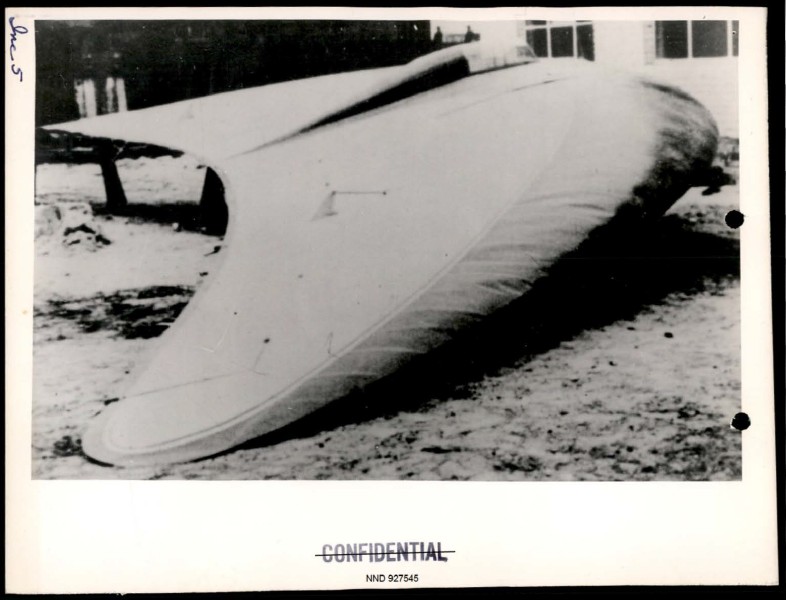

DOW-UAP-D097 — Project Sign Progress Report, 1948
The 1948 Project Sign progress report tabulated sighting shapes, sounds, speeds, formations, photographs, and technical references, mixing unresolved witness reports with a documented hoax and known circular-aircraft engineering studies. The report demonstrates that early Air Force inquiry combined statistical cataloging, case-level skepticism, photographic review, and conventional aeronautical research rather than treating the sightings as a single phenomenon.
- File
- Document · Release 04
- Date
- 1948
- Location
- Various
- Extent
- 45 pages
Search This File
Probed Assessment
The 1948 Project Sign progress report tabulated sighting shapes, sounds, speeds, formations, photographs, and technical references, mixing unresolved witness reports with a documented hoax and known circular-aircraft engineering studies.
Key takeaways
- Project Sign’s tables recorded recurring shapes and reported performance, but the underlying size, speed, and maneuver estimates varied widely and came largely from observers.
- The case review did not accept every submission: one photograph and story were labeled a publicity-and-money hoax, while the Rhoades photographs remained unidentified after photographic review.
- Attached engineering articles documented real low-aspect-ratio and disc-wing experiments, providing a conventional aviation context for saucer-like appearances without explaining every report.
Why it matters
The report demonstrates that early Air Force inquiry combined statistical cataloging, case-level skepticism, photographic review, and conventional aeronautical research rather than treating the sightings as a single phenomenon.
Corroboration
The file directly supports what Project Sign counted and discussed. It does not verify the reported flight characteristics, identify the objects in the photographs, or show that historical disc-wing research caused the sightings.
Open questions
- • How many of the tabulated cases retain complete original witness and investigative files?
- • What later analysis was performed on the Rhoades negatives or first-generation prints?
Probed separates this editorial assessment from the source claims below. It summarizes what the released artifact supports; it is not independent verification.
Official Description from War.gov
This file contains an initial report from the Air Materiel Command regarding Project Sign. Project Sign was a 1948-1949 U.S. Air Force program to investigate the nature and origin of unidentified flying objects (UFO). The report details 100 UFO sightings from 1947-1948. The file also contains an article excerpted from “The Aeroplane,” an aviation-focused periodical magazine published between 1911 and 1968, titled “The Biology of the Flying Saucer.”
Preserved verbatim as source metadata. This wording is separate from Probed’s file-specific description and assessment.
File Context
Related entities
Tracker findings
Project Sign's initial report summarized recurring shapes, hovering, and sound
The report says the compiled cases included high rates of climb and apparent hovering. It counted 31 descriptions using oval, disc, or saucer-like shapes and 11 reports with associated sound, while noting wide variation in reported size.
Most Project Sign cases involved one reported object
A tabulation in the report lists 77 single-object sightings, 21 with two to five objects, eight with five to ten, and nine with more than ten. It also says exhaust trails were reported 23 times and that estimated speeds ranged from very slow or hovering to supersonic.
Release provenance
- Release
- Release 04
- Official ID
- release-04-file-003-dow-uap-d097-project-sign-progress-report-1948
- Cleared
- Jul 10, 2026
Referenced Timeline
Project Sign progress report compiled
The report assembled sighting characteristics, case tables, photographs, and technical reference material.
LinkedProject SIGNLow-aspect-ratio aircraft article published
The first attached Aeroplane article reviewed the history of circular and low-aspect-ratio aircraft.
Second technical article published
The second installment continued the engineering history of low-aspect-ratio designs.
Third technical article published
The third installment discussed disc-wing tests and aerodynamic data.
Source Claims
Claims are attributed to the released source and remain distinct from Probed’s assessment and tracker findings.
The progress report counted 31 descriptions using oval, disc, or saucer shapes and 11 reports with associated sound.
The object was described as being oval, disc or saucer-shaped 31 times
It recorded claimed high rates of climb and apparent hovering, while noting that reported size estimates varied enormously.
High rate of climb, as well as the apparent ability to remain motionless or hover
The tabulation listed 77 single-object sightings, 21 involving two to five objects, eight involving five to ten, and nine involving more than ten.
Number of objects per sighting
Exhaust trails were reported 23 times, and estimated speeds ranged from very slow or hovering to supersonic; these were compiled witness estimates.
Exhaust trails were reported 23 times
The incident review labeled one photograph and associated story a hoax undertaken for publicity and money.
both the photograph and story were a hoax, perpetrated for publicity and money
Reviewers of the Rhoades photographs concluded the image was photographic rather than a film-development defect and described shutter-related trailing, but did not identify the depicted object.
the image is of true photographic nature
An attached Aeroplane article surveyed the history of low-aspect-ratio aircraft instead of treating saucer-like appearance as evidence of an unknown technology.
The Story of Low Aspect Ratio Aircraft
The technical appendix discussed Canova disc-wing wind-tunnel tests and flight attempts, documenting historical engineering work on circular aircraft configurations.
wind-tunnel tests were made in Turin and at Rome of five Canova projects
The article argued that no known aircraft combined very high and fast flight with hovering and near-vertical ascent or descent, framing those reported capabilities as an aerodynamic problem rather than a verified performance record.
No other aircraft is known to do that
Source Material & Evidence
Research Map
Lines appear only when two entities share a row-level source claim or dated timeline event. Unconnected nodes remain visible without implying a relationship.