
DOW-UAP-D093 — Analysis of Flying Object Incidents in the United States, 1948
A 1948 Air Intelligence Division draft analyzed recurring flying-object reports, conventional aircraft and foreign-development possibilities, geographic patterns, and selected visual and radar cases while acknowledging that the evidence could not determine a single origin. The document captures an early intelligence attempt to reason across a diverse case set without treating unresolved classification as proof of one technology or origin.
- File
- Document · Release 04
- Date
- Dec 10, 1948
- Location
- Virginia
- Extent
- 67 pages
Search This File
Probed Assessment
A 1948 Air Intelligence Division draft analyzed recurring flying-object reports, conventional aircraft and foreign-development possibilities, geographic patterns, and selected visual and radar cases while acknowledging that the evidence could not determine a single origin.
Key takeaways
- The draft accepted that observers had reported recurring characteristics but explicitly left open domestic devices, natural phenomena, foreign aircraft, and multiple causes.
- Analysts compared disk, ball, and cigar descriptions with flying-wing aircraft and considered publicity, psychology, and different viewing aspects as contributing factors.
- The selected cases preserve historically important witness and radar reports, yet their high speeds and altitudes were estimates without independent calibration in the released study.
Why it matters
The document captures an early intelligence attempt to reason across a diverse case set without treating unresolved classification as proof of one technology or origin.
Corroboration
The file corroborates the Air Intelligence Division’s 1948 analysis and selected-case summaries. It does not independently validate the objects, radar figures, photographs, or reported performance.
Open questions
- • What revisions distinguish this draft from the later Study No. 203 version?
- • Which original case records provide enough sensor or photographic data for modern reanalysis?
Probed separates this editorial assessment from the source claims below. It summarizes what the released artifact supports; it is not independent verification.
Official Description from War.gov
This file contains a U.S. Air Force (USAF) Air Intelligence Division study, “Analysis of Flying Object Incidents in the United States,” Study No. 203, dated 12/10/1948. The analysis includes an assessment of various reported unidentified flying object (UFO) incidents and theories to account for their nature and origin. Overall, the study assesses that “it appears that some object has been seen; however, the identification of that object cannot be readily accomplished.” The study offers that two “reasonable” origins might account for the phenomena: technologies of a domestic or foreign origin. It also suggests that, if foreign, it is prudent for the United States to assume that UFO observations are attributable to scientific, military, or intelligence activities of the Soviet Union, and, in that case, to take seriously the threat such objects may pose. The file also contains contemporary UFO reports and examples of experimental “flying wing” type aircraft planforms that might account for certain commonly reported UFO characteristics. AARO Comment: This file appears to be an earlier draft version of the file contained in DOW-UAP-D094, whose content is substantively similar.
Preserved verbatim as source metadata. This wording is separate from Probed’s file-specific description and assessment.
File Context
Related entities
Tracker findings
A 1948 case summary described an oblong light making a tight turn
The earlier Study No. 203 draft recounts an observation described as an oblong, single-light object without visible wings or exhaust. The report says it made a tight turn and headed east at an estimated 500–600 mph; the speed is a historical witness estimate, not a validated measurement.
The earlier Study No. 203 draft also recorded the Fukuoka radar case
The 1948 draft says a September 1947 Fukuoka radar target was detected at 89 miles and followed until it faded at 19 miles, with an estimated speed of 840–900 mph. A later version in DOW-UAP-D094 reproduces the same case; neither document independently validates the estimate.
Release provenance
- Release
- Release 04
- Official ID
- release-04-file-018-dow-uap-d093-analysis-of-flying-object-incidents-in-the-united-states-1948
- Cleared
- Jul 10, 2026
Referenced Timeline
Scandinavian ghost-rocket reports began
The study used the reports as context for later European and U.S. sightings.
Kenneth Arnold report
The draft included Arnold’s formation report among selected cases.
LinkedKenneth ArnoldHarmon Field report
A Pan American Airways mechanic reported a circular object and cloud disturbance.
Fukuoka radar report
The appendix listed a target tracked over a long range with a high estimated speed.
Godman/Mantell case context
The study included the Kentucky case in its selected incident material.
Study No. 203 dated
The Air Intelligence Division analysis was issued in draft/report form.
Source Claims
Claims are attributed to the released source and remain distinct from Probed’s assessment and tracker findings.
The draft said the recurring reported characteristics and observer pool supported the contention that some type of flying object had been seen, without establishing a single origin.
support the contention that some type of flying object has been observed
It listed the Chance Vought XF5U-1, Northrop B-35, and YB-49 as examples of domestic flying-wing aircraft that might resemble some reports.
particularly those described as disks and rough cigar shapes
The analysis considered whether one object type viewed under different conditions could account for disk, ball, and cigar descriptions.
possible that a single type of object may be involved in all sightings
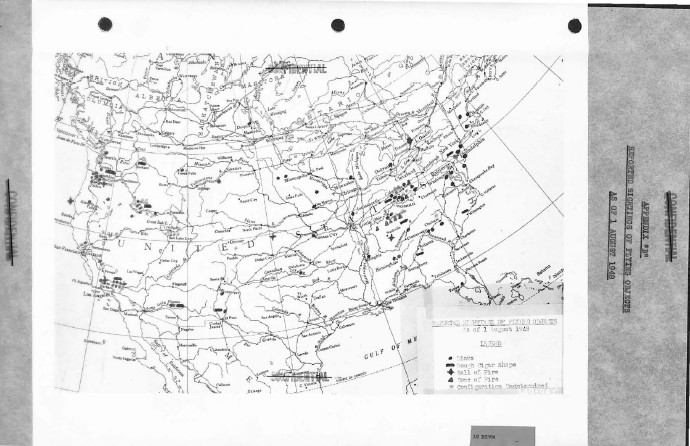
It described concentrations along the Eastern Seaboard and Western Coast but did not treat geographic clustering as establishing an origin.
large concentration of sightings along the Eastern Seaboard
The draft considered whether publicity surrounding Scandinavian ghost rockets and later U.S. reports had psychological or propaganda effects.
strange objects first appeared over the Scandinavian countries in 1946
The report explicitly said it could not determine whether the cases were domestic devices, natural phenomena, or foreign unconventional aircraft.
It is not known at this time whether these phenomena are misidentifications
Richmond Weather Bureau observers reported a metallic disk during pilot-balloon observations, including one reported track at about 25,000 feet; the figures remain historical estimates.
Weather Bureau Station at Richmond, Virginia reported seeing a strange metallic disk
A White Sands report described a disk or sphere moving horizontally at high altitude, while five Portland police officers separately reported disk-like objects.
es m7 July 1947, five Portland, Oregon police officers re-
A Pan American Airways mechanic near Harmon Field reported a circular object and a cloud disturbance, and the draft noted photographs by another employee.
Woodruff, a Pan-American Airways mechanic reported a circular object flying at high velocity
The case compilation included Kenneth Arnold’s 1947 formation report and compared sketches or photographs, but the document did not independently validate the objects depicted.
Kenneth Arnold, while flying near Tacoma, Washington, reported a formation of flying objects
The report described a high-altitude object northeast of Moscow and separately summarized an attempted fighter interception in which a light reportedly outmaneuvered the pursuing aircraft.
The pilot pursued the light which appeared to then take evasive tactics
A report attributed to pilot Combs described an oblong light without wings or exhaust making a tight turn toward the East Coast at an estimated 500–600 mph.
an oblong ball with one light, no wings and no exhaust flame
The radar appendix listed Hokkaido and Fukuoka targets with high estimated speeds; the draft provides no independent calibration or validation of those figures.
an MEW radar at Fukuoka, Japan, picked up a target at 89 miles
A Godman Air Force Base report described a bright silver spherical object at an estimated 30,000–40,000 feet, again based on contemporary observation rather than a confirmed measurement.
visible from the ground at Godman Air Force Base, Kentucky
Source Material & Evidence
Research Map
Lines appear only when two entities share a row-level source claim or dated timeline event. Unconnected nodes remain visible without implying a relationship.